
So I'm sure this has happened to others before. Patient had 85% relief from bilateral lumbar RFA x2 months performed unilaterally 2 weeks apart. Pain then back to baseline. Exam consistent (facet loading +, same area, etc). What do you do? LCD guidelines state only 2 RFA's per 12 months. This is a Medicare patient so no prior auth required. I am hospital employed. I'm considering just going ahead and repeating it. Thoughts?
-
CycleTrack and SDN are teaming up to make medical school admissions more transparent and accessible! Read the announcement to learn how we’re supporting the future of CycleTrack’s free application-tracking tools .
You are using an out of date browser. It may not display this or other websites correctly.
You should upgrade or use an alternative browser.
You should upgrade or use an alternative browser.
RFA doesn't last
Started by oneforfighting
Get help with your application
Use all the free resources available to you from SDN: articles, guides, expert advising, forums discussions, and school research.
Possible issues with technique. You could share your images.
Look for other pain generators...TPI, SI joint.
If nothing else works -> meds/Cymbalta
Look for other pain generators...TPI, SI joint.
If nothing else works -> meds/Cymbalta

Repeating stuff that didn’t work is what got our profession to where it is.
Probably didn’t do enough levels or there is something else at play. A lot of RF patients need TP/muscle spasm calmed down after.
Tell them the guidelines and that they need to wait 4 more months. If they whine tell them to call their insurance company and congressman.
Probably didn’t do enough levels or there is something else at play. A lot of RF patients need TP/muscle spasm calmed down after.
Tell them the guidelines and that they need to wait 4 more months. If they whine tell them to call their insurance company and congressman.
First off, why are you doing them unilaterally? Setting yourself up for seeing this problem on a very regular basis when it wears off in 9 months and you already did 2 RF sessions.
Second, agree with above, look for other pain generators. SI, or (assuming you did L4-5 and L5-S1) L2-4. However, since you did 2 RF sessions already, the patient is SOL if it’s the facets above. Can you share fluoro pics?
Second, agree with above, look for other pain generators. SI, or (assuming you did L4-5 and L5-S1) L2-4. However, since you did 2 RF sessions already, the patient is SOL if it’s the facets above. Can you share fluoro pics?
D
deleted875186
My bet is other pain generator. Even with crappy perpendicular technique, usually there is at least 3 months effect. Would consider repeating with bilateral three levels potentially though if nothing else in exam and history.

Tell them they are probably deconditioned from restricting activity due to pain, and now that the pain generator is blocked it’s important to build up core strength and endurance. Put them in PT and preach importance of daily HEP.How y’all treating the myofascial pain that seems to be residual - promote PT again, serial TPIs, muscle relaxants, etc?

How long after the RFA is the pain returning?So I'm sure this has happened to others before. Patient had 85% relief from bilateral lumbar RFA x2 months performed unilaterally 2 weeks apart. Pain then back to baseline. Exam consistent (facet loading +, same area, etc). What do you do? LCD guidelines state only 2 RFA's per 12 months. This is a Medicare patient so no prior auth required. I am hospital employed. I'm considering just going ahead and repeating it. Thoughts?
Probably another source. What do the disc/endplates look like at those levels?

Suboptimal placement.
Not so sure it is just placement...
When you RF the nerve, you RF the nerve. If the pain relief was due to the RF, you must have hit the nerve, right? Even if the placement was suboptimal, you got pain relief....
1. Did you use steroids? In which case, you might not have hit the nerve at all but the patient had some steroid benefit.
2. The fact you got benefit suggests it's not a different level, except maybe L34. If you RFd the wrong level, there would have been no benefit at all.
3. If there is no pain on one side, it is illogical to justify RFing the nonpainful side.
4. If Medicare without supplement plan, and you are sure it is the facets, give them a choice - wait 4 months, or do the RF again and let the patient know that this RF hopefully last 8-10 months, but if it does not last that long - she will have to wait 10 months before next RF.
What would I do?
Give them exercises, stretches, and 4 weeks time. See them in follow up and see how they are doing at that point. If not so good, re RF. If good, then continue conservative care.
2 months. Reaggravated after working on their house.How long after the RFA is the pain returning?
Already sent him to PT. Didn’t help much.
Did a LESI a month ago. Pt coming into clinic today. So going to see if that helps.
Will get images and post later. Could be suboptimal placement.
Used steroids.
Do unilateral bc that’s how I was trained for reimbursement issues and to reduce possible AE’s such as b/l leg weakness from LA (really just a reimbursement issue I think).
But my question still is that if I have already exhausted two RFA sessions for the year, can I (or should I) go for another RFA within same time frame if pt has Medicare and supplemental insurance. Again, I’m employed so won’t affect my bottom line if it’s not reimbursed. Just don’t want to do anything “illegal” or will come back and bite me.
Medicare will clawback. Guaranteed. your hospital wont be happy. Give him meds and tell him to wait a year. I was trained the same way as you. I changed last year when the rules changed.Already sent him to PT. Didn’t help much.
Did a LESI a month ago. Pt coming into clinic today. So going to see if that helps.
Will get images and post later. Could be suboptimal placement.
Used steroids.
Do unilateral bc that’s how I was trained for reimbursement issues and to reduce possible AE’s such as b/l leg weakness from LA (really just a reimbursement issue I think).
But my question still is that if I have already exhausted two RFA sessions for the year, can I (or should I) go for another RFA within same time frame if pt has Medicare and supplemental insurance. Again, I’m employed so won’t affect my bottom line if it’s not reimbursed. Just don’t want to do anything “illegal” or will come back and bite me.
I used to give steroids post treatment routinely thinking it would reduce post ablation neuritis. I stopped about 2 years ago and have noticed zero difference whatsoever.
I tend to find the neuritis happens more in the thoracic spine, since there's a bit more variability in the medial branch anatomy and perhaps higher likelihood of incomplete lesion due to poor proximity of the probe. I do counsel all my patients on the chance, "small chance of a sunburn like sensation that can last for about a month."
I tend to find the neuritis happens more in the thoracic spine, since there's a bit more variability in the medial branch anatomy and perhaps higher likelihood of incomplete lesion due to poor proximity of the probe. I do counsel all my patients on the chance, "small chance of a sunburn like sensation that can last for about a month."
Oh just another aside -- do you folks anesthesize before or after motor testing? My colleagues all do it before testing so it sets up sooner, but my fear is in someone with undiagnosed CMT or some other neuropathy that even a cc of 2% lidocaine could cause motor blockade. Am I just being paranoid?
Anesthetize after motor testing. But I don't wait full 2ish minutes prior to burning. Patients seem to tolerate the burn fine with waiting only like 30ish seconds it seems. Also i use 1% lido.Oh just another aside -- do you folks anesthesize before or after motor testing? My colleagues all do it before testing so it sets up sooner, but my fear is in someone with undiagnosed CMT or some other neuropathy that even a cc of 2% lidocaine could cause motor blockade. Am I just being paranoid?
With that said, I don't think 1% lido at 1cc volume would even effect nerve root anyway. 2% on the other hand might so I definitely wouldn't think about doing 2% before.
do you do bilaterals only now?Medicare will clawback. Guaranteed. your hospital wont be happy. Give him meds and tell him to wait a year. I was trained the same way as you. I changed last year when the rules changed.
So how does everyone practice here? Bilateral or unilateral lumbar RFAs? Cervical RFA? I'm assuming cervical RFAs are still staggered by a couple of weeks at least due to concern for drop head?
Bilateral one session always if both sides hurt. If they don’t get head drop from the blocks I don’t see how they would from the RFA. On rare occasions where patient feels extremely dizzy with upper cervical blocks, or feels significant neck weakness with the blocks, I’ll do one side, wait 1-2 months, then do the other. Can’t remember the last time I had to, and every patient so far who used to get one side then the other done by someone else has been very grateful to get the whole thing out of the way at once. With the latest Medicare changes, they don’t limit by number of joints and instead limit by number of levels, so even for a 3 level lumber I do it all in one session. My schedule is jam packed and I’m private practice, so I’d probably lose more revenue by taking up 2 appointment slots and paying for the needles twice than I do by taking 50% on the second side.So how does everyone practice here? Bilateral or unilateral lumbar RFAs? Cervical RFA? I'm assuming cervical RFAs are still staggered by a couple of weeks at least due to concern for drop head?
Yes, for both lumbar, cervical (and thoracic)do you do bilaterals only now?
With most plans covering 2 sessions per 12 months, I do bilateral because a decent amount need repeat between 6-12 months. Exception is if TON involved, I'll do uni 2 weeks apart, fingers crossed it lasts 12 months.
For motor I just take one probe and touch it into each cannula briefly. Then lido. Then put probes in, do final AP/L/obl, fine tune a bit if needed. By then lido has settled in.
For motor I just take one probe and touch it into each cannula briefly. Then lido. Then put probes in, do final AP/L/obl, fine tune a bit if needed. By then lido has settled in.
Doing bilateral for both cervical and lumbar for same reasons as mentioned above
With the new restrictions on facet injections can anyone clarify if these can potentially be used to "top off" a patient whose RFA has worn off early?
With the new restrictions on facet injections can anyone clarify if these can potentially be used to "top off" a patient whose RFA has worn off early?
i anesthetize after motor testing.Anesthetize after motor testing. But I don't wait full 2ish minutes prior to burning. Patients seem to tolerate the burn fine with waiting only like 30ish seconds it seems. Also i use 1% lido.
With that said, I don't think 1% lido at 1cc volume would even effect nerve root anyway. 2% on the other hand might so I definitely wouldn't think about doing 2% before.
dont wait 2 minutes. i usually have nurse switch to lesioning on machine while giving the local, and when the temperatures are all roughly the same (usually 33-34 degrees C), its time to lesion. typically about 30 seconds. noone complains.
If you do bilateral 2x in one year it pays100% for first side and 50% for second. But you can repeat in same year. So 1.5x2=3.
If you do unilateral x2 once per year it pays 100% for 1 side. Then 100% for the other then your done. So 1+1=2.
Do bilateral. Better for patients and reimbursement.
If you do unilateral x2 once per year it pays 100% for 1 side. Then 100% for the other then your done. So 1+1=2.
Do bilateral. Better for patients and reimbursement.
YesOh just another aside -- do you folks anesthesize before or after motor testing? My colleagues all do it before testing so it sets up sooner, but my fear is in someone with undiagnosed CMT or some other neuropathy that even a cc of 2% lidocaine could cause motor blockade. Am I just being paranoid?
I think this must have to do with placement. SIS guidelines suggest that size of lesion (as it relates to parallel placement of active RF cannula relative to nerve) influences therapeutic effect as a function of nerve regeneration "distance."
I think this must have to do with placement. SIS guidelines suggest that size of lesion (as it relates to parallel placement of active RF cannula relative to nerve) influences therapeutic effect as a function of nerve regeneration "distance."
Peripheral nerves regrow at about 1 inch per month, 1cm or so per week… I don’t think I’ve seen any good data as to how the MBs regrow after being burned. I try to place the probes parallel to burn as much as possible (SIS technique), but I also have a hard time comprehending how placing the probes perpendicular versus parallel should make much of a difference at all… other than placing perpendicular you would be more likely to miss the nerve all together. Does anyone know why an extra 2 cm of burn should add extra months of relief??
Regardless, if a patient has great relief for only 2 months and my technique looks good, I assume that their nerves just regenerate really quickly, unfortunately. Basically, they are Wolverine. I encourage them to fight crime.
There is a difference between cutting a nerve and Wallerian degeneration from RFA.
There is a difference between cutting a nerve and Wallerian degeneration from RFA.
Sure. That’s what everyone says. But what’s the difference? Wallerian degeneration takes place with L5 and foot drop. That isn’t cutting the nerve. Otherwise everyone’s strength would come back after bad radic or peroneal neuropathy. I just am not sure we know what’s really going on with RF and why it takes the time it does for pain to return. Or at least I’m not. If anyone has literature on it I’d appreciate it.
D
deleted131481
I don't think so. Why risk affecting twitch by doing motor testing after placing local?Oh just another aside -- do you folks anesthesize before or after motor testing? My colleagues all do it before testing so it sets up sooner, but my fear is in someone with undiagnosed CMT or some other neuropathy that even a cc of 2% lidocaine could cause motor blockade. Am I just being paranoid?
I use 1cc 2% lidocaine. I wait 10 seconds and start the burn and the patient is fine.

I mix lido 2% with 0.5% bupi or ropi.I don't think so. Why risk affecting twitch by doing motor testing after placing local?
I use 1cc 2% lidocaine. I wait 10 seconds and start the burn and the patient is fine.
Works virtually immediately.
If you do bilateral 2x in one year it pays100% for first side and 50% for second. But you can repeat in same year. So 1.5x2=3.
If you do unilateral x2 once per year it pays 100% for 1 side. Then 100% for the other then your done. So 1+1=2.
Do bilateral. Better for patients and reimbursement.
It’s assuming you repeat it within one year.
If you do NOT repeat it, then you end up with 1.5 vs 2 -> 25% less in compensation.
I use 0.25% bupi, burn immediately at 80 degrees, absolutely most patients are just fine.
Due to this- I started doing bilateral only for people who complain when we are out less than a year- I have 2 of them. They had to wait until the 12 month mark and now I will do bilateral about q9 months on them. Most people last a year so you’re right you will lose money on those who are NOT repeating within 12 months!It’s assuming you repeat it within one year.
If you do NOT repeat it, then you end up with 1.5 vs 2 -> 25% less in compensation.
I use 0.25% bupi, burn immediately at 80 degrees, absolutely most patients are just fine.

I think you can repeat therapeutic blocks to try to extend out the time frame
therapeutic blocks are specifically for those who fail RFA.
technically, in this case, you could do a therapeutic blocks and do them every 3 months or so instead of repeating RFA.
technically, in this case, you could do a therapeutic blocks and do them every 3 months or so instead of repeating RFA.
These are the RF images. It looks like the L3 and more so L4 tips need to be deeper. Can't recall if he felt lower extremity stimulation with increased depth or not.
As an update, he had no relief with a LESI (expected by me). He went to PT which helped. Had 4 sessions with chiropractor where he had immediate and sustained relief x1 month thus far (pain 1/10). Taken together, not sure what all this means. Will look into therapeutic blocks as suggested above if pain recurs prior to 12 month mark.
I appreciate all the comments thus far.
Learning points for me:
-Proper placement
-Do Bilateral RFAs.
-Therapeutic blocks if RF fails
Attachments
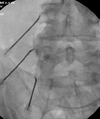

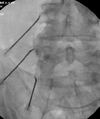

Good trajectories L3 and L4 but could be walked in deeper. That's why lateral is important.
L5 I think you should come in from more oblique like the others to get in the groove. Going without oblique like that you're probably hitting SAP; on lateral looks like your on SAP. Usually don't need a cephalad trajectory due to sacral angle or you'll end up too flat.
How do the endplates look?
L5 I think you should come in from more oblique like the others to get in the groove. Going without oblique like that you're probably hitting SAP; on lateral looks like your on SAP. Usually don't need a cephalad trajectory due to sacral angle or you'll end up too flat.
How do the endplates look?
Don't have SIS book in front of me but Furman has the L5 DR trajectory looking the way I had mine...If by oblique you mean from lateral to medial that is. Because Furman actually has it going from medial to lateral!Good trajectories L3 and L4 but could be walked in deeper. That's why lateral is important.
L5 I think you should come in from more oblique like the others to get in the groove. Going without oblique like that you're probably hitting SAP; on lateral looks like your on SAP. Usually don't need a cephalad trajectory due to sacral angle or you'll end up too flat.
How do the endplates look?
Endplates look degenerated mildly at L4-5. Mild-mod DDD L4-5 and mod-severe at L5-S1 (radiologist read at mild to mod but I disagree).
Hmm that's interesting, wonder why. I'll do it that way only if high crest, no lordosis but usually go the same lateral to medial angle as the others, and same caudal angulation from endplate as well.Furman actually has it going from medial to lateral!
Does therapeutic block include IA facet injections?therapeutic blocks are specifically for those who fail RFA.
technically, in this case, you could do a therapeutic blocks and do them every 3 months or so instead of repeating RFA.
with regards to the diagnostic
with regards to therapeutic:
 www.cms.gov
Intraarticular (IA) facet block(s) are considered reasonable and necessary as a diagnostic test only if medial branch blocks (MMB) cannot be performed due to specific documented anatomic restrictions or there is an indication to proceed with therapeutic intraarticular injections. These restrictions must be clearly documented in the medical record and made available upon request.
with regards to therapeutic:
Therapeutic intraarticular facet injections are not covered unless there is justification in the medical documentation on why RFA cannot be performed.
LCD - Facet Joint Interventions for Pain Management (L38803)
Use this page to view details for the Local Coverage Determination for Facet Joint Interventions for Pain Management.

Thanks for posting your images, that takes guts to do.These are the RF images. It looks like the L3 and more so L4 tips need to be deeper. Can't recall if he felt lower extremity stimulation with increased depth or not.
As an update, he had no relief with a LESI (expected by me). He went to PT which helped. Had 4 sessions with chiropractor where he had immediate and sustained relief x1 month thus far (pain 1/10). Taken together, not sure what all this means. Will look into therapeutic blocks as suggested above if pain recurs prior to 12 month mark.
I appreciate all the comments thus far.
Learning points for me:
-Proper placement
-Do Bilateral RFAs.
-Therapeutic blocks if RF fails
View attachment 362086View attachment 362091View attachment 362092View attachment 362094View attachment 362090
First, more likely the patient has developed SIJ pain after the RF than the RF failing. Those SIJs have not moved much for a long time due to pain inhibition. Post RF, the patients move more in the lumbar spine than they have in a long time, which can flare the SIJs. I have to move onto an SIJ injeciton in about approx 5-10% of my lumbar RF patients.
That said, for your needle placement: square the top endplate of L4 and L5, then tilt the II toward the feet 30 degrees, then oblique 20 degrees. For the L5 PDR, square up the top of the sacrum, then tilt II 35 degrees toward the feet, no oblique needed. Then coaxial needle placement to the mamiloaccesory groove.
This will get the active tip more parallel to the nerves. As it appears on these images, the needle tip is at the medial branch but the majority of the acitve tip is lateral to the medial branch.
Also the needles should be placed closer to the neuroforamen.
Your images are better than 99% of people doing this procedure so I mean no offense.
I do unilateral only. I'm not taking a 50% reduction in pay for extra work. F that. Also, the if the patients develop neuritis bilaterally it is distressing to them and they'll never want to repeat.

What do you do if pt has recurrence of pain at 6 months but you're out of treatments for the year?I do unilateral only. I'm not taking a 50% reduction in pay for extra work. F that. Also, the if the patients develop neuritis bilaterally it is distressing to them and they'll never want to repeat.
Thank you for your feedback. I've learned a lot from this forum and changed my practice based off of what others said. It's helped me and my patients.Thanks for posting your images, that takes guts to do.
First, more likely the patient has developed SIJ pain after the RF than the RF failing. Those SIJs have not moved much for a long time due to pain inhibition. Post RF, the patients move more in the lumbar spine than they have in a long time, which can flare the SIJs. I have to move onto an SIJ injeciton in about approx 5-10% of my lumbar RF patients.
That said, for your needle placement: square the top endplate of L4 and L5, then tilt the II toward the feet 30 degrees, then oblique 20 degrees. For the L5 PDR, square up the top of the sacrum, then tilt II 35 degrees toward the feet, no oblique needed. Then coaxial needle placement to the mamiloaccesory groove.
This will get the active tip more parallel to the nerves. As it appears on these images, the needle tip is at the medial branch but the majority of the acitve tip is lateral to the medial branch.
Also the needles should be placed closer to the neuroforamen.
Your images are better than 99% of people doing this procedure so I mean no offense.
I will need to review my other RF imaging to see if my lack of depth is a consistent issue. This is the first or second time where the relief has not lasted very long.
I assessed him for SIJ pain and it didn't appear to be so. Definitely on my differential.
1) Any Modic changes on MRI? If so, can be good candidate for possible Intracept.
2) How are the discs? Consider discogenic causes?
3) Re-evaluate. Pain is in same area or elsewhere? Could try therapeutic Facet Block if there's significant fluid in that joint still.
2) How are the discs? Consider discogenic causes?
3) Re-evaluate. Pain is in same area or elsewhere? Could try therapeutic Facet Block if there's significant fluid in that joint still.
What do you do if pt has recurrence of pain at 6 months but you're out of treatments for the year?
They are offered a cash pay price. It's not the ideal solution but I did not create this insurance problem and I'm not going to try to solve it by loosing money for my business. If you are employed; it may not matter to you or your employer, especially the hospital.
no modic changes. mild concentric disc bulge at L5-S1, no tear. no central canal stenosis. there's some foraminal stenosis but wouldn't explain axial only back pain. pain is in same area, worse with extension.1) Any Modic changes on MRI? If so, can be good candidate for possible Intracept.
2) How are the discs? Consider discogenic causes?
3) Re-evaluate. Pain is in same area or elsewhere? Could try therapeutic Facet Block if there's significant fluid in that joint still.
On my review, MRI shows some fluid in the joints although no comment from rads. How do you use this guide your treatment plan? I usually don't pay much attention to intra-facetal fluid.
