

-
CycleTrack and SDN are teaming up to make medical school admissions more transparent and accessible! Read the announcement to learn how we’re supporting the future of CycleTrack’s free application-tracking tools .
You are using an out of date browser. It may not display this or other websites correctly.
You should upgrade or use an alternative browser.
You should upgrade or use an alternative browser.
US News Updated Step 1 scores?
Started by DubbiDoctor

Get help with your application
Use all the free resources available to you from SDN: articles, guides, expert advising, forums discussions, and school research.
An awesome individual provided me with this list. Way to go Mayo!
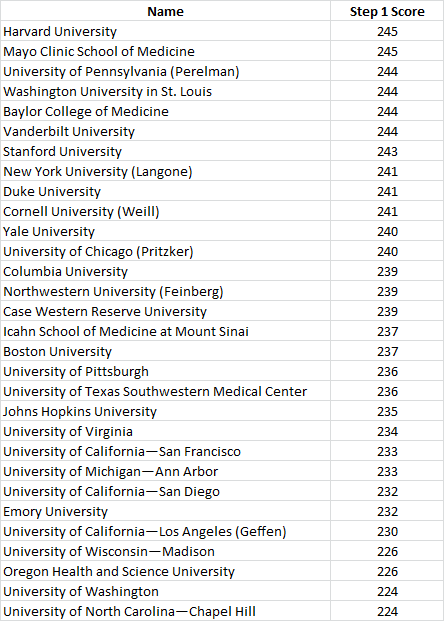

An awesome individual provided me with this list. Way to go Mayo!
Do you know what year this data is from? does it say if it's based on students who took Step 1 in 2016 or 2017?
Advertisement - Members don't see this ad

Does anyone have Dartmouth and MCW Step 1 score?
Anyone have the whole updated listed and is kind enough to share it? 

An awesome individual provided me with this list. Way to go Mayo!
Interesting that the top 15 or so are all privates. Not saying that privates are inherently better med schools, just thinking that they’re probably just more likely to be MCAT score conscious to begin with and there’s probably a correlation between high MCAT scores and high step scores.

Many schools are missing in that ranking. UCF 238, FIU 239.
Looks to me like it’s the USNWR T25 put in order of step one. That would explain those two missing, as well as others like U Cincy
Sent from my iPhone using SDN mobile

It also leaves out Missouri, which has a surprisingly high step 1. It's like a 239 or something.
wow im surprised MCW has high step 1 score!! especially higher than DartmouthDartmouth 227; MCW 234
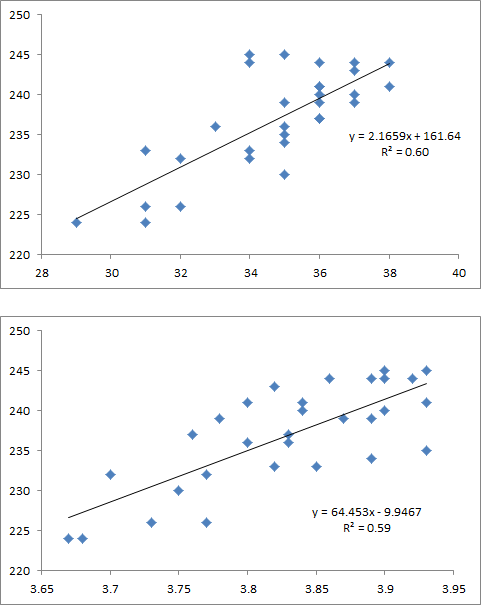
I was also sent these graphs showing a strong correlation between average MCAT and GPA and step 1 scores:Interesting that the top 15 or so are all privates. Not saying that privates are inherently better med schools, just thinking that they’re probably just more likely to be MCAT score conscious to begin with and there’s probably a correlation between high MCAT scores and high step scores.
Anyone got any step 1 scores for Miami last year
Interesting that the top 15 or so are all privates. Not saying that privates are inherently better med schools, just thinking that they’re probably just more likely to be MCAT score conscious to begin with and there’s probably a correlation between high MCAT scores and high step scores.
This is an interesting study - Do MCAT scores predict USMLE scores? An analysis on 5 years of medical student data
From the discussion:
"Each of the MCAT component scores was significantly associated with USMLE Step 1 and Step 2 CK scores, although the effect size was small. Being in the top or bottom scoring range of the MCAT exam was predictive of being in the top or bottom scoring range of the USMLE exams, although the strengths of the associations were weak to moderate."
Advertisement - Members don't see this ad

This is impressive for a state school! Do you have a link for these two?Many schools are missing in that ranking. UCF 238, FIU 239.

What's interesting to me is how for many top schools, the range of MCAT scores accepted hovers from ~94th-98th percentile, which is obviously very competitive. Yet, when we turn to Step 1, the highest reported scores of the bunch—240-245—represent the 70th-78th percentile. Step 1 is supposed to be harder than the MCAT, right? So that makes sense. Still an interesting drop in percentiles, but I'm sure their not directly comparable in reality.
Well tbf, 70-80th percentile is impressive considering these MD students are competing only against other US MD students - that's how the percentiles are determined. For the MCATs, the research-heavy schools have students scoring in the >95th percentile among all people taking the test, many of whom do not matriculate to US MD programs.What's interesting to me is how for many top schools, the range of MCAT scores accepted hovers from ~94th-98th percentile, which is obviously very competitive. Yet, when we turn to Step 1, the highest reported scores of the bunch—240-245—represent the 70th-78th percentile. Step 1 is supposed to be harder than the MCAT, right? So that makes sense. Still an interesting drop in percentiles, but I'm sure their not directly comparable in reality.

@libertyyne kill this convo plz
A
AnatomyGrey12
I was also sent these graphs showing a strong correlation between average MCAT and GPA and step 1 scores
The association is moderate at best.

What's interesting to me is how for many top schools, the range of MCAT scores accepted hovers from ~94th-98th percentile, which is obviously very competitive. Yet, when we turn to Step 1, the highest reported scores of the bunch—240-245—represent the 70th-78th percentile. Step 1 is supposed to be harder than the MCAT, right? So that makes sense. Still an interesting drop in percentiles, but I'm sure their not directly comparable in reality.
I mean, the exams arent really comparable in that way. Also the testing populations are very different. 90th percentile MCAT is top 10% of all MCAT test-takers. 80th percentile Step 1 is top 20% of all Step 1 takers (the vast majority of whom were clustered in and around the top 15% or so of MCAT test takers).

I don't think it's about harder/easier test, it's percentiles so the relative rarity stays the same. A 265 step1 is exactly as common, relative to the pool, as a 38 MCAT. It's the absolute numbers I think, that start becoming more important.
Say you're a school like WashU for example and you want to hit a top 1% median. Not too hard to do when that means filling 60 seats drawing from 1,000 test takers with that score (many more than needed even after accounting for the fractions that will have low GPAs, won't apply to midwestern schools, etc).
Now look at something like ENT. The median for matched is "only" at the 84th percentile...but the year had 358 applicants for 304 spots. The typical ENT program can't demand that their seats be filled by top 1% or top 5% step 1 scores while still asking for the rest of the package. Their seats would go empty. When you're dealing with a small absolute number of top x% scores, most of whom won't be interested in a given competitive specialty, it's just not possible to keep the typical percentiles the same as we see with competitive MD admissions.
Say you're a school like WashU for example and you want to hit a top 1% median. Not too hard to do when that means filling 60 seats drawing from 1,000 test takers with that score (many more than needed even after accounting for the fractions that will have low GPAs, won't apply to midwestern schools, etc).
Now look at something like ENT. The median for matched is "only" at the 84th percentile...but the year had 358 applicants for 304 spots. The typical ENT program can't demand that their seats be filled by top 1% or top 5% step 1 scores while still asking for the rest of the package. Their seats would go empty. When you're dealing with a small absolute number of top x% scores, most of whom won't be interested in a given competitive specialty, it's just not possible to keep the typical percentiles the same as we see with competitive MD admissions.
That's an interesting point. I would imagine for residency programs with far more seats (e.g., IM), you probably see a similar phenomenon as MD admissions in relation to test scores (in the sense that the top programs have their pick of high scorers).I don't think it's about harder/easier test, it's percentiles so the relative rarity stays the same. A 265 step1 is exactly as common, relative to the pool, as a 38 MCAT. It's the absolute numbers I think, that start becoming more important.
Say you're a school like WashU for example and you want to hit a top 1% median. Not too hard to do when that means filling 60 seats drawing from 1,000 test takers with that score (many more than needed even after accounting for the fractions that will have low GPAs, won't apply to midwestern schools, etc).
Now look at something like ENT. The median for matched is "only" at the 84th percentile...but the year had 358 applicants for 304 spots. The typical ENT program can't demand that their seats be filled by top 1% or top 5% step 1 scores while still asking for the rest of the package. Their seats would go empty. When you're dealing with a small absolute number of top x% scores, most of whom won't be interested in a given competitive specialty, it's just not possible to keep the typical percentiles the same as we see with competitive MD admissions.
That's an interesting point. I would imagine for residency programs with far more seats (e.g., IM), you probably see a similar phenomenon as MD admissions in relation to test scores (in the sense that the top programs have their pick of high scorers).
yeah the top IM programs have very high Step scores; although overall IM is less competitive than say derm, it's just as competitive if you want to get into IM at one of the best programs.
There's also some self-selection that goes into this process. For example if someone is interested in both derm and IM, but they end up with a Step score that isn't competitive for derm, they may not bother applying derm and just do IM instead.
I think you got your MCAT vs. Step 1 analogy screwed up.
MCAT % is based on all takers of the exam. Of those 100% who took MCAT and applied to US medical schools, only 40% will get in.
According to new MSRA data, average MCAT for matriculants in US medical school is 511. That 511 would put you in 50% of all medical student.
If your entire class score 80% average on Step 1 amongst all US students, that means your entire class probably score on the top 20% of all medical schools MCAT scores, which will be 92-94 percentile or 515/516 on the new MCAT, or 35/36 on the old MCAT for the entire class.
Not too shabby.
MCAT % is based on all takers of the exam. Of those 100% who took MCAT and applied to US medical schools, only 40% will get in.
According to new MSRA data, average MCAT for matriculants in US medical school is 511. That 511 would put you in 50% of all medical student.
If your entire class score 80% average on Step 1 amongst all US students, that means your entire class probably score on the top 20% of all medical schools MCAT scores, which will be 92-94 percentile or 515/516 on the new MCAT, or 35/36 on the old MCAT for the entire class.
Not too shabby.

Sorry @icedude2010 - Just saw your question. Miami reported 232.Anyone got any step 1 scores for Miami last year
No worries, thanks for the info!Sorry @icedude2010 - Just saw your question. Miami reported 232.

Is there any data on the U of OK?

Here's something I'm curious about: my school's step score as apparently reported on US News is three points lower than what our school told us the average was. And obviously it wouldn't be surprising that a school was inflating it's step score to look better...but why not be honest with the people who are already students there? Not like the difference between a 238 and a 241 is a huge deal, but I'm still curious why they didn't just tell us 238.
Likely different years. Your school has data from the most recent group to take it. US News is probably a year behind them. Going up or down 2-3 points between years is commonHere's something I'm curious about: my school's step score as apparently reported on US News is three points lower than what our school told us the average was. And obviously it wouldn't be surprising that a school was inflating it's step score to look better...but why not be honest with the people who are already students there? Not like the difference between a 238 and a 241 is a huge deal, but I'm still curious why they didn't just tell us 238.
Advertisement - Members don't see this ad

What’s the national average?
Also does anyone’s have step 1 scores from USNews for UIC, Rush, Creighton, and Quinnipiac?
Also does anyone’s have step 1 scores from USNews for UIC, Rush, Creighton, and Quinnipiac?
Mean is 228What’s the national average?
http://www.usmle.org/pdfs/transcripts/USMLE_Step_Examination_Score_Interpretation_Guidelines.pdf
Interesting that there are schools in the top 50 who are below the median.
Only State schools in States with relatively small populations. They have relatively low MCAT medians as well.Interesting that there are schools in the top 50 who are below the median.
Here's something I'm curious about: my school's step score as apparently reported on US News is three points lower than what our school told us the average was. And obviously it wouldn't be surprising that a school was inflating it's step score to look better...but why not be honest with the people who are already students there? Not like the difference between a 238 and a 241 is a huge deal, but I'm still curious why they didn't just tell us 238.
Likely different years. Your school has data from the most recent group to take it. US News is probably a year behind them. Going up or down 2-3 points between years is common
yeah this is definitely it. what's reported for my school is also 3 points lower than what we were told from the class that most recently took Step 1

Anybody have the info for Ohio State, Illinois, and Indiana?
Indiana is 233, Ohio is 234, UIC is 230
anyone have USF?
So next year Mayo is going to show 248?yeah this is definitely it. what's reported for my school is also 3 points lower than what we were told from the class that most recently took Step 1
anyone have the scores for evms or slu?

These numbers are not very helpful . Step 1 score is heavily dependent on self studying
Why is University of Washington so low (224) when it's a top 20 school??
They recruit their student body very differently than other top 20s. Instead of pulling a bunch of very high-stats kids from all over the country, they're focused on admitting residents of Washington and a few neighboring states. As a result their MCAT/GPA is usually a lot lower than similarly ranked schools. For example right now it is 510/3.65 while the school ranked next to it (Yale) is 521/3.89Why is University of Washington so low (224) when it's a top 20 school??
Their interview rates are also a ton more generous. They interviewed 50% of instate applicants last year. Compare to UCLA which interviewed 9%.
every year it's the same thread
People at Dell are reporting that the Step 1 avg for the first class will be 249.
Last edited:
Advertisement - Members don't see this ad
Crazy if true, considering their median stats aren't that high. Did you hear this from the administration at an interview?People at Dell are reporting that the Step 1 median for the first class will be 249.
Crazy if true, considering their median stats aren't that high. Did you hear this from the administration at an interview?
Nah, several current students. and it was mean, fixed
Last edited:

And r^2 of 0.6 is not a strong correlationI was also sent these graphs showing a strong correlation between average MCAT and GPA and step 1 scores:
Just because this same topic comes up every couple months...
1. These are averages with very large standard deviations (like 10-15 pts minimum). Theres no difference between a 245 at 1 school and a 235 at the next.
2. Step is primarily an individual study method. Everyone nationally uses the same basic resources: uworld, first aid, pathoma. Lectures and stuff from school have very little part in the your studying. Thr biggest impact from your school is going to be the length of dedicated, how much required lecture time do you have, do you take it after 2nd or 3rd year. Not anything related to the quality of the education the school gives in preclinical years.
3. People base their studying and preparation for step 1 off their interests. Thia isnt like the MCAT where you always want a higher score. People who want to go into family med dont need to study for a 250. Washington has come up in this thread, and washington has a strong primary care focus to bring physicians to the wami states. If someone knows they only need a 215 to be competitive for their desired residency they dont need to spend months and months studying for a 250. There were people in my class interested in primary care who took step 1 during the 1st week of dedicated and had a month vacation. They could have studied more and gotten a higher score but it wasnt necessary.
4. These are self reported scores, I'd take them with a grain of salt. Some schools may be including people who took Step 1 late (aka needed more time to study to ensure passing) and others may not be.
1. These are averages with very large standard deviations (like 10-15 pts minimum). Theres no difference between a 245 at 1 school and a 235 at the next.
2. Step is primarily an individual study method. Everyone nationally uses the same basic resources: uworld, first aid, pathoma. Lectures and stuff from school have very little part in the your studying. Thr biggest impact from your school is going to be the length of dedicated, how much required lecture time do you have, do you take it after 2nd or 3rd year. Not anything related to the quality of the education the school gives in preclinical years.
3. People base their studying and preparation for step 1 off their interests. Thia isnt like the MCAT where you always want a higher score. People who want to go into family med dont need to study for a 250. Washington has come up in this thread, and washington has a strong primary care focus to bring physicians to the wami states. If someone knows they only need a 215 to be competitive for their desired residency they dont need to spend months and months studying for a 250. There were people in my class interested in primary care who took step 1 during the 1st week of dedicated and had a month vacation. They could have studied more and gotten a higher score but it wasnt necessary.
4. These are self reported scores, I'd take them with a grain of salt. Some schools may be including people who took Step 1 late (aka needed more time to study to ensure passing) and others may not be.
Similar threads


- Replies
- 14
- Views
- 2K


