Advertisement - Members don't see this ad
There's no way that's true, must have been drunk/half asleep/randomly choosing answers on the IQ test or something like that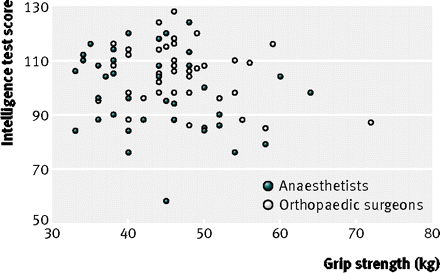
There is an anesthesiologist somewhere with an IQ of 60.


Use all the free resources available to you from SDN: articles, guides, expert advising, forums discussions, and school research.
There's no way that's true, must have been drunk/half asleep/randomly choosing answers on the IQ test or something like that
There is an anesthesiologist somewhere with an IQ of 60.

Instead of asking which surgeons have the best hands, it may have been more useful to ask which surgical procedure requires the steadiest hands.
But to answer the question - Ophthalmology. And in my opinion, it's not even close. Neurosurgery, Ortho, and Vascular might have long surgeries, but the delicacy required in Ophthalmology might be unrivaled.
Check out the details regarding a partial thickness corneal transplant called a DMEK (descemet membrane endothelial keratoplasty) in which the descemet membrane and endothelial layer of the patient's cornea (10-15 microns thick) is replaced by a donor graft.
Descemet Membrane Endothelial Keratoplasty (DMEK)
But it's still a terrible question. You should do what you like, and then do it to the best of your technical ability. There are incredibly challenging operations in all surgical specialties, and doing even a routine case flawlessly is probably beyond most people's ability. Caring about which surgical specialty requires the "perfect hands" is one of the most premed things I've seen on allo (oops I mean whatever the new name is) in a while.
lol who uses stealth for bullet removal? just do crani and digApparently nobody has seen Dr. Strange remove a bullet from someone's brain without stealth navigation....
Congenital heart surgery.
wow. smallest ive seen has been 10-0I use 12-O nylon for bypass

Speaking of triggers, I've been waiting for an opportunity to post something I saw hanging up at my school that triggered me hard.

lol who uses stealth for bullet removal? just do crani and dig


There is an anesthesiologist somewhere with an IQ of 60.


Really though, colorectal probably has the best hands, given the uh, gentle nature with which they must assess certain anorectal pathologies.

Speaking of triggers, I've been waiting for an opportunity to post something I saw hanging up at my school that triggered me hard.

Underwater Basket WeavingI know that this varies on the specific operation being done, but in general which surgical specialty takes the best fine motor skills/hand dexterity?
Can rank them or discuss (also can include specific subspecialties within):
ENT
Neurosurgery
Plastics
Ophtho
Urology
Vascular
Urology
General surgery subspecialties
Etc
u know u really wanted to ask which surgical subspecialty gets the most chicks.


is there any OMM practiced during surgery? Do DO surgeons get excited when an incision is made so they can omm right on the bone rather than on inconvenient skin?DO surgeons probably have better hands than any MD surgeon because we learn OMM.
is there any OMM practiced during surgery? Do DO surgeons get excited when an incision is made so they can omm right on the bone rather than on inconvenient skin?

u know u really wanted to ask which surgical subspecialty gets the most chicks.
Well that's not what I meant. DOs learn how to feel cranial bones move during respiration because we can actually feel the CSF. That's how strong their proprioception is. So I'm just saying they probably have less operative morbidity/mortality because they make less mistakes.
You will get some bites on this I bet.

Your preceptor who told you this is an idiot.Well that's not what I meant. DOs learn how to feel cranial bones move during respiration because we can actually feel the CSF. That's how strong their proprioception is. So I'm just saying they probably have less operative morbidity/mortality because they make less mistakes.
Your preceptor who told you this is an idiot.


In my experience, ObGyns might be the only men who know where everything is😉
Except for the clitoris, of course. We are all still on the hunt to find where it's hidden!In my experience, ObGyns might be the only men who know where everything is

Well that's not what I meant. DOs learn how to feel cranial bones move during respiration because we can actually feel the CSF. That's how strong their proprioception is. So I'm just saying they probably have less operative morbidity/mortality because they make less mistakes.
That's some of the craziest **** I've heard in a long time.


Your preceptor who told you this is an idiot.
Well that's not what I meant. DOs learn how to feel cranial bones move during respiration because we can actually feel the CSF. That's how strong their proprioception is. So I'm just saying they probably have less operative morbidity/mortality because they make less mistakes.
Your subtle insult is a 10/10 on the cringe scale.Awh come on, it was a 0/10 trolling effort.
I should have been more specific. It's called a fluid wave and it's the CSF moving in sacral flexion and extension. You should probably study the head in more detail if you're a neurosurgeon, I'd be worried!CSF is on the inside, probably just the STA or your preceptor feeling their own pulse.
I should have been more specific. It's called a fluid wave and it's the CSF moving in sacral flexion and extension. You should probably study the head in more detail if you're a neurosurgeon, I'd be worried!
I forgot you charlatans believe touchy feely voodoo to amphiarthrotic joints lets the bad humors out. I'll go back to my emperic evidence based medicine, randomized controlled trials, and standard of care. To each their own.
I should have been more specific. It's called a fluid wave and it's the CSF moving in sacral flexion and extension. You should probably study the head in more detail if you're a neurosurgeon, I'd be worried!
Fluid waves eh? I'll show you sacral flexion and extension
Fluid waves eh? I'll show you sacral flexion and extension

Not to be pedantic, but you can only nutate and counter-nutate the sacrum. It's fixed to the ilium.

For a neurosurgeon he was pretty stupid and picked a fight with the SDN Overlord.how did neusu a 4 year member and mod get banned loL?
are ppl jealous he is practicing in teh speciality that has an overwhleming lead on getting chicks at 31%
how did neusu a 4 year member and mod get banned loL?
are ppl jealous he is practicing in teh speciality that has an overwhleming lead on getting chicks at 31%
how did neusu a 4 year member and mod get banned loL?
are ppl jealous he is practicing in teh speciality that has an overwhleming lead on getting chicks at 31%
How many times do you plan to comment on neurosurgery and getting "teh" "chicks"?[/QUOTE
Teh chicks brah
This thread is a trainwreck

I haven't decided yet if I am proud or embarrassed to have started this thread..



Our mission is to provide students with free, unbiased information, resources, and advising for careers in the health professions. We believe every student deserves access to trustworthy guidance, regardless of background or ability to pay.
