

-
Practice your interview with the new SDN AI Interview Coach. Choose a school, answer by voice or typing, and receive a personalized feedback report. Available now to all SDN members. Try the AI Interview Coach.
You are using an out of date browser. It may not display this or other websites correctly.
You should upgrade or use an alternative browser.
You should upgrade or use an alternative browser.
2023 Match Data
Started by Beeftenderloin

D
deleted87051
Crazy idea - let's simply admit people into academic positions based on *gasp* academic achievement.
That would suck for recruited athletes and legacies. I think most of the kids who go to Harvard from my community are recruited athletes. That was also the case at my high school in the 1980s.
That doesn't really counter anything I said, because it's still a fact that 70% of Asian Americans......the main minority in question with the most population overrepresentation, who arguably "lose" the most from affirmative action.....still favor affirmative action.Americans see grades, standardized test scores as top factors to be considered in college admissions
Countering the previous infographic on how nearly 70% of Asian Americans want Affirmative Action, how about the above infographic which shows that 74% of All Americans want an admissions process that is blinded to race and ethnicity?
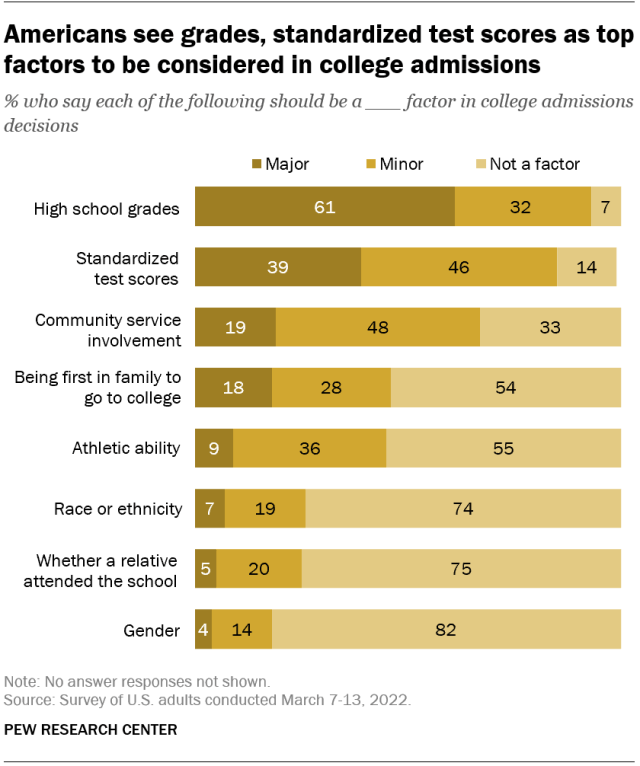
The Pew graphic you posted is neither here nor there. It doesn't surprise me that 74% of Americans want race-blinded admissions considering 61% of American are white. I do find it interesting though that not even a majority of Americans think that the most objective criterion, standardized test scores, should be a major factor in admissions.
Advertisement - Members don't see this ad
Sure, that would make sense for undergrad. fortunately med schools don’t have sports teams, and there is still racist discrimination occurring when it would be simple to admit based on merit.That would suck for recruited athletes and legacies. I think most of the kids who go to Harvard from my community are recruited athletes. That was also the case at my high school in the 1980s.
Also, the graphic I posted earlier from The Economist corrects for athletes/legacies and there is still profound descrimination.
Last edited:

Crazy idea - let's simply admit people into academic positions based on *gasp* academic achievement.
Meh, society is measurably better off with racial affirmative action. Especially for med school.
If we were closer to racial equality I might agree with you.
Do you think we (government and public policy makers) should make addressing racial disparities in healthcare a priority at all? Pretty much any plan focused on addressing that problem will disproportionately affect white and asian people to at least some extent. Want better inner city public schools? That tax money is probably going to come more from white and asian high earners. Want to improve healthcare access in underserved communities? The money has to come from somewhere.
If you don't think the racial disparity is important for whatever reason, and wanted to just focus on fighting poverty... well black people would tend to disproportionately benefit from those plans as well, so it seems to run counter to whatever meritocratic ideal you're holding there too.
@vector2 I think the interesting question is when do you stop affirmative action. For those who want to address racial disparities, there seems to be some disagreement. I've heard different arguments for ending it once you've closed the racial wealth gap, and I've heard others argue for more modest endpoints. I'm not sure where I stand. Thoughts?
D
deleted1156722
One can see from the above arguments in this thread that it is convenient to bolster weak arguments with select and persuasive statistics.That doesn't really counter anything I said, because it's still a fact that 70% of Asian Americans......the main minority in question with the most population overrepresentation, who arguably "lose" the most from affirmative action.....still favor affirmative action.
The Pew graphic you posted is neither here nor there. It doesn't surprise me that 74% of Americans want race-blinded admissions considering 61% of American are white. I do find it interesting though that not even a majority of Americans think that the most objective criterion, standardized test scores, should be a major factor in admissions.
Maybe you just don’t want to admit the fact that majority of Americans (74%) don’t want race/ethnicity to be factored in the admissions.
As the saying goes, “Lies, damned lies, and statistics"!
One can see from the above arguments in this thread that it is convenient to bolster weak arguments with select and persuasive statistics.
Maybe you just don’t want to admit the fact that majority of Americans (74%) don’t want race/ethnicity to be factored in the admissions.
As the saying goes, “Lies, damned lies, and statistics"!
Meh, it was probably fair in the context of their conversation focusing on asian discrimination.
D
deleted1156722
That’s a very utilitarian thing to say- when 75% of Americans state that they don’t want race/ethnicity based discrimination in admissions!Meh, it was probably fair in the context of their conversation focusing on asian discrimination.
One can see from the above arguments in this thread that it is convenient to bolster weak arguments with select and persuasive statistics.
Maybe you just don’t want to admit the fact that majority of Americans (74%) don’t want race/ethnicity to be factored in the admissions.
As the saying goes, “Lies, damned lies, and statistics"!
Dude, you were the one who brought up SFFA, which for all intents and purposes has a focus on Asian Americans' admission to Harvard. The fact that 70% of Asian Americans are in favor of AA is eminently pertinent to that line of discussion.
I have no problem admitting that 74% of Americans (61% of which are white) don't want race or ethnicity to be a factor. People are generally tribal and self-interested, and thus are willing to favor things that benefit themselves. That doesn't make it any more just or unjust.
D
deleted1156722
You are wrong - SFFA is arguing for race-blind admissions, and not seeking admissions to favor Asians or Whites. According to your own post, it was brought out by a White conservative, working together with Asian American applicants.Dude, you were the one who brought up SFFA, which for all intents and purposes has a focus on Asian Americans' admission to Harvard. The fact that 70% of Asian Americans are in favor of AA is eminently pertinent to that line of discussion.
I have no problem admitting that 74% of Americans (61% of which are white) don't want race or ethnicity to be a factor. People are generally tribal and self-interested, and thus are willing to favor things that benefit themselves. That doesn't make it any more just or unjust.
Basically, the argument of SFFA is a need for a fair admissions process and seeks to remove race/ethnicity based discrimination in admissions. Nothing tribal here when 2 widely different racial groups ( Whites and Asians) are asking for this change.
Needless to state, the liberals love identity politics, would like to divide and discriminate Americans further along racial lines.
That’s a very utilitarian thing to say- when 75% of Americans state that they don’t want race/ethnicity based discrimination in admissions!
??? I have no problem saying majorities can be wrong. A majority of Americans wanted to invade Iraq after 9-11. (I think) A majority of Americans still believe in some flavor of JFK assassination conspiracy. A large majority of Russians support Putin. All things I disagree with.
Edit: ok, you're trolling me now. That was good.
Last edited:
I'm aware of what they're arguing for (and the fact that the result of race-blind admissions obviously and implicitly favors whites and Asians). The "70% of Asian Americans favor affirmative action" figure still remains pertinent, as my post was in response to you saying "More than 25,000 aggrieved ORM students affected by Affirmative Action (Asians>Whites) bravely signed on as plaintiffs " in addition to the fact that the original SFFA plaintiffs Blum brought on are Asian Americans who signed on to the Harvard case.You are wrong - SFFA is arguing for race-blind admissions, and not seeking admissions to favor Asians or Whites. According to your own post, it was brought out by a White conservative, working together with Asian American applicants.
Basically, the argument of SFFA is a need for a fair admissions process and seeks to remove race/ethnicity based discrimination in admissions.
D
deleted87051
According to your own post, it was brought out by a White conservative, working together with Asian American applicants.
“Working together” is a stretch. I think it’s more accurate to say white conservative lawyer went trolling for Asian American Harvard rejects to become his plaintiffs. He went looking for them. They didn’t seek out his counsel.
A lot of people on this thread are ORM. Some of us do not consider white people or black people to be the cause of our successes and failures. And apparently some do. Video games probably have a lot more to do with it😉
Last edited by a moderator:
Interesting people are advocating for discrimination against certain groups for the betterment of the greater good. I think humanity has tried this experiment once or twice before and it hasn't gone well.
I would not do a busy asc job 45-50 hours a week for 425k. No early days. That asc job really needs to pay 550k and up with the amount of money they are generating. Don’t be fooled by the no calls/no weekends sales pitch.I think this thread goes to show what a good career anesthesiology actually is. You can bust your butt, pickup extra call and make 750+ or you can get a lifestyle ASC job and pull down 425..all depending on the location and employment situation. To finish residency after 4 years and have those salaries available combined with the flexibility to change jobs/location is unheard of in medicine. Congratulations to all who matched. This is a great field.
Better to take a hospital job with daytime hours and more more built in inefficiency. And sell off your weekend calls. The weeknight calls aren’t bad with post call day off.
Advertisement - Members don't see this ad
Interesting people are advocating for discrimination against certain groups for the betterment of the greater good. I think humanity has tried this experiment once or twice before and it hasn't gone well.
-shrug- If you're going to try to address big problems like racial healthcare disparities you need to do things that will make the situation better and not worse. Discrimination got us into this predicament.
Do you think it's a problem that we have persistent racial disparities in healthcare and wealth?
I've focused mostly on racial healthcare disparities but it's worth talking about wealth too because wealth measurably impacts health to a point.
The current wealth gap between black Americans and white Americans is about 6 to 1. Some economists estimate that if hypothetically post-emancipation we were to eliminate all of the effects of segregation, labor market discrimination, exclusion from welfare programs, housing market discrimination, banking and loan discrimination etc; AND if black people had the same savings rates as white people... there would STILL be a white-to-black wealth disparity of 3 to 1.
It seems like a very intractable problem to me that materially harms a lot of people. We should really devote a lot of energy to address it and the harms of affirmative action are small as others have discussed.
I'm not going to wade too far into the political ****storm that is this thread, but I will throw a little more fuel on the fire because I happened to be reading a paper tonight that seemed very relevant:
2019 American Economic Review paper showing that black men randomized to be seen by black doctors were substantially more likely (20+%) to accept recommendations for preventative testing and flu shots that were recommended for them by guidelines. The paper goes on to stipulate that if true across various subsets of preventive care, this could account for ~8% of the mortality gap between black and white men (admittedly, I think this stipulation is a bit of a reach, but I'm also only an armchair economist).
EDIT: This made me laugh, but then once you think about it it's much more sad than amusing. And a legacy a lot of posters in this thread seem to have forgotten...

2019 American Economic Review paper showing that black men randomized to be seen by black doctors were substantially more likely (20+%) to accept recommendations for preventative testing and flu shots that were recommended for them by guidelines. The paper goes on to stipulate that if true across various subsets of preventive care, this could account for ~8% of the mortality gap between black and white men (admittedly, I think this stipulation is a bit of a reach, but I'm also only an armchair economist).
EDIT: This made me laugh, but then once you think about it it's much more sad than amusing. And a legacy a lot of posters in this thread seem to have forgotten...
Attachments
Last edited:
I think this also demonstrates the level of protectionism in medicine since there obviously are many more qualified individuals than there are spots to give. You’re right, these are coveted, selective positions that guarantee a decent income and level of prestige and the number of them per capita has been decreasing for some time.
If one truly believes that ORMs are now disadvantaged in medicine, a logical choice would then be to avoid medicine and go into a field where you feel merit is better acknowledged and there is less protectionism since there would be less opportunity for those in power to manipulate selection. I would imagine that engineering or entrepreneurship would be better fits, but then you’re competing against the whole world instead of just Americans.
Plenty of protectionism in business.
The rationale can be summarized as : Let me in and then shut the door. I can’t blame them. Look at the specialties that fail to “shut the door” so to speak. Ripped to shreds otherwise
I'm aware of what they're arguing for (and the fact that the result of race-blind admissions obviously and implicitly favors whites and Asians). The "70% of Asian Americans favor affirmative action" figure still remains pertinent, as my post was in response to you saying "More than 25,000 aggrieved ORM students affected by Affirmative Action (Asians>Whites) bravely signed on as plaintiffs " in addition to the fact that the original SFFA plaintiffs Blum brought on are Asian Americans who signed on to the Harvard case.
Can you please show me where this “70%” of Asian Americans is from? Thanks
Can you please show me where this “70%” of Asian Americans is from? Thanks

70% of Asian Americans support affirmative action. Here's why misconceptions persist.
With the Harvard affirmative action case a step closer to the Supreme Court, Asian American activists say much of their work involves dispelling myths about affirmative action's impacts.

69% of Asian American Registered Voters Support Affirmative Action - AAPI Data
In spite of racially charged campaigns by opponents of affirmative action that have portrayed Asian Americans as adversaries, a strong majority of Asian American registered voters supports the policy in university admissions. Moreover, Asian American support has remained stable and high for...
 aapidata.com
69% of Asian American registered voters surveyed favor affirmative action. In 2022, Asian American registered voters favor “affirmative action policies designed to help Black people, women, and other minorities gain better access to higher education.” By more than a 3-to-1 margin, Asian Americans favor affirmative action in higher education, and their support for the policy has remained consistent since 2014.
Yes, I think all those issues you outlined are serious and should be corrected. No, I don’t think the answer to solving past discrimination and racism is to institute new racist and discriminatory policies.-shrug- If you're going to try to address big problems like racial healthcare disparities you need to do things that will make the situation better and not worse. Discrimination got us into this predicament.
Do you think it's a problem that we have persistent racial disparities in healthcare and wealth?
I've focused mostly on racial healthcare disparities but it's worth talking about wealth too because wealth measurably impacts health to a point.
The current wealth gap between black Americans and white Americans is about 6 to 1. Some economists estimate that if hypothetically post-emancipation we were to eliminate all of the effects of segregation, labor market discrimination, exclusion from welfare programs, housing market discrimination, banking and loan discrimination etc; AND if black people had the same savings rates as white people... there would STILL be a white-to-black wealth disparity of 3 to 1.
It seems like a very intractable problem to me that materially harms a lot of people. We should really devote a lot of energy to address it and the harms of affirmative action are small as others have discussed.
D
deleted1156722
Here is the more updated polling data from Pollfish and published by Seattle, WA based intelligent, done during the week after the SCOTUS hearing ( Nov 2022):Yes, I think all those issues you outlined are serious and should be corrected. No, I don’t think the answer to solving past discrimination and racism is to institute new racist and discriminatory policies.
Key findings:
- 49% of Asian Americans oppose affirmative action
- 53% support the Supreme Court banning affirmative action; 26% oppose
- 39% say affirmative action is a racist policy, and this is the top reason Asian Americans oppose affirmative action
- 7 in 10 say affirmative action impacts the way they vote
- 58% of Midterm voters who voted for a Republican candidate for senator or representative in congress did so for the first time
4 in 10 Asian Americans say affirmative action is racist - Intelligent
Half of Asian Americans support Supreme Court banning affirmative action

Popularity polls apparently only matter when it isn't abortion bans.
I think any website can outsource whatever question they want to an online surveyor without actually having to be rigorous about it. Which is how you end up with weird data in the above survey like 53% wanting SCOTUS to ban AA even though only 49% of the cohort opposed AA to begin with.
AAPI data (the source for the NBC article) has been doing their voter survey since 2016, asks questions on over a dozen topics, and publishes their methodology. Here is their 2022 data
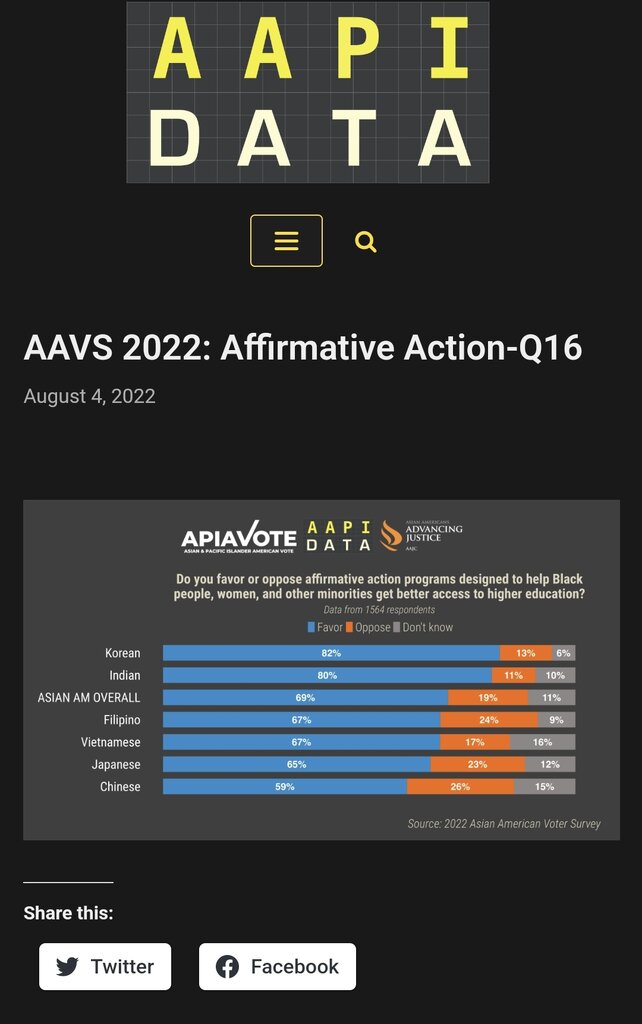
 aapidata.com
Another thing I'd note is that 538, which runs their own pollster reliability rating system that's used in their poll aggregator, quoted the above polling data in their recent article on how Asian Americans came to play a central role in the battle over affirmative action
AAPI data (the source for the NBC article) has been doing their voter survey since 2016, asks questions on over a dozen topics, and publishes their methodology. Here is their 2022 data
2022 Asian American Voter Survey - AAPI Data
Election-year surveys of registered voters; includes many priority issues such as gun control, immigration, hate crimes, and more.
aapidata.com
Another thing I'd note is that 538, which runs their own pollster reliability rating system that's used in their poll aggregator, quoted the above polling data in their recent article on how Asian Americans came to play a central role in the battle over affirmative action
Last edited:
No, I don’t think the answer to solving past discrimination and racism is to institute new racist and discriminatory policies.
Would you be in favor of using federal tax dollars to address the racial healthcare disparity even if those tax dollars are mostly paid by white and asian people? White and asian people are a higher percentage of the tax base than black people and other minorities.
If you would be ok with using tax dollars, I don't really see a material difference between that and race-conscious AA. It's just one is slightly more explicit than the other but they're both trying to address problems you think are important.
Example. The President and Congress want to form a task force that specifically tries to address heart failure in the black community (black men have something like a 70% higher chance of developing heart failure than white men), it would funnel more money into healthcare centers that see a lot of black people, increase hiring of nurses and other healthcare workers like dieticians and pharmacists, connect more black men with PCPs and cardiologists earlier, and maybe even try to address some of the broader systemic causes.
Would it be wrong to spend tax dollars on that program if they were disproportionately born by white and asian people?
Last edited:
D
deleted1156722
Agree 100%.I think any website can outsource whatever question they want to an online surveyor without actually having to be rigorous about it. Which is how you end up with weird data in the above survey like 53% wanting SCOTUS to ban AA even though only 49% of the cohort opposed AA to begin with.
AAPI data (the source for the NBC article) has been doing their voter survey since 2016, asks questions on over a dozen topics, and publishes their methodology. Here is their 2022 data
View attachment 368578
2022 Asian American Voter Survey - AAPI Data
Election-year surveys of registered voters; includes many priority issues such as gun control, immigration, hate crimes, and more.
Another thing I'd note is that 538, which runs their own pollster reliability rating system that's used in their poll aggregator, quoted the above polling data in their recent article on how Asian Americans came to play a central role in the battle over affirmative action
Polling questions in fact can elicit desirable answers by rephrasing certain questions-
AAPI Data seems to ask if Affirmative Action is bad for Blacks, women and “other minorities…” Then you can see how Asian Americans can imagine themselves being a part of that “minorities” and agreeing to that.
I don’t see a problem with the Intelligent poll having 49% Asian Americans oppose Affirmative Action in general, and 53% of Asian Americans agreeing with SCOTUS banning AA only because not everyone likes the process of using Judicial body taking over and strong-arming the policy-making process which should be a legislative function. So 49% would have preferred to just state that they oppose affirmative action and 53% would like the additional role of the SCOTUS in this decision. That seems reasonable too.
Regardless, all these polls show that there can never be a true overwhelming majority opinion on something as sensitive as “Affirmative Action” with so much history behind it. (although 75% Americans against considering race/ethnicity factors in admissions is pretty convincing to me)
I feel that no discrimination is “good discrimination “. Maybe only if Affirnatjve Action is banned, the system will actually be forced to look at other ( and likely better )solutions to address the fundamental problems with inequalities in our society.
Last edited by a moderator:
D
deleted1156722
I thought the liberal side argument is Racial discrimination is the root cause of all evils, and thus the cornerstone of Pro-Affirmative Action ideas.Would you be in favor of using federal tax dollars to address the racial healthcare disparity even if those tax dollars are mostly paid by white and asian people? White and asian people are a higher percentage of the tax base than black people and other minorities.
If you would be ok with using tax dollars, I don't really see a material difference between that and race-conscious AA. It's just one is slightly more explicit than the other but they're both trying to address problems you think are important.
Example. The President and Congress want to form a task force that specifically tries to address heart failure in the black community (black men have something like a 70% higher chance of developing heart failure than white men), it would funnel more money into healthcare centers that see a lot of black people, increase hiring of nurses and other healthcare workers like dieticians and pharmacists, connect more black men with PCPs and cardiologists earlier, and maybe even try to address some of the broader systemic causes.
Would it be wrong to spend tax dollars on that program if they were disproportionately born by white and asian people?
So now, you want to look to adding “SES Tax penalty” on top of “Race box penalty” for Asians & Whites.
Why didn’t I see this coming sooner?
Which factor do you want to argue for- Race or SES based penalty? You certainly can’t have the cake and eat it too!
I thought the liberal side argument is Racial discrimination is the root cause of all evils, and thus the cornerstone of Pro-Affirmative Action ideas.
So now, you want to look to adding “SES Tax penalty” on top of “Race box penalty” for Asians & Whites.
Why didn’t I see this coming sooner?
Which factor do you want to argue for- Race or SES based penalty? You certainly can’t have the cake and eat it too!
What are you even talking about? Under the status quo, the majority of the top 1% earners pay the majority of taxes. The majority of 1% earners also happen to be white and asian.
Literally every government program is disproportionately paid for by white and asian people.
So in your mind, where "no discrimination is good discrimination" can you tolerate government programs which are a cost to white and asian people, but benefit black people?
D
deleted1156722
Agree with you here: “Govt stays out of the bedrooms & Govt. stays out of the uterus”Popularity polls apparently only matter when it isn't abortion bans.
61% Americans want safe and legal abortions.
75% Americans want to ban Affirmative Action.
I am with the majority and am supporting both of the above… Are you?
D
deleted1156722
Free market Liberalism and Democratic Socialism cannot co-exist in America.What are you even talking about? Under the status quo, the majority of the top 1% earners pay the majority of taxes. The majority of 1% earners also happen to be white and asian. Literally every government program is disproportionately paid for by white and asian people…
The democratic socialist reforms being planned as part of the current progressive agenda, and with its grandiose plans for restructuring economic life for its citizens using socialist and racist policies, will either end up (1) assuming more authoritarian powers and that means we won’t have a democracy anymore (or 2) abandoning the socialist plans of the progressives and turn back to fairness and equality- not equity.
edit: Because my premise is all things in society will improve if we stop focusing on uncontrollable factors like Race or Sex. That has led to so much division and hatred in our country. Using "race" as a proxy for SES is a grave mistake. We need to have a truly “color-blind” and “race-blind” system. We need “equality” and not “equity”.
Last edited by a moderator:
Advertisement - Members don't see this ad
Would you be in favor of using federal tax dollars to address the racial healthcare disparity even if those tax dollars are mostly paid by white and asian people? White and asian people are a higher percentage of the tax base than black people and other minorities.
If you would be ok with using tax dollars, I don't really see a material difference between that and race-conscious AA. It's just one is slightly more explicit than the other but they're both trying to address problems you think are important.
Example. The President and Congress want to form a task force that specifically tries to address heart failure in the black community (black men have something like a 70% higher chance of developing heart failure than white men), it would funnel more money into healthcare centers that see a lot of black people, increase hiring of nurses and other healthcare workers like dieticians and pharmacists, connect more black men with PCPs and cardiologists earlier, and maybe even try to address some of the broader systemic causes.
Would it be wrong to spend tax dollars on that program if they were disproportionately born by white and asian people?
School funding/resources is not a zero sum game. "Let's help failing schools" is different than "Let's help blacks by admitting less Asians".
edit: Also OK with US trying to help blacks with HF. However, if services were ONLY offered to blacks that would be racist. Again, denying a certain people group services based on race is, by definition, racist. In your example - Do the healthcare centers getting more money for HF turn away non-black patients with HF? I imagine if a non-black patient went to one of the healthcare centers getting more support for HF, they would be equally treated and cared for. This is very different than college/med school admissions where there's distinct acceptance/rejection based on race.
Last edited:
School funding/resources is not a zero sum game. "Let's help failing schools" is different than "Let's help blacks by admitting less Asians". The equivalent for schools would be "Lets help black only schools by taking resources from asian only schools".
edit: Also OK with US trying to help blacks with HF. However, if services were ONLY offered to blacks that would be racist. Again, denying a certain people group services based on race is, by definition, racist.
It's a meaningless distinction if we're just talking about tax dollars.
The result is a redistribution of wealth and resources from one racial group to another.
It sounds like you're ok if we focus specifically on black people, so long as we don't actually say we're trying to focus on black people. If this is just a rhetoric game that's fine.
The "color-blind" position I'm arguing against would say that you can't have any law or policy that includes racial preference in it. Such a position would be opposed to the HF treatment example I proposed.
It's a meaningless distinction if we're just talking about tax dollars.
The result is a redistribution of wealth and resources from one racial group to another.
It sounds like you're ok if we focus specifically on black people, so long as we don't actually say we're trying to focus on black people. If this is just a rhetoric game that's fine.
The "color-blind" position I'm arguing against would say that you can't have any law or policy that includes racial preference in it. Such a position would be opposed to the HF treatment example I proposed.
Yes, I am advocating for color blind policies. I'm ok with helping failing schools, sick patients, and low income individuals. I don't care how that works out racially. I am not ok with specifically saying let's ONLY help black schools, black sick patients, and black low income individuals. Which is what DEI often is - specifically targeting certain groups to help based on race.
Yes, I am advocating for color blind policies. I'm ok with helping failing schools, sick patients, and low income individuals. I don't care how that works out racially. I am not ok with specifically saying let's ONLY help black schools, black sick patients, and black low income individuals. Which is what DEI often is - specifically targeting certain groups to help based on race.
Lol. So we can have our HF clinic that just happens to treat 95% black people. We just can't call it a black clinic or suggest to anyone that black people are disproportionately benefiting. That's fine by me, so long as you actually support measures like that.
To me, that is still "targeting a certain group to help based on race", but if we need to play some word games to get everyone on board, that's fine.
Last edited:
LOL, what??? This entire line of discussion has been about how Asian Americans have essentially been on the *wrong* end of benefiting from affirmative action, but you're positing that Asian Americans would think they're included in the "other minorities" category that is benefiting? This is 100% NOT a reasonable interpretation of that poll because it should be obvious that "other minorities" implicitly means URMs. Asian Americans (including South Asians such as myself) are usually hyperaware that they (generally speaking depending on the ethnic subgroup) either don't require affirmative action or require it very rarely wrt to educational opportunity.AAPI Data seems to ask if Affirmative Action is bad for Blacks, women and “other minorities…” Then you can see how Asian Americans can imagine themselves being a part of that “minorities” and agreeing to that.
Furthermore, that 70% support figure is consistent with other higher quality polls going back a decade.

Where do Asian Americans Stand on Affirmative Action?
June 24, 2013The U.S. Supreme Court affirmed the ability of universities to attain the educational benefits of diversity by implementing race-based affirmative action programs, but narrowly tailor
 naasurvey.com
I've read this para like three times and it still doesn't parse. The part where you wrote "some folks may not like the process of using Judicial body taking over and strong-arming the policy-making process" implies that even fewer people within the overall group of Asian Americans would support SCOTUS banning AA, but yet the SCOTUS figure is higher than the "oppose in general" figure. It's a logical contradiction, because the group of Asian Americans who support SCOTUS banning AA has to be a smaller subset within the larger group of AAs who oppose it in general. 53 ≮ 49.I don’t see a problem with the Intelligent poll having 49% Asian Americans oppose Affirmative Action in general, and 53% of Asian Americans agreeing with SCOTUS banning AA only because some folks may not like the process of using Judicial body taking over and strong-arming the policy-making process which should be a legislative function.That seems reasonable too.
BTW, earlier when you were calling Justice KBJ a token, you never answered when I asked afterwards whether the Thurgood Marshall and Sandra Day O'Connor were also "tokens." Were they nominations racist and sexist, respectively?I feel that no discrimination is “good discrimination “.
D
deleted1156722
#1: Look at the polling question in AAPI: It is very vague instead of asking specifically who the Affirmative Action beneficiaries are i.e Blacks, Latinos, Native Americans. Furthermore, they were “interviewed in English as well as Asian languages”. So basically many of them might be clearly ignorant of the premise and objectives of Affirmative Action, and would be of the mindset that America welcomes and supports all minorities based on meritocracy ( blissfully unaware that there is more than what meets the eye with the Identity politics happening here). Probably, the second generation Asian Americans would understand better than their parents who moved to America for merit and equal opportunities without nepotism, and escaping the discrimination that they have faced in their own countries where merit is substituted for class/ caste/social status/ connections/ corruption etc… only to realize it is the same game here, only played with a different name race/ ethnicity and ALDC list.LOL, what??? This entire line of discussion has been about how Asian Americans have essentially been on the *wrong* end of benefiting from affirmative action, but you're positing that Asian Americans would think they're included in the "other minorities" category that is benefiting? This is 100% NOT a reasonable interpretation of that poll because it should be obvious that "other minorities" implicitly means URMs. Asian Americans (including South Asians such as myself) are usually hyperaware that they (generally speaking depending on the ethnic subgroup) either don't require affirmative action or require it very rarely wrt to educational opportunity.
Furthermore, that 70% support figure is consistent with other higher quality polls going back a decade.
View attachment 368616
Where do Asian Americans Stand on Affirmative Action?
June 24, 2013The U.S. Supreme Court affirmed the ability of universities to attain the educational benefits of diversity by implementing race-based affirmative action programs, but narrowly tailor
I've read this para like three times and it still doesn't parse. The part where you wrote "some folks may not like the process of using Judicial body taking over and strong-arming the policy-making process" implies that even fewer people within the overall group of Asian Americans would support SCOTUS banning AA, but yet the SCOTUS figure is higher than the "oppose in general" figure. It's a logical contradiction, because the group of Asian Americans who support SCOTUS banning AA has to be a smaller subset within the larger group of AAs who oppose it in general. 53 ≮ 49.
BTW, earlier when you were calling Justice KBJ a token, you never answered when I asked afterwards whether the Thurgood Marshall and Sandra Day O'Connor were also "tokens." Were they nominations racist and sexist, respectively?
How do you then explain the decline in support once there became more awareness of this SCOTUS case. The Asian Americans realized their folly of supporting such programs in the past. Atleast that is my extrapolation based on studying this survey characteristics in depth. ( I am positive you are going to chew me out on this explanation 🙄)
#2 My bad…good catch! Yes, I worded that paragraph wrongly and have edited it now to convey what I actually meant to state.
# 3 Justice Marshall and Justice O’Connor were definitely not token candidates in my opinion. (and they were confirmed with huge senate majority/ unanimously which is unthinkable now) I have reviewed their rulings and writings mainly pertaining to Affirmative Action ( The landmark Brown v Board, for Justice Marshall and Justice Day O’Connor in University of California v. Bakke, and Grutter v. Bollinger). Very nuanced and powerful. IMHO, they both were eager for equal protection for all, and I came away thinking they would have liked AA to expire sooner than later, and definitely not wanted it infinitely.
# 3 Justice Marshall and Justice O’Connor were definitely not token candidates in my opinion. (and they were confirmed with huge senate majority/ unanimously which is unthinkable now) I have reviewed their rulings and writings mainly pertaining to Affirmative Action ( The landmark Brown v Board, for Justice Marshall and Justice Day O’Connor in University of California v. Bakke, and Grutter v. Bollinger). Very nuanced and powerful. IMHO, they both were eager for equal protection for all, and I came away thinking they would have liked AA to expire sooner than later, and definitely not wanted it infinitely.
This is just wild. First off, O'Connor wasn't present on the court for Bakke... so I don't know what opinion of hers you read there. But assuming you meant Marshall's opinion in that case, we can look at specifically what he signed onto:
"Racial classifications call for strict judicial scrutiny. Nonetheless, the purpose of overcoming substantial, chronic minority underrepresentation in the medical profession is sufficiently important to justify petitioner's remedial use of race."
"I agree with the judgment of the Court only insofar as it permits a university to consider the race of an applicant in making admissions decisions. I do not agree that petitioner's admissions program violates the Constitution. For it must be remembered that, during most of the past 200 years, the Constitution, as interpreted by this Court, did not prohibit the most ingenious and pervasive forms of discrimination against the Negro. Now, when a State acts to remedy the effects of that legacy of discrimination, I cannot believe that this same Constitution stands as a barrier."
Bakke was split 4-4-1, it was Powell who pretty much unilaterally argued "affirmative action is ok, but I just don't like quota systems". Marshall was fine with quota systems and remediation for historic harms. Your notion that "both" Marshall and O'connor would support your view today that affirmative action should expire isn't grounded in anything in the Bakke decision.
Just to go one step further, Marshall points to the SAME racial disparities in healthcare that I point to when I argue affirmative action should continue as a means of redress:
"The position of the Negro today in America is the tragic but inevitable consequence of centuries of unequal treatment. Measured by any benchmark of comfort or achievement, meaningful equality remains a distant dream for the Negro.
A Negro child today has a life expectancy which is shorter by more than five years than that of a white child. The Negro child's mother is over three times more likely to die of complications in childbirth, and the infant mortality rate for Negroes is nearly twice that for whites. The median income of the Negro family is only 60% that of the median of a white family, and the percentage of Negroes who live in families with incomes below the poverty line is nearly four times greater than that of whites."
Today, black people are still have a life expectancy 3.6 years less than white people. Black women are still over 3 times as likely to die from childbirth complications as white women. Black infant mortality is now OVER twice what it is for white children (2.4x). Median white income is ~$78,000 while median black income is ~$48,000 (61%). I can't find the last specific percentages easily, but 19.5% of black people are below the poverty line, whereas only 8.1% for white people.
If you like Marshall, and you see the problems with racial disparities in healthcare today, you should be A-OK with race conscious admissions.

Black Women Over Three Times More Likely to Die in Pregnancy, Postpartum Than White Women, New Research Finds - Population Reference Bureau
Stark racial disparities in U.S. maternal deaths underscore the need to address equity.
 www.prb.org
Infant Mortality and Black/African Americans
Infant mortality refers to the death of a baby between 1 day and 1 year old.
 minorityhealth.hhs.gov

The Demographics of Income and Wealth in the United States
Income levels for Americans vary across geography, race, and gender.
 www.pgpf.org

U.S. Poverty Statistics
U.S. Poverty statistics and U.S. poverty rate include a summary of various categories of race, education, age, and other attributes of those in poverty. Get the manageable government data, and reports from Federal Safety Net. Visit us today.
federalsafetynet.com
Last edited:

Do any of you recall the "polls" around Brown vs the Board of Education? Did SCOTUS care what the polling was around this issue? No. SCOTUS knew that this issue was highly contentious especially in the South but still made the correct decision based on the law.
In 2023, SCOTUS will rule that race should not play a significant role in admissions. Again, polling won't have anything to do the their ruling based on the Constitution. Discrimination is against the US Constitution no matter how you try to justify it.
Schools will need to figure a way around "race" as the determining factor in admissions. I suspect they will utilize economic circumstances to replace race.

 www.aclu.org
In 2023, SCOTUS will rule that race should not play a significant role in admissions. Again, polling won't have anything to do the their ruling based on the Constitution. Discrimination is against the US Constitution no matter how you try to justify it.
Schools will need to figure a way around "race" as the determining factor in admissions. I suspect they will utilize economic circumstances to replace race.
What You Need to Know about Affirmative Action at the Supreme Court | ACLU
Two cases before the high court will determine whether race conscious admissions policies can be used by universities.
www.aclu.org
#1: Look at the polling question in AAPI: It is very vague instead of asking specifically who the Affirmative Action beneficiaries are i.e Blacks, Latinos, Native Americans. Furthermore, they were “interviewed in English as well as Asian languages”. So basically many of them might be clearly ignorant of the premise and objectives of Affirmative Action, and would be of the mindset that America welcomes and supports all minorities based on meritocracy ( blissfully unaware that there is more than what meets the eye with the Identity politics happening here). Probably, the second generation Asian Americans would understand better than their parents who moved to America for merit and equal opportunities without nepotism, and escaping the discrimination that they have faced in their own countries where merit is substituted for class/ caste/social status/ connections/ corruption etc… only to realize it is the same game here, only played with a different name race/ ethnicity and ALDC list.
How do you then explain the decline in support once there became more awareness of this SCOTUS case. The Asian Americans realized their folly of supporting such programs in the past. Atleast that is my extrapolation based on studying this survey characteristics in depth. ( I am positive you are going to chew me out on this explanation 🙄)
I like how your explanation here is that Asian Americans, despite being the most highly educated ethnic group in America, are somehow too stupid to realize they're not included in the group of minorities who derive the most (instead of, in Asians' case, the least) benefit from affirmative action. Really makes a ton of sense there, friend.
#2 My bad…good catch! Yes, I worded that paragraph wrongly and have edited it now to convey what I actually meant to state.
Right. Glad we could established that the poll you quoted makes no sense.
# 3 Justice Marshall and Justice O’Connor were definitely not token candidates in my opinion. (and they were confirmed with huge senate majority/ unanimously which is unthinkable now) I have reviewed their rulings and writings mainly pertaining to Affirmative Action ( The landmark Brown v Board, for Justice Marshall and Justice Day O’Connor in University of California v. Bakke, and Grutter v. Bollinger). Very nuanced and powerful. IMHO, they both were eager for equal protection for all, and I came away thinking they would have liked AA to expire sooner than later, and definitely not wanted it infinitely.
What you think of their rulings or confirmations is irrelevant. You called Justice KBJ a token by virtue of how she was selected, and the number of votes a justice gets in this hyperpartisan era has nothing to do with their qualifications.
The salient fact is that both Johnson and Reagan had already decided on favoring a candidate with a particular race or sex before nominating them
Johnson, who had long desired to solidify his legacy in regards to civil rights by nominating a non-white justice,[4][5] believed that the choice of a nominee to fill the ensuing vacancy "was as easy as it was obvious", according to the scholar Henry J. Abraham.[5]:
You took issue with Biden for nominating a "token" justice for this very reason, but yet somehow earlier nominations where the president used the exact same logic don't apply. Seems a little conspicuous.
Last edited:
Do any of you recall the "polls" around Brown vs the Board of Education? Did SCOTUS care what the polling was around this issue? No. SCOTUS knew that this issue was highly contentious especially in the South but still made the correct decision based on the law.
In 2023, SCOTUS will rule that race should not play a significant role in admissions. Again, polling won't have anything to do the their ruling based on the Constitution. Discrimination is against the US Constitution no matter how you try to justify it.
Schools will need to figure a way around "race" as the determining factor in admissions. I suspect they will utilize economic circumstances to replace race.
What You Need to Know about Affirmative Action at the Supreme Court | ACLU
Two cases before the high court will determine whether race conscious admissions policies can be used by universities.
Activist court gonna activist court.
Ignore stare decisis and pretend Gratz v. Bollinger, Grutter v. Bollinger, and Fisher v. U of Texas don't exist.
Last edited:
Do any of you recall the "polls" around Brown vs the Board of Education? Did SCOTUS care what the polling was around this issue? No. SCOTUS knew that this issue was highly contentious especially in the South but still made the correct decision based on the law.
In 2023, SCOTUS will rule that race should not play a significant role in admissions. Again, polling won't have anything to do the their ruling based on the Constitution. Discrimination is against the US Constitution no matter how you try to justify it.
Schools will need to figure a way around "race" as the determining factor in admissions. I suspect they will utilize economic circumstances to replace race.
What You Need to Know about Affirmative Action at the Supreme Court | ACLU
Two cases before the high court will determine whether race conscious admissions policies can be used by universities.
Discriminate for over 200 years against a specific race? That's bad. Try to fix the consequences of that discrimination? Just as bad. Got it. Your position is clear and absolutist.
We'll see how SCOTUS rules, depending on how severely they turn against race conscious language the potential public health consequences could be far reaching. For example, this SCOTUS has taken aim at ICWA (Indian Child Welfare Act) with some previous decisions. It's conceivable that further erosion of ICWA protections could come out of these future decisions.
Affirmative action and public health repercussions:

Affirmative Action and Public Health Repercussions - Network for Public Health Law
this issue brief highlights select ways in which race and ethnicity are historically or currently used as public health decision-making or allocation factors in programs, research, funding, or workforce issues in the U.S. through (I) federal laws, (II) federal programs and agencies, and (III)...
 www.networkforphl.org
Last edited:
D
deleted1156722
I like how your explanation here is that Asian Americans, despite being the most highly educated ethnic group in America, are somehow too stupid to realize they're not included in the group of minorities who derive the most (instead of, in Asians' case, the least) benefit from affirmative action.
You are misinterpreting me. Please read my response again. I was talking about the first generation Asian Americans who were included in the poll and had limited English proficiency. So are they thinking somehow they are the most educated in this society? You choose to conveniently conflate the literacy quotient of 1st and 2nd generation Asian Americans, but love to harp on the literacy needs and protection needed for blacks/other minorities through Affirmative Action. This is called hypocrisy. Gimme a break, pal!
You are wrong again! I only conceded that I poorly worded that para and rephrased/edited it. I had a busy day yesterday and my brain was exhausted, and I admit I made some errors in typing my response and regarding the correct authors of the SC ruling in historical cases. (Justice Marshall vs Justice O’Connor) as rowsdower88 pointed out.Right. Glad we could established that the poll you quoted makes no sense.
That’s all I admit to and I never said that the poll data is wrong. You are demo’ing the classic example of hyperbole when you are making up the rest of your above statement. That means you did not read what I posted.
Why am I even wasting my time arguing with you at all?
Here it is again what I posted word by word, so that you can see what I wrote:
“I don’t see a problem with the Intelligent poll having 49% Asian Americans oppose Affirmative Action in general, and 53% of Asian Americans agreeing with SCOTUS banning AA only because not everyone likes the process of using Judicial body taking over and strong-arming the policy-making process which should be a legislative function. So 49% would have preferred to just state that they oppose affirmative action and 53% would like the additional role of the SCOTUS in this decision. That seems reasonable too.”
So that changes nothing here. I wasn’t even born when Marshall or O’Connor were nominated and I wasn’t interested in that part of their history, only their rulings. The earlier nominations or the presidents who nominated them is not even a factor in my response.What you think of their rulings or confirmations is irrelevant. You called Justice KBJ a token by virtue of how she was selected. You took issue with Biden for nominating a "token" justice for this very reason, but yet somehow earlier nominations where the president used the exact same logic don't apply. Seems a little conspicuous.
What is clear is Biden nominated KBJ to pander to black and women voters and played dirty identity politics. You could also call out Trump on the same matter as he nominated ACB to pander to women voters. There is nothing more to it.
I still maintain that we need to hire the “Best person for every job, regardless of race, ethnicity, sex, gender ”.
I am engaging with you in good faith and your convenient and snarky response is not what I call as reciprocation.
Last edited by a moderator:
D
deleted1156722
I agree with you, that the universities will be forced to look for other factors besides Race to keep the diversity when SCOTUS delivers its verdict. I have my Dom Perignon ready!Do any of you recall the "polls" around Brown vs the Board of Education? Did SCOTUS care what the polling was around this issue? No. SCOTUS knew that this issue was highly contentious especially in the South but still made the correct decision based on the law.
In 2023, SCOTUS will rule that race should not play a significant role in admissions. Again, polling won't have anything to do the their ruling based on the Constitution. Discrimination is against the US Constitution no matter how you try to justify it.
Schools will need to figure a way around "race" as the determining factor in admissions. I suspect they will utilize economic circumstances to replace race.
Firstly, they will make SES as the criteria, and second, many bureaucratic DEI officers who are draining the funds from the universities (which needs to go towards student education and scholarships ) can be now let go from the university payroll. They can now be on the search for more productive jobs- instead of creating division and hatred on campus and suppress free speech. Win -Win for all!👍

Stanford Law official who admonished judge during speech is on leave, dean says
Stanford Law School will not discipline students who disrupted a campus speech by a conservative federal judge earlier this month, but an official who appeared to intervene on the protesters' behalf is now on leave, the law school's dean said Wednesday.
Last edited by a moderator:
You are misinterpreting me. Please read my response again. I was talking about the first generation Asian Americans who were included in the poll and had limited English proficiency. So are they thinking somehow they are the most educated in this society? You choose to conveniently conflate the literacy quotient of 1st and 2nd generation Asian Americans, but love to harp on the literacy needs and protection needed for blacks/other minorities through Affirmative Action . That is called hypocrisy. Gimme a break, pal!
You are literally inventing an explanation -- without any evidence whatsoever -- to wish away findings in multiple polls that you disagree with. It's pure fantasy speculation at its finest, because it's plainly obvious that in a poll directed explicitly toward Asian people, language stating "Black people, women, and other minorities " is sure as sht not also referring to Asian people.
FFS, stop being so disingenuous about it. If you want to disagree with the poll, fine, but don't be a child and pretend it says something it doesn't.
“I don’t see a problem with the Intelligent poll having 49% Asian Americans oppose Affirmative Action in general, and 53% of Asian Americans agreeing with SCOTUS banning AA only because not everyone likes the process of using Judicial body taking over and strong-arming the policy-making process which should be a legislative function. So 49% would have preferred to just state that they oppose affirmative action and 53% would like the additional role of the SCOTUS in this decision. That seems reasonable too.”
This still doesn't make any sense. The implication is still that fewer than 49% would want SCOTUS banning AA if "not everyone[within the general subset of Asians who oppose AA] like the process of using Judicial body..."
The methodology is bad.
So that changes nothing here. I wasn’t even born when Marshall or O’Connor were nominated and I wasn’t interested in that part of their history, only their rulings. Biden nominated KBJ to pander to black women just as Trump nominated ACB to pander to women voters. There is nothing more to it.
I am engaging with you in good faith and this is not what I call reciprocation.
Lol, what does when you were born have to do with it? The question is about your principles and whether a president announcing beforehand that he's going to nominate someone of X race or sex "tokenizes" that person. It either does or doesn't.
You said KBJ was a token because you were probably blissfully unaware that the exact same kind of presidential pre-announcement / pre-decision has happened multiple times throughout history. You're still free to maintain your stance. However, the least you could do is try to maintain the tiniest iota of logical consistency and admit that by your standard Justices Marshall, SDO, and ACB are as well.
Win -Win for all!👍
I have my Dom Perignon ready!
Party on Garth.
If you're this full throated about the prospect of reducing black docs you can stop imagining you have the ghost of Thurgood Marshall backing you up.
Advertisement - Members don't see this ad
D
deleted1156722
rowsdower88, you just quoted a writing from Justice Marshall with some forbidden words in it. You have the luxury of not being cancelled by SDN mods because you are on the “politically correct“ side of this argument. However, I saw so many other posters with benign comments-atleast from what I can see made on this same forum and whose account got removed/ revoked. Thank you for demonstrating exactly how the progressive ideology of free speech works at this time.Party on Garth.
If you're this full throated about the prospect of reducing black docs you can stop imagining you have the ghost of Thurgood Marshall backing you up.
Needless to state, you are basically wrong when you are misinterpreting my statement to say I am all for “reducing black doctors” when all I am saying is “Best person for every job regardless of race, ethnicity, sex or gender”. You can look over every post of mine with a magnifying glass, and see that I have always maintained that stance.
When medical schools prioritize diversity, equity, and inclusion over science, learning and research, ultimately every patient suffers, and additionally, there is unnecessary hatred and division in our society along racial lines.
As Justice Roberts stated eloquently, “ The only way to stop racial discrimination is to stop discriminating based on race”.
Finally, I am done with having this discussion with privileged people like you (rowsdower88 and vector2) who are so self-satisfied with your exaggerated sense of righteousness that you cannot see beyond your partisan talking points. Adios.
rowsdower88, you just quoted a writing from Justice Marshall with some forbidden words in it. You have the luxury of not being cancelled by SDN mods because you are on the “politically correct“ side of this argument. However, I saw so many other posters with benign comments-atleast from what I can see made on this same forum and whose account got removed/ revoked. Thank you for demonstrating exactly how the progressive ideology of free speech works at this time.
Needless to state, you are basically wrong when you are misinterpreting my statement to say I am all for “reducing black doctors” when all I am saying is “Best person for every job regardless of race, ethnicity, sex or gender”. You can look over every post of mine with a magnifying glass, and see that I have always maintained that stance.
When medical schools prioritize diversity, equity, and inclusion over science, learning and research, ultimately every patient suffers, and additionally, there is unnecessary hatred and division in our society along racial lines.
As Justice Roberts stated eloquently, “ The only way to stop racial discrimination is to stop discriminating based on race”.
Finally, I am done with having this discussion with privileged people like you (rowsdower88 and vector2) who are so self-satisfied with your exaggerated sense of righteousness that you cannot see beyond your partisan talking points. Adios.
No AA -> fewer black docs... Sugar coat your position however you want, SCOTUS once again has the opportunity to hurt black communities and increase racial disparities. This court won't miss.
D
deleted87051
average er doc works 16 shifts a month. Combo of 8/12 hours.
It’s equivalent to crna’s doing (8) 24 hours I know who cover ob at many hospitals.
People want days off. Fortunately for anesthesia the crna’s aren’t taking less money like the np in the er.
The low point for anesthesia in this modern era was around 2012-2015 range. Salaries as low as 180k for full time doc in the south I saw advertised. Most in the low 200s when the AMCs were in full swing. It was almost laughable mednax (American anesthesiology) brought over north Atlanta practice and tried to pay in the low 200s for overnight Friday/Saturday/Sunday weekend coverage at 240k full time. Same stuff down in central Florida. Weekend overnight coverage. And that’s full time. Like 45 weeks coverage
My 2nd job out of residency was in academics for about $110k. But at the time, the average house in La Jolla cost $400-500k. So maybe that wasn’t so bad considering the cost of living.
Housing tanked 1989-1991 in San Diego and wash dc during end of the Cold War.My 2nd job out of residency was in academics for about $110k. But at the time, the average house in La Jolla cost $400-500k. So maybe that wasn’t so bad considering the cost of living.
It took almost 10 years for home prices to recover
I know that time frame. Not 40% tank like the housing bubble.
But a 15% decline. Which is still significant.

So no AA>>>fewer black docs? Do black applicants have trouble getting accepted into med school? An earlier poster posted a graph suggesting that black applicants with lower stats have a higher admission rate than other races. Maybe more black applicants with better stats is the answer? Having done admission interviews for 17 years, we realized finding qualified black applicants within our admission metrics was not easy. Many good people champion DEI, citing the benefits to society. What I haven't seen is data in the lower Stat group suggesting they are successful in medical school and pass boards. Are their remediation rates and board pass rates similiar to their med school peers? There are always unintended consequences to every policy action. I think we can all agree that lower Stat applicants are at higher risk of med school and board failures than higher Stat students. The success of all our students, including med students should be our priority and they should be put into a position to succeed. My former school recruits at inner city high schools and has a summer program to introduce high schoolers to medicine. I believe AA would be better served by bringing lower Stat students in for a post bac year before med school. This should improve their success and self esteem. I would be fine if tax dollars covered this post back year.No AA -> fewer black docs... Sugar coat your position however you want, SCOTUS once again has the opportunity to hurt black communities and increase racial disparities. This court won't miss.

