
-
CycleTrack and SDN are teaming up to make medical school admissions more transparent and accessible! Read the announcement to learn how we’re supporting the future of CycleTrack’s free application-tracking tools .
You are using an out of date browser. It may not display this or other websites correctly.
You should upgrade or use an alternative browser.
You should upgrade or use an alternative browser.
aamc cbt11 thread
Started by sekistudent

Get help with your application
Use all the free resources available to you from SDN: articles, guides, expert advising, forums discussions, and school research.

Which one of the following properties of a wave is independent of all others? (AAMC11)
A) Wavelength
B) Frequency
C) Velocity
D) Amplitude
The answer is D. On another AAMC (possibly #9) they had a similar question and the answer was velocity (which is what I picked this time). To my knowledge velocity only depends on the medium (it's essentially a constant). Amplitude (which I think is the same as Intensity) is only related to the Energy you put into the wave hence, it's also a constant. This discrepancy is really starting to annoy me.
I'm confused as to why velocity is dependent on wavelength/frequency (even though the eqn states v = wavelength*frequency). This is like saying C = Q/V hence Capacitance depends on the charge and the voltage.
Thank you for the help!
A) Wavelength
B) Frequency
C) Velocity
D) Amplitude
The answer is D. On another AAMC (possibly #9) they had a similar question and the answer was velocity (which is what I picked this time). To my knowledge velocity only depends on the medium (it's essentially a constant). Amplitude (which I think is the same as Intensity) is only related to the Energy you put into the wave hence, it's also a constant. This discrepancy is really starting to annoy me.
I'm confused as to why velocity is dependent on wavelength/frequency (even though the eqn states v = wavelength*frequency). This is like saying C = Q/V hence Capacitance depends on the charge and the voltage.
Thank you for the help!

Which one of the following properties of a wave is independent of all others? (AAMC11)
A) Wavelength
B) Frequency
C) Velocity
D) Amplitude
The answer is D. On another AAMC (possibly #9) they had a similar question and the answer was velocity (which is what I picked this time). To my knowledge velocity only depends on the medium (it's essentially a constant). Amplitude (which I think is the same as Intensity) is only related to the Energy you put into the wave hence, it's also a constant. This discrepancy is really starting to annoy me.
I'm confused as to why velocity is dependent on wavelength/frequency (even though the eqn states v = wavelength*frequency). This is like saying C = Q/V hence Capacitance depends on the charge and the voltage.
Thank you for the help!
"Velocity only depends on medium" is only true given constant wavelength and frequency.
For example, light of different frequencies travels at different speeds through glass, even though the medium is the same. Velocity is not independent of frequency or wavelength.
Amplitude, however, will not change regardless of change in medium (velocity), wavelength, or frequency.
Advertisement - Members don't see this ad
Question concerning BS138 "The walls of the alveoli are most likely composed of which of the following tissues?"
I thought all epithelial cells were connected to a basement membrane at least partially composed of connective tissue? Therefore I choose D. Can someone tell me where I'm screwing up?
Thanks!
I thought all epithelial cells were connected to a basement membrane at least partially composed of connective tissue? Therefore I choose D. Can someone tell me where I'm screwing up?
Thanks!
Question concerning BS138 "The walls of the alveoli are most likely composed of which of the following tissues?"
I thought all epithelial cells were connected to a basement membrane at least partially composed of connective tissue? Therefore I choose D. Can someone tell me where I'm screwing up?
Thanks!
The basement membrane is proteinaceous, and can exist without the need for connective tissue (which in this case would put further cells between the alveolar lumen and the capillaries.
Also not all epithelial cells are even connected to a basement membrane, see stratified epithelia.
For Physics question 45,
"If the centrifuge car in Figure one emitted a sound as it moved, a stationary observer standing just outside the radius of the centrifuge will hear:"
A frequency that oscillates due to the car approaching and receding.
How do you know the car will approach and then go away from the observer? Are we supposed to assume the car makes multiple revolutions? Because I assumed, due to diagram 2 on figure 1, that the observer would be standing outside the radius (to the left of the car) as the car moves away from the observer (going in the direction the arrow indicates), for that one moment. Thus, the frequency would be decreasing.
"If the centrifuge car in Figure one emitted a sound as it moved, a stationary observer standing just outside the radius of the centrifuge will hear:"
A frequency that oscillates due to the car approaching and receding.
How do you know the car will approach and then go away from the observer? Are we supposed to assume the car makes multiple revolutions? Because I assumed, due to diagram 2 on figure 1, that the observer would be standing outside the radius (to the left of the car) as the car moves away from the observer (going in the direction the arrow indicates), for that one moment. Thus, the frequency would be decreasing.
For Physics question 45,
"If the centrifuge car in Figure one emitted a sound as it moved, a stationary observer standing just outside the radius of the centrifuge will hear:"
A frequency that oscillates due to the car approaching and receding.
How do you know the car will approach and then go away from the observer? Are we supposed to assume the car makes multiple revolutions? Because I assumed, due to diagram 2 on figure 1, that the observer would be standing outside the radius (to the left of the car) as the car moves away from the observer (going in the direction the arrow indicates), for that one moment. Thus, the frequency would be decreasing.
Imagine the car starting at the point in the circle closest to the observer. Start the sound and let it go through one revolution. The frequency has oscillated about its source frequency for 2pi radians. The first half of the trip the frequency is decreasing, the second half it's increasing.
Imagine the car starting at the point in the circle closest to the observer. Start the sound and let it go through one revolution. The frequency has oscillated about its source frequency for 2pi radians. The first half of the trip the frequency is decreasing, the second half it's increasing.
Thanks, that's what I figured. My original assumption was based on a immediate time frame where the car wouldn't have completed even half of a revolution. I guess if there's no stopping time or force, we should always assume the car moves infinitely.
Imagine the car starting at the point in the circle closest to the observer. Start the sound and let it go through one revolution. The frequency has oscillated about its source frequency for 2pi radians. The first half of the trip the frequency is decreasing, the second half it's increasing.
Oops, duplicate post.
I have a question about #126 from the BS section. The answer is B. I see why that's correct, but I think that D is a logical answer too. Why wouldn't the tRNA for cysteine increase overall if more cP-450 is being made in a smoker's lungs? I wasn't satisfied with the AAMC explanation. Can anyone explain this, please?

Question on number 32 on PS: When equal volumes of solutions of MgSO4 and NiF2 are mixed, a precipitate is formed. Which of the following pieces of information will be least useful in determining the identity of the precipitate? A. Molar solubility of MgF2 B. Molar solubility of MgSO4 C. Molar solubility of NiSO4 D. Concentration of NiF2 solution. My question: Why do we need to know the concentration of NiF2? The answer is B, by the way.
remember the procedure for when you do solubility equations. You need to know how much of the initial stuff you put in (in this case NiF2) to predict how much of it will break up and form the percipitates
Can anyone explain the reasoning on 136? I got the question correct, but now I realize my reasoning was fallacious and I don't understand that of the explanation.
The stem says a nucleotide was added to the ORF. Okay, fine. The explanation says we should expect a different amino acid at the C-terminus of the translated polypeptide. Why? We're not told where the nucleotide was added into the ORF (it could have been inserted anywhere, not necessarily added to the end), and even if it were added to the end, we wouldn't necessarily get a changed amino acid at the end of the polypeptide.
Furthermore how is it even possible to add in a single nucleotide and not create or eliminate a stop codon?
If the sGP mRNA sequence is this:
AUG|GCU|AUA|CUA|UGA
And we add a single nuc. in the ORF (before the stop codon), we get:
AUG|GCU|AUA|CUA|UUG|A
Which eliminates our stop codon because it shifts the reading frame.
I'm confused.
Anyone else have an insight on this? Could the stop codeon be added onto it after splicing? or maybe the original stop codeon was eliminated but a new one was created downstream?

Anyone else have an insight on this? Could the stop codeon be added onto it after splicing? or maybe the original stop codeon was eliminated but a new one was created downstream?
What I got from the AAMC explanation was that since it is a frameshift mutation, the amino acid sequence until the frameshift will be the same (so the N-terminus will stay the same) while the amino acid sequences after that will change (so the C-terminus, as well as bunch of others, will be different from sGP)
As for the PS question about why air resistance is ignored when a compact object falls a very short distance, the passage itself says that "the upward force is proportion to the square of the air speed" so the velocity is much more influential in changing air resistance force.
They said that there is 1 coordinate bond to a cysteine residue. Seeing as how this is indicative of only 1 cysteine, I don't think producing more cP-450 would cause a huge increase in demand for cysteine. Now, if cP-450 were made of some disproportionately large % of cysteine (like 25%) I could see how tRNA for cysteine would increase.I have a question about #126 from the BS section. The answer is B. I see why that's correct, but I think that D is a logical answer too. Why wouldn't the tRNA for cysteine increase overall if more cP-450 is being made in a smoker's lungs? I wasn't satisfied with the AAMC explanation. Can anyone explain this, please?
Advertisement - Members don't see this ad

So my PS questions begin....
#26- I got this right, but I'm not sure my logic is right. Why are we squaring 2 as opposed to another number? How do we know that the KE is proportional to the square of the velocity? I feel like I'm missing something here in the passage. If someone could explain their logic that would be great!
#28- I understand why the last part is a constant, but I don't understand the first part of the graph. Wouldn't the distance increase as the velocity increases? I felt like the slope should be more steep. I said C, and definitely understand why that's wrong, just not quite understanding the logic behind the answer.
#33- Does anyone have a simple, intuitive way to solve these sorts of problems? I now understand the math behind it, but I'm not sure I could produce that kind of logic again on a test so if anyone has an easier method to solve this than what AAMC describes I would love to hear it
#44- Could someone explain this? I'm just not getting how they got this answer even though I somehow got the answer right.
#26- I got this right, but I'm not sure my logic is right. Why are we squaring 2 as opposed to another number? How do we know that the KE is proportional to the square of the velocity? I feel like I'm missing something here in the passage. If someone could explain their logic that would be great!
#28- I understand why the last part is a constant, but I don't understand the first part of the graph. Wouldn't the distance increase as the velocity increases? I felt like the slope should be more steep. I said C, and definitely understand why that's wrong, just not quite understanding the logic behind the answer.
#33- Does anyone have a simple, intuitive way to solve these sorts of problems? I now understand the math behind it, but I'm not sure I could produce that kind of logic again on a test so if anyone has an easier method to solve this than what AAMC describes I would love to hear it
#44- Could someone explain this? I'm just not getting how they got this answer even though I somehow got the answer right.
So my PS questions begin....
#26- I got this right, but I'm not sure my logic is right. Why are we squaring 2 as opposed to another number? How do we know that the KE is proportional to the square of the velocity? I feel like I'm missing something here in the passage. If someone could explain their logic that would be great!
#28- I understand why the last part is a constant, but I don't understand the first part of the graph. Wouldn't the distance increase as the velocity increases? I felt like the slope should be more steep. I said C, and definitely understand why that's wrong, just not quite understanding the logic behind the answer.
#33- Does anyone have a simple, intuitive way to solve these sorts of problems? I now understand the math behind it, but I'm not sure I could produce that kind of logic again on a test so if anyone has an easier method to solve this than what AAMC describes I would love to hear it
#44- Could someone explain this? I'm just not getting how they got this answer even though I somehow got the answer right.
for 26 🙂
KE=1/2mv^2 therefore doubling the velocity would increase the KE by 4 🙂

So my PS questions begin....
#26- I got this right, but I'm not sure my logic is right. Why are we squaring 2 as opposed to another number? How do we know that the KE is proportional to the square of the velocity? I feel like I'm missing something here in the passage. If someone could explain their logic that would be great!
#28- I understand why the last part is a constant, but I don't understand the first part of the graph. Wouldn't the distance increase as the velocity increases? I felt like the slope should be more steep. I said C, and definitely understand why that's wrong, just not quite understanding the logic behind the answer.
#33- Does anyone have a simple, intuitive way to solve these sorts of problems? I now understand the math behind it, but I'm not sure I could produce that kind of logic again on a test so if anyone has an easier method to solve this than what AAMC describes I would love to hear it
#44- Could someone explain this? I'm just not getting how they got this answer even though I somehow got the answer right.
#26: Kinetic Energy = 1/2 mv^2. Doubling velocity increase kinetic energy by a factor 4
#28. delta d = (v1)(t) + 1/2(a)(t^2) .. v1=0 ... delta d = 1/2 (a)(t^2) .. so the first part is exponential ... remember slope of the graph is velocity, so velocity increases until you reach a point where it doesn't increase any further because acceleration is 0 (Fnet is zero, F=ma), and the second part is straight because velocity is the same. C is wrong because distance = 1/2 (a)(t^2), meaning that distance experiences a greater change than t (does it make sense? doubling t, quadruples d.. think about it) and the curve bends toward the axis of greater change - hope it makes sense!
#33. Nothing too sophisticated here. (1) write down the balanced equation (2) find the mol ratio of the 2 compounds you are considering (3) convert moles to mass by multiplying by molecular weight (4) remember diatomic ones ("BrINClHOF" are the diatomic ones) for those the molecular weight is twice !
#44. This is purely a logic question honestly, think about a centrifuge, you are spinning the "bucket" as fast as possible, the maximum possible angle can be 90 degrees, not more than that .... lol i jusst don't know how to explain it... it's like spinning a bucket horizontally, it will at max turn sideways but won't flip over ...
sorry if these don't make sense
#26: Kinetic Energy = 1/2 mv^2. Doubling velocity increase kinetic energy by a factor 4
#28. delta d = (v1)(t) + 1/2(a)(t^2) .. v1=0 ... delta d = 1/2 (a)(t^2) .. so the first part is exponential ... remember slope of the graph is velocity, so velocity increases until you reach a point where it doesn't increase any further because acceleration is 0 (Fnet is zero, F=ma), and the second part is straight because velocity is the same. C is wrong because distance = 1/2 (a)(t^2), meaning that distance experiences a greater change than t (does it make sense? doubling t, quadruples d.. think about it) and the curve bends toward the axis of greater change - hope it makes sense!
#33. Nothing too sophisticated here. (1) write down the balanced equation (2) find the mol ratio of the 2 compounds you are considering (3) convert moles to mass by multiplying by molecular weight (4) remember diatomic ones ("BrINClHOF" are the diatomic ones) for those the molecular weight is twice !
#44. This is purely a logic question honestly, think about a centrifuge, you are spinning the "bucket" as fast as possible, the maximum possible angle can be 90 degrees, not more than that .... lol i jusst don't know how to explain it... it's like spinning a bucket horizontally, it will at max turn sideways but won't flip over ...
sorry if these don't make sense
The only one I still don't get is 44... How does the bucket spin 90 degrees?!? Lol. At least my instinct was somewhat right on that one?
Need some help on PS #20, how do we know that it all equals mg???
I can't access my e-mcat right now (maintenance), but IIRC this was that question where they had a contraption with a spinning bucket and asked what maximum angle change would the bucket experience? I viewed this question as if I were holding a bucket an arm's length away from me by its handle, and started spinning around as fast as possible. The bucket would go from being upright (opening faces straight up) to sideways (opening faces me) when I get to spinning at maximum speed.The only one I still don't get is 44... How does the bucket spin 90 degrees?!? Lol. At least my instinct was somewhat right on that one?
Hopefully this was easy to follow, my analogies kind of suck.
I can't access my e-mcat right now (maintenance), but IIRC this was that question where they had a contraption with a spinning bucket and asked what maximum angle change would the bucket experience? I viewed this question as if I were holding a bucket an arm's length away from me by its handle, and started spinning around as fast as possible. The bucket would go from being upright (opening faces straight up) to sideways (opening faces me) when I get to spinning at maximum speed.
Hopefully this was easy to follow, my analogies kind of suck.
Ahhh I see! Like 90 degrees to the body

Can someone explain to me the melanosome passage?
The + in the Killing by CTL means normal immune function, right?
But the information in the question says that both mutations should have + in the Killing by CTL, no? That confused me so I eliminated A and B....
The + in the Killing by CTL means normal immune function, right?
But the information in the question says that both mutations should have + in the Killing by CTL, no? That confused me so I eliminated A and B....
Attachments

Last edited:
Sorry for a double post, but I'm also hoping whether someone can explain why the answer can't be amino acid sequence for this one:
Amino Acid sequence determines primary structure no?
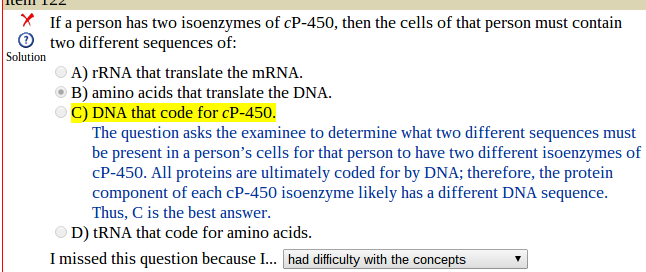
Amino Acid sequence determines primary structure no?
The answer choice you selected is worded such that it is nonsensical; DNA is not translated, but transcribed (and in any case not by amino acids).Sorry for a double post, but I'm also hoping whether someone can explain why the answer can't be amino acid sequence for this one:
Amino Acid sequence determines primary structure no?
View attachment 182280

Had there been an asterisk next to NPY alone, then the answer to item 8 would have been C right?
dudewheresmymd, it stated in the passage that NPY is a neuromodulator, which modulates the effects of a hormone, not causes direct secretion of something, like in this case it is LH. The point is that NPY alone is just a neuromodulator, and without a hormone to neuromodulate, there is no difference in LH.
dudewheresmymd, it stated in the passage that NPY is a neuromodulator, which modulates the effects of a hormone, not causes direct secretion of something, like in this case it is LH. The point is that NPY alone is just a neuromodulator, and without a hormone to neuromodulate, there is no difference in LH.
But in AAMCs explanation they look to Table 1 to answer the question...I originally picked C, but in retrospect that only would have been the right answer if 0.28 had an asterisk next to it right to make it significantly lower than 0.31 with saline? Can someone confirm?
Also passage states that LH causes secretion of sex hormones so if LH were to signfiicantly decrease, then estrogen would too right?
I still think the point of the passage was to drive through that NPY was a neuromodulator, and that it neuromodulated GnRH to manipulate/amplify LH release.
And yes to your second question, except when it comes to the corpus luteum's secretion of both progesterone and estrogen.
And yes to your second question, except when it comes to the corpus luteum's secretion of both progesterone and estrogen.
For BS, quesiton 105, can someone please explain why doubling the S chromosome products makes the imbalance worse (rather than better)?
Thanks!
Thanks!
Advertisement - Members don't see this ad

1. can someone explain why C isn't correct????
the answer to #5 states that it is a catalyst
20. when i rearranged i got
F= E * (L/DELTA L) * A
Is the .01 in their answer the delta L? wouldn't you use the reciprocal of this when you calculate. how do you even do this without L?
the answer to #5 states that it is a catalyst
20. when i rearranged i got
F= E * (L/DELTA L) * A
Is the .01 in their answer the delta L? wouldn't you use the reciprocal of this when you calculate. how do you even do this without L?
Attachments


Last edited:
lol i calculated 50 and when i saw that wasn't an answer, i tried 2cm as the radius. still couldn't get any answer. lost my headFor #25, I think one way to look at it is to, as you say, notice that air resistance is proportional to v^2, so velocity contributes more to the force of air resistance than surface area does.
I have a question on #23:
The optical power P of a lens is expressed in diopters: P = 1/f, where f is the focal length in meters. Given that the lens-to-retina distance in the human eye averages 2.0 cm, which of the following is closest to the power of the lens of the human eye?
A. 0.05
B. 2
C. 10
D. 40
The correct answer is D (weird, because 1/(2.0 * 10^-2) is really 50, but 40 is the "closest"). How were you supposed to know that the lens-to-retina distance is the focal length as opposed to the radius of curvature? If you were to assume 2.0 cm was the radius of curvature, focal length would be 1 cm, and P would be 100 which isn't an answer, so I didn't have to worry about it for this question, but I am still curious as to what would have led one to determine that "lens-to-retina distance" = f. Thanks!
HOW THE HELL IS 40 CLOSEST TO 50. I KNOW THE MCAT IS ALL ABOUT ROUNDING BUT THAT IS A HUGE REACH
dosage compensation is preferred in nature. that is what i learned in a upper div class called Molecular basis of human disease. you want the same number of genes in a male and female. that is why in humans, part of 1 of the X chromosomes (assume whole x chromosome for the MCAT) in female gets inactivated. males only have 1 X chromosome so females should have 1 to maintain dosage compensationFor BS, quesiton 105, can someone please explain why doubling the S chromosome products makes the imbalance worse (rather than better)?
Thanks!
http://en.wikipedia.org/wiki/Dosage_compensation
i hate how the MCAT says you only need lower division bio to do well... i guess it's because you need inference skills more than knowledge but still i feel like some of their questions/answer choices are really overreaching for "lower division bio"
but then again my AP credit got me out of lower division bio so i never experienced it. it was a waste of time is what students who took it told me
i couldn't find this in the TBR chapter so i wiki'ed it. are you sure it only works for mirrors? if so, thanks for the tip. will write this in my notesf = r/2 is only valid for mirrors, just by the way.
but the wiki does say
http://en.wikipedia.org/wiki/Radius_of_curvature_(optics)
"A spherical lens or mirror surface has a center of curvature located in (x, y, z) either along or decentered from the system local optical axis."
Spherical lenses still have a radius of curvature (r), but the focal point is only r/2 for mirrors.i couldn't find this in the TBR chapter so i wiki'ed it. are you sure it only works for mirrors? if so, thanks for the tip. will write this in my notes
but the wiki does say
http://en.wikipedia.org/wiki/Radius_of_curvature_(optics)
"A spherical lens or mirror surface has a center of curvature located in (x, y, z) either along or decentered from the system local optical axis."
Sent from my neural implant using SDN Mobile
both converging and diverging mirrors? i would think plane mirrors don't have a RoC would they?Spherical lenses still have a radius of curvature (r), but the focal point is only r/2 for mirrors.
Sent from my neural implant using SDN Mobile
also do you think that 40 is a reasonable answer? i easily calculated 50 in a few seconds and was dumbfounded when it wasn't a choice and wasted so much time trying other manipulations (ended up guessing). i have always seen estimates of calculations to be plus or minus a few numbers but never by this much unless the numbers are very big
TRICKY BASTARDSOhhhhhh. That makes so much sense. Okay, thank you so much!! Silly mistakes like this are so costly, argh.
was this ever figured out? i am at an utter lossQuestion stem says no stop codon is eliminated.

For BS, quesiton 105, can someone please explain why doubling the S chromosome products makes the imbalance worse (rather than better)?
Thanks!
The term is dosage compensation and humans use the same mechanism for controlling gene expression for sex-linked genes. In this problem, RS means you're female while RR means you're male. You are not concerned about the gene expression for S because, for example in human males (XY), the Y chromosome is mostly a sex determinant.
So the real question is: how do I make sure the total gene expression of genes on R is the same for both males and females. Any of these ways are possible and are actually observed in different species.
1) Reducing the transcription of each R chromosome for males to half.
2) Doubling the transcription of the R chromosome for females.
3) Inactivating one of the R chromosomes for males.
Human females undergo dosage compensation through X-inactivation.
was this ever figured out? i am at an utter loss
I didn't really read everybody's take on this question, but here's just reasoning.

Of all the choices, (A) is the only one that can be correct. (B) is not correct because peptides are synthesized from the N-terminus to the C-terminus. It would not make sense to have the carboxy-terminal stay the same, but have an altered amino-terminal sequence. (C) is not correct because an addition of one nucleotide will not generate an additional amino acid in this case. The question states that the change does not create or eliminate a stop codon. I'm guessing the test writers meant that there will not be a new stop codon in a new location, though the actual codon may have changed sequence. (D) is not correct with the same logic as (C).
For (A) to be correct, the insertion would need to:
Shift the sequence such that a new codon appears in the exact location as the old stop codon. (i.e. the stop codons need to be interwoven in each other from the initial transcript - the first two nucleotides of the old stop codon need to be the last two nucleotides of the new stop codon and the last codon translated needed to end with a U)
This cannot be happen. The condition simply cannot be met, so I have no idea why (A) can even be a plausible answer, but it is certainly a "better choice" over (B), (C), and (D).
Says lipid-soluble toxins must be oxidized before excretion. Otherwise, the toxin couldn't pass through:
A. Bowman Capsule
B. cell membranes
I know why it is A, but why should B be wrong? If it's lipid soluble, wouldn't it be able to dissolve in the phospholipid bilayer according to the fluid mosaic model of membranes? I would think that the unoxidized version would be stuck in the membranes of the filtration membrane, which contains the visceral Bowman's capsule.
Or is my error in assuming the toxin' solubility in the phospholipid bilayer???
A. Bowman Capsule
B. cell membranes
I know why it is A, but why should B be wrong? If it's lipid soluble, wouldn't it be able to dissolve in the phospholipid bilayer according to the fluid mosaic model of membranes? I would think that the unoxidized version would be stuck in the membranes of the filtration membrane, which contains the visceral Bowman's capsule.
Or is my error in assuming the toxin' solubility in the phospholipid bilayer???
The Ebola passage.
According to the passage, CatB and CatL are proteases; but earlier in the passage, it was mentioned that these "acid-dependent proteases trigger conformational changes in EGP."
This last statement is exactly what prevented me from choosing D (digestion into smaller protein fragments) because in my mind, the proteases caused conformational changes in EGP to allow viral coat proteins to bind to EGP and promote fusion.
According to the passage, CatB and CatL are proteases; but earlier in the passage, it was mentioned that these "acid-dependent proteases trigger conformational changes in EGP."
This last statement is exactly what prevented me from choosing D (digestion into smaller protein fragments) because in my mind, the proteases caused conformational changes in EGP to allow viral coat proteins to bind to EGP and promote fusion.
BS #100
Asks for the graph for treatment with NPY alone. According to the table, the level of LH actually decreases by a tiny amount, but the answer indicates that it doesn't change at all.
Can someone reconcile this please????
BS #135
The Ebola passage.
According to the passage, CatB and CatL are proteases; but earlier in the passage, it was mentioned that these "acid-dependent proteases trigger conformational changes in EGP."
This last statement is exactly what prevented me from choosing D (digestion into smaller protein fragments) because in my mind, the proteases caused conformational changes in EGP to allow viral coat proteins to bind to EGP and promote fusion.
BS #125
Says lipid-soluble toxins must be oxidized before excretion. Otherwise, the toxin couldn't pass through:
A. Bowman Capsule
B. cell membranes
I know why it is A, but why should B be wrong? If it's lipid soluble, wouldn't it be able to dissolve in the phospholipid bilayer according to the fluid mosaic model of membranes? I would think that the unoxidized version would be stuck in the membranes of the filtration membrane, which contains the visceral Bowman's capsule.
Or is my error in assuming the toxin' solubility in the phospholipid bilayer???
Asks for the graph for treatment with NPY alone. According to the table, the level of LH actually decreases by a tiny amount, but the answer indicates that it doesn't change at all.
Can someone reconcile this please????
BS #135
The Ebola passage.
According to the passage, CatB and CatL are proteases; but earlier in the passage, it was mentioned that these "acid-dependent proteases trigger conformational changes in EGP."
This last statement is exactly what prevented me from choosing D (digestion into smaller protein fragments) because in my mind, the proteases caused conformational changes in EGP to allow viral coat proteins to bind to EGP and promote fusion.
BS #125
Says lipid-soluble toxins must be oxidized before excretion. Otherwise, the toxin couldn't pass through:
A. Bowman Capsule
B. cell membranes
I know why it is A, but why should B be wrong? If it's lipid soluble, wouldn't it be able to dissolve in the phospholipid bilayer according to the fluid mosaic model of membranes? I would think that the unoxidized version would be stuck in the membranes of the filtration membrane, which contains the visceral Bowman's capsule.
Or is my error in assuming the toxin' solubility in the phospholipid bilayer???
BS #100
Asks for the graph for treatment with NPY alone. According to the table, the level of LH actually decreases by a tiny amount, but the answer indicates that it doesn't change at all.
Can someone reconcile this please????
BS #135
The Ebola passage.
According to the passage, CatB and CatL are proteases; but earlier in the passage, it was mentioned that these "acid-dependent proteases trigger conformational changes in EGP."
This last statement is exactly what prevented me from choosing D (digestion into smaller protein fragments) because in my mind, the proteases caused conformational changes in EGP to allow viral coat proteins to bind to EGP and promote fusion.
BS #125
Says lipid-soluble toxins must be oxidized before excretion. Otherwise, the toxin couldn't pass through:
A. Bowman Capsule
B. cell membranes
I know why it is A, but why should B be wrong? If it's lipid soluble, wouldn't it be able to dissolve in the phospholipid bilayer according to the fluid mosaic model of membranes? I would think that the unoxidized version would be stuck in the membranes of the filtration membrane, which contains the visceral Bowman's capsule.
Or is my error in assuming the toxin' solubility in the phospholipid bilayer???
Anyone???
@erythrocyte666 for #100 - at the bottom of the table it shows an * indicating whether or not the result is actually significantly different. Because with NPY alone, while the raw data does show it is slightly lower, statistical analysis indicates there is no significant difference, which is why the answer choice says it doesn't change at all.

Wait, so why do you think these two statements are contrary? I was thrown off by the wording initially. Were you as well? But CatB & CatL are proteases and they do induce a conformational change based on the experiment results. "Digestion into smaller protein fragments" can mean breaking peptide bonds to induce a conformational change, what proteases do. Thus D is the best answer "based on the passage" as the question states.BS #135
The Ebola passage.
According to the passage, CatB and CatL are proteases; but earlier in the passage, it was mentioned that these "acid-dependent proteases trigger conformational changes in EGP."
This last statement is exactly what prevented me from choosing D (digestion into smaller protein fragments) because in my mind, the proteases caused conformational changes in EGP to allow viral coat proteins to bind to EGP and promote fusion.
Although proteolytic-induced dimerization is technically possible but that's not "based on the passage."
For a compound to be excreted, does it need to pass through a cell membrane or Bowman's capsule? That's all it's asking.BS #125
Says lipid-soluble toxins must be oxidized before excretion. Otherwise, the toxin couldn't pass through:
A. Bowman Capsule
B. cell membranes
I know why it is A, but why should B be wrong? If it's lipid soluble, wouldn't it be able to dissolve in the phospholipid bilayer according to the fluid mosaic model of membranes? I would think that the unoxidized version would be stuck in the membranes of the filtration membrane, which contains the visceral Bowman's capsule.
Or is my error in assuming the toxin' solubility in the phospholipid bilayer???
Last edited:
Advertisement - Members don't see this ad

@Cawolf so is it necessary when you're comparing NiF concentrations to see if they fluctuate? And if they lower, that means that NiSO4 has precipitated?
This question does not really require any specifics.
The NiF2 contributes the reactants for the precipitation reaction - which is equilibrium dependent on the concentration of the reactants. To determine which compound will precipitate first, we need to know how much of what reactants we start with.


