Organic Chemistry Question Thread

This forum made possible through the generous support of SDN members, donors, and sponsors. Thank you.

QofQuimica

Seriously, dude, I think you're overreacting....
Moderator Emeritus
Lifetime Donor
15+ Year Member
Joined
Oct 12, 2004
Messages
18,899
Reaction score
4,295
Points
6,651
Location
Florida/Fellowship
  1. Fellow [Any Field]
  2. Attending Physician
All users may post questions about MCAT, DAT, OAT, or PCAT organic chemistry here. We will answer the questions as soon as we reasonably can. If you would like to know what organic topics appear on the MCAT, you should check the MCAT Student Manual (http://www.aamc.org/students/mcat/studentmanual/start.htm)

Acceptable topics:
-general, MCAT-level organic
-particular MCAT-level organic problems, whether your own or from study material
-what you need to know about organic for the MCAT
-how best to approach to MCAT organic passages
-how best to study MCAT organic
-how best to tackle the MCAT biological sciences section

Unacceptable topics:
-actual MCAT questions or passages, or close paraphrasings thereof
-anything you know to be beyond the scope of the MCAT

********

If you really know your organic, I can use your help. If you are willing to help answer questions on this thread, please let me know. Here are the current members of the Organic Chemistry Team:

-QofQuimica (thread moderator): I have my M.S. in organic chemistry and I'm currently finishing my Ph.D., also in organic chemistry. I have several years of university organic chemistry TA teaching experience. In addition, I teach organic chemistry classes through Kaplan for their MCAT, DAT, OAT, and PCAT courses. On the MCAT, I scored 15 on BS, 43 overall.

P.S. If you shorten "organic chemistry" to "orgo," not only will I not answer your questions, but during the BS section, your test form will backside attack you with a zillion strong nucleophiles (via the SN2 mechanism, of course).

-Learfan: Learfan has his Ph.D. in organic chemistry and several years worth of industrial chemistry experience. He scored 13 on the BS section of the MCAT, and 36 overall.
 
When learning the ortho/para & meta directors, do you recommend just memorizing it? or is there a strategy to it?
 
When learning the ortho/para & meta directors, do you recommend just memorizing it? or is there a strategy to it?

You can use resonance structures as a strategy. But writing them all out can often be time consuming. I would say just memorize the strong/weak activators/deactivators, maybe using the resonance structures of the intermediates to help, so it's not mindless memorizing at least. If you're that kind of person, really take the time to learn. It might help your overall ability.
 
The following is from AAMC practice exam - Biological science passage explanation. I'm having hard time to get this into my head.

----------------------------------------------
20. If a leak develops in the vacuum distillation apparatus, the boiling points of the two components of caraway seed oil will:

A) both increase.

The boiling point of a liquid is the temperature at which the vapor pressure of the liquid equals the surface pressure. The normal boiling point is measured at 1 atm pressure. The vapor pressure of a liquid increases with increasing temperature. Hence, the boiling point of a liquid decreases as the pressure on the surface of the liquid is decreased. If a leak develops in the apparatus, the surface pressure will increase, as will the boiling points of both liquids. Thus, answer choice A is the best answer.


----------------------------------------------
I'm not quite understood of its reasoning. Especially,
"...the boiling point of a liquid decreases as the pressure on the surface of the liquid is decreased. If a leak develops in the apparatus, the surface pressure will increase, as will the boiling points of both liquids."

What is vapor pressure, surface pressure of liquid/gas and how do they change?. All I know is that boiling occurs when the surface pressure of liquid is equal to the vapor pressure.

Also,

Why is it that if a leak develops during the distilation, the surface pressure increases? Wouldn't the pressure within the apparatus higher than the outside pressure? therefore wouldn't it decrease if there is a leak? (higher P flow into lower P)

What does the surface tension of liquid do during the boiling process? I believe from liquid -> gas, you break the bond. Endothermic. So, surface tension needs to be broken to enter gaseous phase. Is it true?

I'm confused.. help,,

thanks,
-minsoo.
 
I can understand your confusion. That explanation is unnecessarily complicated, in my opinion. The only concept you really need to know to answer this question is the definition of boiling point. To wit: the boiling point is the temperature at which the vapor pressure of the liquid is equal to the ambient pressure. That is, if you are heating a liquid at standard atmospheric pressure (1 ATM), it will start to boil when it's vapor pressure approaches 1 ATM.

If you apply a vacuum to the liquid in a given system, it will boil more readily. Why? Think about it: you are decreasing the ambient pressure (less than 1 ATM) of the system. You won't need to heat the liquid as much to get it to boil. The boiling point will decrease relative to baseline.

Therefore, if the vacuum seal is disturbed, the ambient pressure of the system will increase (vacuum is decreased inside the apparatus). A higher ambient pressure inside the apparatus, means that the boiling point will increase because now the vapor pressure of the liquid must increase to meet the increased ambient pressure inside the apparatus.
 
I can understand your confusion. That explanation is unnecessarily complicated, in my opinion. The only concept you really need to know to answer this question is the definition of boiling point. To wit: the boiling point is the temperature at which the vapor pressure of the liquid is equal to the ambient pressure. That is, if you are heating a liquid at standard atmospheric pressure (1 ATM), it will start to boil when it's vapor pressure approaches 1 ATM.

If you apply a vacuum to the liquid in a given system, it will boil more readily. Why? Think about it: you are decreasing the ambient pressure (less than 1 ATM) of the system. You won't need to heat the liquid as much to get it to boil. The boiling point will decrease relative to baseline.

Therefore, if the vacuum seal is disturbed, the ambient pressure of the system will increase (vacuum is decreased inside the apparatus). A higher ambient pressure inside the apparatus, means that the boiling point will increase because now the vapor pressure of the liquid must increase to meet the increased ambient pressure inside the apparatus.
Great explanation. I'd just like to kinda rephrase it in a sorta layman's terms and also help create a mental image which has helped me understand BP and vapor pressure better.

Essentially, in a normal system like over a pot of water, there's air above the water pushing down on it (ambient pressure). Now, when you apply heat the water it causes the molecules to begin moving around a lot (especially when you consider temperature a measure of kinetic energy...and KE being the "energy of motion") so a lot of water molecules are now bumping into the surface of the water. This is your vapor pressure. Now, if you add more heat and more energy, the molecules will push against the surface increasing that pressure until at one point the pressure on top of the water equals the pressure of the air pushing down. The pressure moving up = the pressure pushing down. This is the boiling point. This is when water begins to bubble and water molecules literally burst out of the liquid phase and into the gaseous phase. So let's say you take away the pressure pushing down on your water, now you need less pressure pushing up against the water's surface therefore meaning you need less energy for your water molecules therefore effectively lowering the BP of your water.

I hope this helps...honestly, draw out what's happening and it makes things clearer.
 
Thank you Thank you Thank you!
Now I understand about the bp / vapor/ambient pressure. After I read your reasonings, now I can visualize what's going on.


I got one more question for you =)
This concept kinda stresses me out cause I get confused all the time. It's about mp/bp/solubility question.

I believe,
......branching lowers mp/bp due to less surface area
......chain length raises mp/bp due to more surface area

How about the bonding or presence of different functional group like OH ? What other trends should I memorize for the mp/bp/solubility ?
e.g. molecule with H-bonding,,, will increase bp cause H-bonding is strong to break so more heat required,, is it?
......what about mp ? i can't make a logical reasoning for mp with H-bong.. aaa, i forgot again !

thanks!

-minsoo.
 
Thank you Thank you Thank you!
Now I understand about the bp / vapor/ambient pressure. After I read your reasonings, now I can visualize what's going on.


I got one more question for you =)
This concept kinda stresses me out cause I get confused all the time. It's about mp/bp/solubility question.

I believe,
......branching lowers mp/bp due to less surface area
......chain length raises mp/bp due to more surface area

How about the bonding or presence of different functional group like OH ? What other trends should I memorize for the mp/bp/solubility ?
e.g. molecule with H-bonding,,, will increase bp cause H-bonding is strong to break so more heat required,, is it?
......what about mp ? i can't make a logical reasoning for mp with H-bong.. aaa, i forgot again !

thanks!

-minsoo.

H-bonding raises boiling point. Boiling point is a reflection of the strength of intermolecular forces. H-bonding is the strongest type of intermolecular force, which is why H-bonding raises boiling point (because you need to add lots of energy to break H-bonds). Any functional group that can hydrogen bond will increase the boiling point. Some functional groups can only accept hydrogen bonds (e.g. -OR), so they increase boiling point, but not as much as functional groups that can both donate and accept H-bonds (e.g. -OH).
 
I can understand your confusion. That explanation is unnecessarily complicated, in my opinion. The only concept you really need to know to answer this question is the definition of boiling point. To wit: the boiling point is the temperature at which the vapor pressure of the liquid is equal to the ambient pressure. That is, if you are heating a liquid at standard atmospheric pressure (1 ATM), it will start to boil when it's vapor pressure approaches 1 ATM.

If you apply a vacuum to the liquid in a given system, it will boil more readily. Why? Think about it: you are decreasing the ambient pressure (less than 1 ATM) of the system. You won't need to heat the liquid as much to get it to boil. The boiling point will decrease relative to baseline.

Therefore, if the vacuum seal is disturbed, the ambient pressure of the system will increase (vacuum is decreased inside the apparatus). A higher ambient pressure inside the apparatus, means that the boiling point will increase because now the vapor pressure of the liquid must increase to meet the increased ambient pressure inside the apparatus.

Here is some more info on boiling point and vapor pressure

In a closed, evacuated container partially filled with liquid some of the molecules escape from the surface of the liquid to form a gas. Eventually the rate at which the liquid evaporates to form a gas becomes equal to the rate at which the gas condenses to form the liquid. At this point, the system is in equilibrium and the space above the liquid is saturated with liquid vapor. The pressure exerted by liquid vapor at equilibrium is called that liquid's (saturated) vapor pressure. In other words, the vapor pressure of a liquid is literally the pressure of the gas (or vapor) that collects above the liquid in a closed container at a given temperature.


An evacuated container is not necessary. If the liquid evaporates into air, the vapor is mixed with air and the pressure that it exerts cannot be measured directly. However, the vapor does still exert pressure and it is still called the vapor pressure of the liquid.

The vapor pressure of a liquid depends on its temperature. The fraction of the molecules that have enough energy to escape from a liquid increases with the temperature of the liquid. As a result, the vapor pressure of a liquid also increases with temperature. When the temperature is such that the vapor pressure is equal to the external pressure acting on the surface of the liquid, the liquid boils. That temperature is called the boiling point of a liquid. In other words, the boiling point is the temperature at which the vapor pressure equals external pressure, so that the external pressure can no longer hold the liquid in a liquid state and vapor-filled bubbles begin to form.
The normal boiling point of a liquid is the temperature at which its vapor pressure is equal to one atmosphere (760 torr). This means liquids can boil at almost any temperature if the opposing pressure is adjusted. The higher the pressure exerted on the liquid the higher the boiling point for the liquid (since more energy is required for vapor pressure to equal external pressure). Pressure cookers elevate the pressure and raise the boiling point for a liquid. The boiling point can be reduced by lowering the opposing pressure. This happens naturally at high elevations.

A liquid doesn't have to be heated to its boiling point before it can become a gas. Evaporation is a process where a liquid converts to the gas through the gradual escape of molecules from the liquid to the gas at temperatures below the boiling point. The escaping molecules exert a partial pressure that is less than the opposing external pressure. The molecules of the liquid will gradually escape into the atmosphere if the container is open. Water, for example, evaporates from an open container at room temperature (20oC), even though the boiling point of water is 100oC. The temperature of a system depends on the average kinetic energy of its particles. The term average is in this statement because there is an enormous range of kinetic energies for these particles. Even at temperatures well below the boiling point of a liquid, some of the particles are moving fast enough to escape from the liquid. When this happens, the average kinetic energy of the liquid decreases. As a result, the liquid becomes cooler than its surroundings. It therefore absorbs energy from its surroundings until it returns to thermal equilibrium (remember that heat flows from hot to cold). But as soon as this happens, some of the water molecules once again have enough energy to escape from the liquid. In an open container, this process continues until all of the water evaporates.

So why do liquids with a low boiling point have a high vapor pressure?

Vapor pressure is caused by the molecules of liquid breaking intermolecular bonds to form a gas. Whether a molecule is able to escape depends on the mass of the molecule, the kinetic energy of the molecule, and the forces between molecules. Since low boiling point indicates weak intermolecular forces, it's easier to overcome intermolecular forces.
As a result, more molecules have the needed kinetic energy to escape as gas at any given temperature. This creates high vapor pressure.

Here is another way to look at it: if the vapor pressure is low, the liquid must be heated to a higher temperature for its vapor pressure to equal the external pressure. The boiling point (i.e. the temperature at which vapor pressure is equal to atmospheric pressure) will therefore be high.
 
I can understand your confusion. That explanation is unnecessarily complicated, in my opinion. The only concept you really need to know to answer this question is the definition of boiling point. To wit: the boiling point is the temperature at which the vapor pressure of the liquid is equal to the ambient pressure. That is, if you are heating a liquid at standard atmospheric pressure (1 ATM), it will start to boil when it's vapor pressure approaches 1 ATM.

If you apply a vacuum to the liquid in a given system, it will boil more readily. Why? Think about it: you are decreasing the ambient pressure (less than 1 ATM) of the system. You won't need to heat the liquid as much to get it to boil. The boiling point will decrease relative to baseline.

Therefore, if the vacuum seal is disturbed, the ambient pressure of the system will increase (vacuum is decreased inside the apparatus). A higher ambient pressure inside the apparatus, means that the boiling point will increase because now the vapor pressure of the liquid must increase to meet the increased ambient pressure inside the apparatus.

More comments on boiling point and colligative properties

Colligative properties depend only on the number of solute particles (molecules or ions) in solution and NOT on their identity.
Non-colligative properties depend on the identity of the dissolved species. Osmotic pressure, vapor pressure, freezing point
depression, and boiling point elevation are examples of colligative properties.

Boiling-point elevation is a colligative property that states that a solution will have a higher boiling point than that of a pure solvent
(i.e. pure liquid) after the addition of a nonvolatile solute.

The change in boiling point can be determined by the equation

ΔTB.P.= i·Kb·m,

where m is the molality of the solute,
i is the Van 't Hoff factor (the number of dissolved particles the solute will create when dissolved),
and Kb is the constant unique to each solvent.

As you can see from the formula, the more solute dissolved, the greater the effect, since boiling point elevation is directly proportional
to the molality of the solute.

Boiling point elevation is a direct consequence of vapor pressure reduction. The boiling point of a liquid is defined as the temperature
at which the vapor pressure of that liquid equals the external (usually atmospheric) pressure Vapor pressure of a liquid is achieved
when the rates of evaporation and condensation are equal. When particles of solute are added, the rate of evaporation of solvent
is diminished simply because the number of solvent molecules close to the surface (i.e. those that are available to escape) is
reduced. Since vapor pressure is lowered, a higher temperature is required to raise vapor pressure to the level of atmospheric pressure
(i.e. to achieve boiling).
 
I'm a bit confused about this question. Can someone explain why the answer I chose was wrong and why the answer is right.

In a sample of cis-1,2-dichlorocyclohexane at room temperature, the chlorines would:

Answer I put - Both be equatorial whenever the molecule is in chair conformation

Real answer- Both alternate between equatorial and axial but will never exist both axial or both equatorial at the same time.

I figured that since it was cis, both would have the same conformation, and i thought that equatorial conformations made the molecule more stable. Correct me if I am wrong.
 
I'm a bit confused about this question. Can someone explain why the answer I chose was wrong and why the answer is right.

In a sample of cis-1,2-dichlorocyclohexane at room temperature, the chlorines would:

Answer I put - Both be equatorial whenever the molecule is in chair conformation

Real answer- Both alternate between equatorial and axial but will never exist both axial or both equatorial at the same time.

I figured that since it was cis, both would have the same conformation, and i thought that equatorial conformations made the molecule more stable. Correct me if I am wrong.

It's not possible to have cis-1,2-dichlorocyclohexane with both Cl substituents equatorial. Equatorial substituents on adjacent carbons of a
cyclohexane ring are trans to each other (i.e. one's above the ring and the other is below the ring). For the same reason, it's not possible to
have cis-1,2-dichlorocyclohexane with both Cl substituents in axial position. Since both substituents are Cl, both of them cause the SAME amount of steric hindrance, so it doesn't matter which of the 2 Cl atoms is in equatorail and which is in axial position. So the cyclohexane rapidly interconverts between 2 equally stable conformations.

 
i thought that equatorial conformations made the molecule more stable. Correct me if I am wrong.

Your line of thinking here is correct.... BULKY substituents on adjacent carbons love to be equatorial because it keeps them as far away from each other as possible, thus minimizing steric hindrance. Thats why two equatorial substituents are labeled "trans".

The question, however, describes a "cis" molecule and the answer you originally selected describes "trans".
 
Why does the pKa of benzoic acid decrease less when an electron withdrawing group is placed on the meta as opposed to the para?

that's a confusing question. i would think that the meta position, being closer would withdraw electrons more than the para, making the acidic proton more likely to be given away. But, if indeed, this is the case, that the pKa decreases more with the electron withdrawing group on the para position, maybe it has to do with the angle at which the electrons are being withdrawn....since the benzene ring is flat, the para position pulls the electrongs directly opposite, 180degrees away, verses the meta position?...I have no clue though....just taking a stab at it.
 
that's a confusing question. i would think that the meta position, being closer would withdraw electrons more than the para, making the acidic proton more likely to be given away. But, if indeed, this is the case, that the pKa decreases more with the electron withdrawing group on the para position, maybe it has to do with the angle at which the electrons are being withdrawn....since the benzene ring is flat, the para position pulls the electrongs directly opposite, 180degrees away, verses the meta position?...I have no clue though....just taking a stab at it.

well i think it has to do with the way the deactivating groups (nitro / esters) withdrawal electrons from benzene, but then my logic is wrong somewhere.

the group, lets just say its methyl ester, with draws electrons from its meta position through resonance. This would withdrawal electrons from the benzoic acid when the methyl ester is meta to the benzoic acid. Obviously, this is wrong.
 
I have a question.

How come CH3(C=O)CH3 + NH3 results in CH3(C=NH)CH3 + H2O ?

I thought NH3, a good nucleophile would add to the carbonyl C to become amide (CH3)2(C=O)NH2. I just don't understand how NH3 substitutes the carbonyl Oxygen.


Thank you!
 
I have a question.

How come CH3(C=O)CH3 + NH3 results in CH3(C=NH)CH3 + H2O ?

I thought NH3, a good nucleophile would add to the carbonyl C to become amide (CH3)2(C=O)NH2. I just don't understand how NH3 substitutes the carbonyl Oxygen.


Thank you!

The NH3 is a good nucleophile and does add to the carbonyl C at first which gives (CH3)2(C-O^-)NH3+. The H+ protonates the negatively charged oxygen giving a hemiaminal (CH3)2(C-OH)NH2. An H+ leaves the amine group and protonates the hydroxy group to form water a good leaving group. At the same time a double bond is formed between the N and the original carbonyl carbon to give (CH3)2(C=NH).

I hope that wasn't too obscure.
 
The NH3 is a good nucleophile and does add to the carbonyl C at first which gives (CH3)2(C-O^-)NH3+. The H+ protonates the negatively charged oxygen giving a hemiaminal (CH3)2(C-OH)NH2. An H+ leaves the amine group and protonates the hydroxy group to form water a good leaving group. At the same time a double bond is formed between the N and the original carbonyl carbon to give (CH3)2(C=NH).

I hope that wasn't too obscure.

Thanks for your explanation.
I see that the leaving group of H2O.

Then, how come ester + NH3 becomes an amide+alocohol

e.g. CH3(C=O)OCH2CH3 + NH3 -> CH3(C=O)NH2 + OHCH2CH3

Why not imine ? Why doesn't the oxygen at the carbonyl C leave in the form of H2O ?
 
Thanks for your explanation.
I see that the leaving group of H2O.

Then, how come ester + NH3 becomes an amide+alocohol

e.g. CH3(C=O)OCH2CH3 + NH3 -> CH3(C=O)NH2 + OHCH2CH3

Why not imine ? Why doesn't the oxygen at the carbonyl C leave in the form of H2O ?

I think this reaction happens because (-OR) in the ester (-OCH2CH3) is a better leaving group, then the (-CH3) in the first reaction with the ketone (CH3(C=O)CH3. In the ketone reaction you had to create a good leaving group (H2O), since there wasn't one already present. But in this reaction, its already there, so it can easily leave.

That's my reasoning anyway, I'm not certain if its entirely correct, so anybody else who knows, please chip in. Thx.
 
Thanks for your explanation.
I see that the leaving group of H2O.

Then, how come ester + NH3 becomes an amide+alocohol

e.g. CH3(C=O)OCH2CH3 + NH3 -> CH3(C=O)NH2 + OHCH2CH3

Why not imine ? Why doesn't the oxygen at the carbonyl C leave in the form of H2O ?

When ammonia attacks the carbonyl, rather than protonating the carbonyl oxygen, it protonates the other oxygen, creating a good alcohol leaving group. A double bond is then reformed between the former carbonyl oxygen and the carbonyl carbon.
 
I think this reaction happens because (-OR) in the ester (-OCH2CH3) is a better leaving group, then the (-CH3) in the first reaction with the ketone (CH3(C=O)CH3. In the ketone reaction you had to create a good leaving group (H2O), since there wasn't one already present. But in this reaction, its already there, so it can easily leave.

That's my reasoning anyway, I'm not certain if its entirely correct, so anybody else who knows, please chip in. Thx.

-OR, -OH isn't a very good leaving group, it has to be protonated, but it's definitely a better leaving group than -CH3.
 
-OR, -OH isn't a very good leaving group, it has to be protonated, but it's definitely a better leaving group than -CH3.

ok, I see...so does it have to be protonated to be a good leaving group? For example, (-Cl) is a good leaving group right? Can that not just leave on its own, or does it have to be protonated as well to be a good leaving group?
 
ok, I see...so does it have to be protonated to be a good leaving group? For example, (-Cl) is a good leaving group right? Can that not just leave on its own, or does it have to be protonated as well to be a good leaving group?

Cl and the other halogens, are inherently electronegative, so they're perfectly happy to be on their own carrying a negative charge, so that makes them good leaving groups; the exception is fluorine, which is SO electronegative, that you would have a hard time kicking it off a carbon chain. No hard and fast rule really covers every case for what makes a good leaving group, but basically anything that's got a good way to deal with a charge after its expulsion makes a good leaving group, i.e. halogens, tosylate esters (through resonance), etc. Hydroxide ion is a strong base, and that little hydrogen on the oxygen won't do much to balance the fully fledged charge that would result if it were kicked off an alkyl group... but now protonate the hydroxyl group, and you use the opposite strategy... put a charge (+) on a species that would rather have no charge (certainly not a positive charge!)... so now water becomes a great leaving group.
 
Cl and the other halogens, are inherently electronegative, so they're perfectly happy to be on their own carrying a negative charge, so that makes them good leaving groups; the exception is fluorine, which is SO electronegative, that you would have a hard time kicking it off a carbon chain. No hard and fast rule really covers every case for what makes a good leaving group, but basically anything that's got a good way to deal with a charge after its expulsion makes a good leaving group, i.e. halogens, tosylate esters (through resonance), etc. Hydroxide ion is a strong base, and that little hydrogen on the oxygen won't do much to balance the fully fledged charge that would result if it were kicked off an alkyl group... but now protonate the hydroxyl group, and you use the opposite strategy... put a charge (+) on a species that would rather have no charge (certainly not a positive charge!)... so now water becomes a great leaving group.


Thanks alot! That was a good explanation!
 
ok, I see...so does it have to be protonated to be a good leaving group? For example, (-Cl) is a good leaving group right? Can that not just leave on its own, or does it have to be protonated as well to be a good leaving group?

-Cl is a good leaving group due to electronegativity. It likes to have the electrons more than O or N and doesn't have to be protonated.

Think of it in terms of acid conjugates. Groups with low pKa are good leaving groups. Groups with high pKa are poor leaving groups. For example HCl = -10 vs CH3OH = 16.
 
-Cl is a good leaving group due to electronegativity. It likes to have the electrons more than O or N and doesn't have to be protonated.

Think of it in terms of acid conjugates. Groups with low pKa are good leaving groups. Groups with high pKa are poor leaving groups. For example HCl = -10 vs CH3OH = 16.


so weak bases like halogens are good leaving group. and having a weak base is necessary to have SN1 or SN2 right ?
 
so weak bases like halogens are good leaving group.

Yes. But not fluorine; you usually need a crown ether to get fluoride ions off.

and having a weak base is necessary to have SN1 or SN2 right ?

Please clarify your question. Are you referring to the nucleophile or the leaving group on the electrophile?

Perhaps if you identify which conditions you think apply for each case of reaction order, we can review them.
 
so weak bases like halogens are good leaving group. and having a weak base is necessary to have SN1 or SN2 right ?

Halogens are typically good leaving groups. Iodine is usually the best because of it's large size as compared to BR/CL. It's larger size allows it to stay in "contact" with the molecule it's leaving for longer - making it more stable as the nucleophile approaches.

SN1 and SN2 are very different reactions, so they require different conditions.

SN2 requires a strong nucleophile (likes partial "+" on carbon) and minimal steric hindrance. This makes sense b/c the rxn happens in one step by a backside attack. If the backside of the carbon is "hidden" by bulky substituents, the nucleophile can't weasel it's way in to cause the rxn. Since the strong nucleophile causes an instantaneous rxn, there is no time for rearrangements.

SN1 is the kindler gentler version. A more substituted carbon is the key here. The carbon has plenty of others carbons around to donate/share it's electron density with. If a halogen wants to leave and take his electrons - No problem! That Carbon has plenty of friendly other C's to help him share the burgen of being electron deficient (read: inductive effect & hyperconjugation). Since there's no rush to get electrons because the C has help from his friends a weak nucleophile will work in this reaction. This relative lack of urgency is also why rearrangements are commonin this reaction.
 
Thanks for your answer! It really helped me!

I have one more if you don't mind..


Step 2 : 2(CH=CH-COOH) bonded to phenyl in para position. (do i write it as (CH=CH-COOH)2Ph ? anyways..)

Step 3 : 2(CH=CH-COOCH3) bonded to phenyl in para position.


28. The overall result of Step 2 was an esterification. What role did SOCl2 play in the transformation of Compound 3 into Compound 4?

A) It served as a solvent for DMF.

B) It converted the diacid into a diacid chloride.
Direct reaction of a carboxylic acid with an alcohol is not an efficient way to make an ester. It is usually better to “activate” the acid, or convert it into a more reactive derivative, with a better leaving group for the acyl substitution. Acid chlorides are the most reactive of acid derivatives. In Step 2, SOCl2 is used to convert the diacid into a diacid chloride, which is not isolated but reacts directly to give the ester. Answer choice B is the correct answer.

C) It converted the diacid into a disulfide.

D) It served as a solvent for CH3OH.


is diacid chloride a form of extra Cl attached to diacid ? i just dont get this. How is possible that H is bonded to two groups. COOH-Cl ?
or is that mean Cl attaches to the terminal H of COOH to make it COO- + HCl ? ,,

help,

thank you!
 
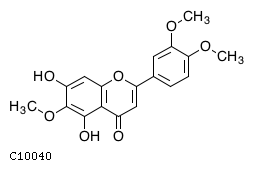
not sure if this is the right place to ask, but if someone could help me in synthesizing Resveratrol and/or Eupatilin I'd be extremely grateful

structures:

Resveratrol
resveratrol.jpg


Eupatilin
C10040.gif
 
not sure if this is the right place to ask, but if someone could help me in synthesizing Resveratrol and/or Eupatilin

What are your starting reagents? Usually the question gives a bit more info. You'll use acetylene for the middle of the first compound.
 
What are your starting reagents? Usually the question gives a bit more info. You'll use acetylene for the middle of the first compound.

Starting with a benzene ring I believe. The question doesn't specify though.
 
In acid catalyzed epoxide ring opening, is it ALWAYS the more highly substituted carbon that is attacked? Or is it that tertiary carbons are attacked if tertiary carbons are present but if there are only primary or secondary then, the primary will be attacked? Thanks.
 
i'm having trouble with this question: place the following molecules in order of increasing nucleophilicity: pyridine, triethylamine, acetonitrile, and DMAP. A study book says nucleophilicity (in increasing order) is acetonitrile, pyridine, DMAP, and triethylamine, but I don't understand why since I thought tertiary amines were too hindered to be good nucleophiles. I"m so confused. Thanks for any help!
 
In acid catalyzed epoxide ring opening, is it ALWAYS the more highly substituted carbon that is attacked? Or is it that tertiary carbons are attacked if tertiary carbons are present but if there are only primary or secondary then, the primary will be attacked? Thanks.

Under acidic conditions, the nucleophile attacks the most substituted carbon of epoxide ring because a more stable carbocation is formed.

http://www.smccd.net/accounts/lawrencey/Chem232_Sp07/232_Lecture/16_Handout.pdf
 
Why does the pKa of benzoic acid decrease less when an electron withdrawing group is placed on the meta as opposed to the para?

It deosn't necessarily. You're question intruiged me enough to pull out my text book. I'm looking at a table (Organic Chemistry, 6th Ed, CAREY, pg.834): "Acidity of Some Substituted Benzoic Acids," and only for for a nitro group is the pKa for a meta position .1 larger than the para position--this difference is relatively inconsequential, yet I'm still wondering myself. For all of the halogens the pKa is larger for para substituted benzoic acids.

The benzoic acids with the lowest pKas are the ones that are substituted in the ortho position and those of the meta and para positions are much higher*(edit) and comparable, but meta pKas are slightly lower.
 
you can think of it that way, but i think the mcat wants you to know that epoxides generally retain stereochemistry.

killinsound, wishuponastar's question was about about regiochemistry of nucleophilic epoxide ring-opening, not stereochemistry.
 
i'm having trouble with this question: place the following molecules in order of increasing nucleophilicity: pyridine, triethylamine, acetonitrile, and DMAP. A study book says nucleophilicity (in increasing order) is acetonitrile, pyridine, DMAP, and triethylamine, but I don't understand why since I thought tertiary amines were too hindered to be good nucleophiles. I"m so confused. Thanks for any help!

I'll take a stab at this question. If any of this is wrong, hopefully the O-Chem heavyweights will correct me.


All 4 of these molecules are nucleophiles because they each have a nitrogen atom with a lone pair of electons (the so-called
business end of the molecule). The more readily a molecule shares its lone pair of electrons, the better it is as a nucleophile.
Lets consider how readily each of these molecules shares its lone pair of electrons on Nitrogen.

Note: atomic radius and electronegativity is the same for all 4 molecules, so we need to consider other factors.

First, lets consider hybridization of N atom in each molecule. In trimethylamine, N is sp3 hybridized (25% s-character),
in DMAP and pyridine, N is sp2 hybridized (33% s-character), in acetonitrile N is sp hybridized (50% s-character). The
greater the s character, the more tightly are the electrons held, which means they are less available for sharing.

Based on hybridization alone, the order of increasing nucleophilicity is:

acetonitrile < pyridine, DMAP < triethylamine

Alkyl groups donate electron density by induction, further increasing nucleophilicity of triethylamine. Steric hindrance
of tertiary amines is usually outcompeted by inductive electron donation of alkyl groups.

We still need to decide the relative nucleophilicity of pyridine and DMAP. The lone pair of electrons on the nitrogen of pyridine
is not involved in the Pi system of the ring, so it's available for sharing. Ring nitrogen of DMAP is a better nucleophile than the
ring nitrogen of pyridine because THE OTHER nitrogen of DMAP is donating electron density via resonance.

So the order of INCREASING nucleophilicity is: acetonitrile < pyridine < DMAP < triethylamine
 
No problem! That Carbon has plenty of friendly other C's to help him share the burgen of being electron deficient (read: inductive effect & hyperconjugation). Since there's no rush to get electrons because the C has help from his friends a weak nucleophile will work in this reaction. This relative lack of urgency is also why rearrangements are commonin this reaction.

haha! you are a fantastic story teller! i really enjoyed it :laugh:
 
I had a basic question about bond conjugation.

First of all, conjugation is defined by book as alternating single and double bonds. Can a compound be conjugated if it has only one double bond between two single bonds? For some reason, I can't seem to accept that it is a conjugated species because whenever I think conjugated, I think the minimum is two double bonds.

Also, in terms of stability during an reaction, would something prefer a conjugated carbocation with the positive charge on a primary carbon or a nonconjugated carbocation with the positive charge on a secondary carbon?

For example:
CH2(+)-CH=CH-CH3 versus CH2=CH-CH(+)-CH3

Thanks in advance.
 
I had a basic question about bond conjugation.

First of all, conjugation is defined by book as alternating single and double bonds. Can a compound be conjugated if it has only one double bond between two single bonds? For some reason, I can't seem to accept that it is a conjugated species because whenever I think conjugated, I think the minimum is two double bonds.

Also, in terms of stability during an reaction, would something prefer a conjugated carbocation with the positive charge on a primary carbon or a nonconjugated carbocation with the positive charge on a secondary carbon?

For example:
CH2(+)-CH=CH-CH3 versus CH2=CH-CH(+)-CH3

Thanks in advance.


Don't quote me on this, but I'm pretty sure that you need at least 2 double bonds for it to be considered "conjugated".
 
Don't quote me on this, but I'm pretty sure that you need at least 2 double bonds for it to be considered "conjugated".

I'm quoting you on this b/c your right..... you need two double bonds seperated by a single bond for conjugation. This is why benzene ring is so stable.
 
...This is why benzene ring is so stable.

That's true... but isn't aromaticity sort of... its own thing?

For example, you can have a fully conjugated ring that enjoys some stability because of its conjugation... but if it isn't aromatic, it may still be more reactive than a benzene ring, which requires REALLY special conditions for reactivity.

Just want to bring this distinction up because I hear this a lot... "benzene is special because it's conjugated"... but I think that's only a part of the story. Yes benzene is conjugated... but its aromaticity is what makes it so exceptionally stable.

No?
 
That's true... but isn't aromaticity sort of... its own thing?

For example, you can have a fully conjugated ring that enjoys some stability because of its conjugation... but if it isn't aromatic, it may still be more reactive than a benzene ring, which requires REALLY special conditions for reactivity.

Just want to bring this distinction up because I hear this a lot... "benzene is special because it's conjugated"... but I think that's only a part of the story. Yes benzene is conjugated... but its aromaticity is what makes it so exceptionally stable.

No?

This is kind of straying from my original question. I'm sure the actual reason for why aromatic compounds are so much more stable will require a quantum mechanical explanation.

Does anyone know with certainty the answer to my original question (a few posts above)?

Thanks for all the replies thus far.
 
I had a basic question about bond conjugation.

First of all, conjugation is defined by book as alternating single and double bonds. Can a compound be conjugated if it has only one double bond between two single bonds? For some reason, I can't seem to accept that it is a conjugated species because whenever I think conjugated, I think the minimum is two double bonds.

Also, in terms of stability during an reaction, would something prefer a conjugated carbocation with the positive charge on a primary carbon or a nonconjugated carbocation with the positive charge on a secondary carbon?

For example:
CH2(+)-CH=CH-CH3 versus CH2=CH-CH(+)-CH3

Thanks in advance.

In terms of stability,
CH2(+)-CH=CH-CH3 < CH2=CH-CH(+)-CH3


Those two compounds are resonance structures of one compound. The + charge is delocalized over both carbons, but there is a greater portion of it on the secondary carbon (CH2=CH-CH(+)-CH3 contributes more to the overall structure of the carbocation).

Also, in terms of stability during an reaction, would something prefer a conjugated carbocation with the positive charge on a primary carbon or a nonconjugated carbocation with the positive charge on a secondary carbon?

This question does not match the above example you provided. But to answer it to the best of my interpretive ability,

CH2(+)-CH=CH-CH3 < CH3-CH2-CH(+)-CH3

Does this help? You're not getting clear answers because your question wasn't that clear. At least it isn't to me.
 
I had a basic question about bond conjugation.

First of all, conjugation is defined by book as alternating single and double bonds. Can a compound be conjugated if it has only one double bond between two single bonds? For some reason, I can't seem to accept that it is a conjugated species because whenever I think conjugated, I think the minimum is two double bonds.

Also, in terms of stability during an reaction, would something prefer a conjugated carbocation with the positive charge on a primary carbon or a nonconjugated carbocation with the positive charge on a secondary carbon?

For example:
CH2(+)-CH=CH-CH3 versus CH2=CH-CH(+)-CH3

Thanks in advance.

SIMPLY:
Conjugation is single bonds alternating along a carbon chain with double (or triple) bonds.

Conjugation infers a small amount of stability to a molecule by creating double bond character between the single bonds. This happens because the p-orbitals between the pi bonds can align and overlap across the single bonds even though there isn't an actual bond there. A few years ago some researchers discovered that conjugated systems can conduct electricity because of this ability...

You are correct, you can not have this effect without at least 2 double bonds.

--------------

Once one of those conjugated pi bonds attacks an electrophile you lose the conjugation, but you create a allylic carbocation which some people refer to as conjugated (helps some people understand, but ultimately incorrect)


--------------

Resonance stabilization is generally a more important factor than substituents in comparing stability.

ie. a secondary carbocation will be LESS stable than a primary allylic carbocation.
 
Top Bottom