
-
CycleTrack and SDN are teaming up to make medical school admissions more transparent and accessible! Read the announcement to learn how we’re supporting the future of CycleTrack’s free application-tracking tools .
You are using an out of date browser. It may not display this or other websites correctly.
You should upgrade or use an alternative browser.
You should upgrade or use an alternative browser.
Rad Onc Meme Thread
Started by evilbooyaa

Get help with your application
Use all the free resources available to you from SDN: articles, guides, expert advising, forums discussions, and school research.

Advertisement - Members don't see this ad

Read today's Quadshot
Quadshot:
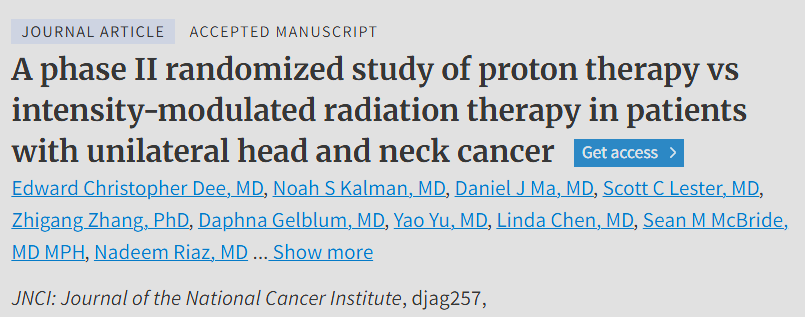
The primary outcome of clinician-graded acute grade 2+ mucositis was significantly lower with proton therapy (7.4% v 22.7%). Grade 2+ dysgeusia was also lower with proton therapy (9.3% v 31.8%). However, there were no significant differences in patient-reported adverse effects.
Manuscript:
Although randomized, the trial was not blinded.
Quadshot:
The primary outcome of clinician-graded acute grade 2+ mucositis was significantly lower with proton therapy (7.4% v 22.7%). Grade 2+ dysgeusia was also lower with proton therapy (9.3% v 31.8%). However, there were no significant differences in patient-reported adverse effects.
Manuscript:
Although randomized, the trial was not blinded.

Brilliant. Did Vince Gilligan rip off Chris Nolan a little? I always thought so.Read today's Quadshot
View attachment 424185
Quadshot:
The primary outcome of clinician-graded acute grade 2+ mucositis was significantly lower with proton therapy (7.4% v 22.7%). Grade 2+ dysgeusia was also lower with proton therapy (9.3% v 31.8%). However, there were no significant differences in patient-reported adverse effects.
Manuscript:
Although randomized, the trial was not blinded.
View attachment 424187
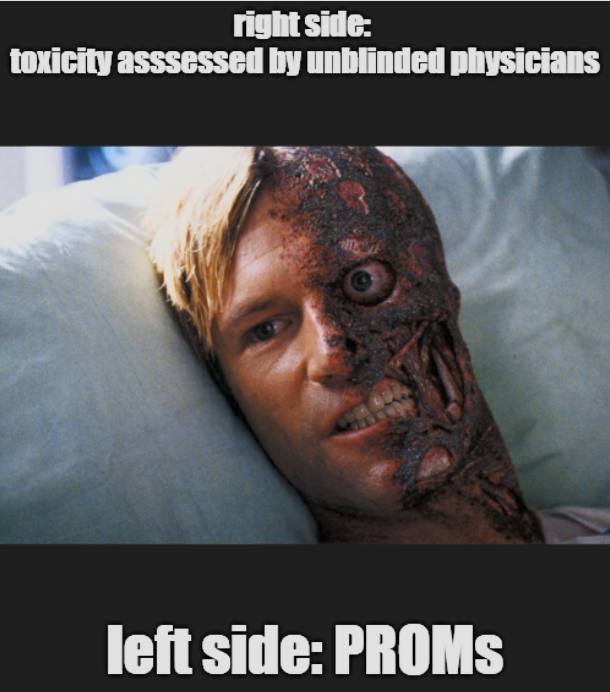
Patients, who have no financial incentive whatsoever: no statistically significant difference in PROs.
Unblinded physicians practicing in a system with every incentive to justify a very expensive, highly reimbursed technology: IT WORKS!
Unblinded physicians practicing in a system with every incentive to justify a very expensive, highly reimbursed technology: IT WORKS!
Patients, who have no financial incentive whatsoever: no statistically significant difference in PROs.
Unblinded physicians practicing in a system with every incentive to justify a very expensive, highly reimbursed technology: IT WORKS!
Sort of makes you question the clinical judgement and ethics of the authors on the study
Patients, who have no financial incentive whatsoever: no statistically significant difference in PROs.
Unblinded physicians practicing in a system with every incentive to justify a very expensive, highly reimbursed technology: IT WORKS!
On the other hand if it’s unblinded (so not placebo controlled drug trials) patients can also report Lower tox if they think it should be lower because they’re getting something they perceive to be ‘better’
EvergreenPatients, who have no financial incentive whatsoever: no statistically significant difference in PROs.
Unblinded physicians practicing in a system with every incentive to justify a very expensive, highly reimbursed technology: IT WORKS!
"It is difficult to get a man to understand something, when his salary depends on his not understanding it." -Upton Sinclair
H&N RT has come a long way when the field is attempting to reduce Grade 2 acute mucositis.Read today's Quadshot
View attachment 424185
Quadshot:
The primary outcome of clinician-graded acute grade 2+ mucositis was significantly lower with proton therapy (7.4% v 22.7%). Grade 2+ dysgeusia was also lower with proton therapy (9.3% v 31.8%). However, there were no significant differences in patient-reported adverse effects.
Manuscript:
Although randomized, the trial was not blinded.
An interesting tidbit (at least to me):
FUNDING: This study was funded by the Memorial Sloan Kettering Cancer Center Department of Radiation Oncology Research and Development funds.
A three site randomized IIT of 98 patients with 3 year follow up ain't cheap.
Evicore or CMS, take your pick.Who is Palpatine in the world of evidence based radonc?
Advertisement - Members don't see this ad
Really remarkable how much rad onc has lost over the last thirty years … 6 weeks of breast for everyone, 8-9 weeks of prostate for low to high risk, adjuvant lung, GI, two weeks of palliative RT, whole brain and now PCI. When does a grain of sand being added to itself over and over become a pile or a heap.
Good thing we are training more than ever!Really remarkable how much rad onc has lost over the last thirty years … 6 weeks of breast for everyone, 8-9 weeks of prostate for low to high risk, adjuvant lung, GI, two weeks of palliative RT, whole brain and now PCI. When does a grain of sand being added to itself over and over become a pile or a heap.
May I add:Really remarkable how much rad onc has lost over the last thirty years … 6 weeks of breast for everyone, 8-9 weeks of prostate for low to high risk, adjuvant lung, GI, two weeks of palliative RT, whole brain and now PCI. When does a grain of sand being added to itself over and over become a pile or a heap.
- rectal cancer (we are out in MSI-high and some patients only get 5 fractions)
- esophageal cancer (most are now ADC and ESOPEC made us irrelevant there) & gastric cancer
- pancreatic cancer (failed trials over and over again)
- hodgkin's lymphoma / DLBCL (deferred regularly in good responders on PET)
Most of the "gains" we are making are oligometastatic/-progressive disease, re-irradiation and countless courses of palliative RT for the stage IV patients that seem to live longer and longer due to the drugs they are getting.
I would count external beam APBI as a gain, as it reintroduced us into over-70 breast cancer s/p lumpectomy. I also wouldn't downplay SBRT for oligomets as much. It's been a pretty decent part of my practice, and it's pretty satisfying to play such an impactful role in Stage IV disease when used appropriately.
Arthritis also counts, as does the increased interest in benign conditions. Sure, it should always have been a part of the playbook, but I'm glad it's finally getting the respect it deserves.
I still treat a lot of rectal cancer, and I would argue the recent data pushes back against 5-fraction rectal enough that it's finally more or less dead in routine cases.
I also still treat a decent amount of pancreatic cancer, so I can't agree it's completely dead. Our role has always been somewhat nebulous and hard to define here. Hopefully systemic advances get to the point where local control again makes a difference.
Finally, I don't think the esophageal story is over. I can, before the end of my career, see us getting to a TNT rectal-style esophageal protocol. I have a hard time believing the data wouldn't support it.
Arthritis also counts, as does the increased interest in benign conditions. Sure, it should always have been a part of the playbook, but I'm glad it's finally getting the respect it deserves.
I still treat a lot of rectal cancer, and I would argue the recent data pushes back against 5-fraction rectal enough that it's finally more or less dead in routine cases.
I also still treat a decent amount of pancreatic cancer, so I can't agree it's completely dead. Our role has always been somewhat nebulous and hard to define here. Hopefully systemic advances get to the point where local control again makes a difference.
Finally, I don't think the esophageal story is over. I can, before the end of my career, see us getting to a TNT rectal-style esophageal protocol. I have a hard time believing the data wouldn't support it.
'Most of the "gains" we are making are oligometastatic/-progressive disease, re-irradiation and countless courses of palliative RT for the stage IV patients that seem to live longer and longer due to the drugs they are getting.'
this should not be understated. for those of us with busy practices - this is why.
this should not be understated. for those of us with busy practices - this is why.

'Most of the "gains" we are making are oligometastatic/-progressive disease, re-irradiation and countless courses of palliative RT for the stage IV patients that seem to live longer and longer due to the drugs they are getting.'
this should not be understated. for those of us with busy practices - this is why.
Half of my practice has become SRS brain met whack-a-mole.
its all about the gainz, bruh
For PCI, whole brain, 5-6 weeks breast, good riddance.
Derm anesthesia GI aren’t that innovative but are still good specialties to practice.
Other than imrt and sbrt what other advances have their been in rad onc?
We do need innovation in order to stop losing indications. Imagine if med onc still only had platinum and anthracyclines.
There’s nothing wrong with lack of innovation, but it is dumb to pump out residents like an oil spigot in that environment. Lack of innovation plus overtraining is worst of all worlds.
Derm anesthesia GI aren’t that innovative but are still good specialties to practice.
Other than imrt and sbrt what other advances have their been in rad onc?
We do need innovation in order to stop losing indications. Imagine if med onc still only had platinum and anthracyclines.
There’s nothing wrong with lack of innovation, but it is dumb to pump out residents like an oil spigot in that environment. Lack of innovation plus overtraining is worst of all worlds.
Other than imrt and sbrt what other advances have their been in rad onc?

FLASH!
🤣 🤣 🤣
We will probably lose early stage breast at some point to a biomarker.Really remarkable how much rad onc has lost over the last thirty years … 6 weeks of breast for everyone, 8-9 weeks of prostate for low to high risk, adjuvant lung, GI, two weeks of palliative RT, whole brain and now PCI. When does a grain of sand being added to itself over and over become a pile or a heap.
At 5 fx I find that to be unlikelyWe will probably lose early stage breast at some point to a biomarker.
Seems like a good poly market bet- what indication will xrt loose next?
Advertisement - Members don't see this ad
I'm simming a 64 yo in a couple hours for APBI. She said she wouldn't have done RT if I suggested more than that. I'm not afraid of losing Stage I ER+ breast tany time soon.

Problem is that is a significant part of most practices’ volume.I'm simming a 64 yo in a couple hours for APBI. She said she wouldn't have done RT if I suggested more than that. I'm not afraid of losing Stage I ER+ breast tany time soon.
We may have quantum computers in the next 10 years and possibly AGI, but predicting the 1/10 early stage breast that will benefit from radiation is beyond human capacity?
Maybe it will be an ultra sensitive ctdna or a biomarker/genetic signature. I am sure there are a lot of academic radoncs working hard to eliminate xrt. Corey spears (?) was claiming that he came up with a biomarker test that was commercialized a few years ago. Going to be a lot of shots on goal
Maybe it will be an ultra sensitive ctdna or a biomarker/genetic signature. I am sure there are a lot of academic radoncs working hard to eliminate xrt. Corey spears (?) was claiming that he came up with a biomarker test that was commercialized a few years ago. Going to be a lot of shots on goal
Last edited:
It is kinda wild how evidence-based decision making goes completely out of the window when it comes to endocrine therapy in early-stage breast cancer patients.Endocrine therapy is way worse than apbi and it’s still around and used in practically everybody.
Plenty of pts were getting adjuvant chemo in stage III lung before the Advent of IO. Data was pretty poor there tooIt is kinda wild how evidence-based decision making goes completely out of the window when it comes to endocrine therapy in early-stage breast cancer patients.
😉We may have quantum computers in the next 10 years and possibly AGI, but predicting the1/109 out of 10 early stage breast thatwilldo not benefit from radiation is beyond human capacity?

Does 5 fraction sbrt generate more rvus than 28 fractions?
Under the new coding I wouldn't be surprised unless using Calypso markersDoes 5 fraction sbrt generate more rvus than 28 fractions?
28 fractions of two isocenter whatever or breath hold whatever is a lot more reimbursement than 5 fraction SBRT. I think RVUs would dunk too. And keep in mind in a few months we will get about a 20% bump on the non-SBRT EBRT codes. An SBRT only practice couldn’t really ever be viable because the indications for SBRT are so lesser than those for EBRT in general. (Of course a non-SBRT EBRT practice is viable.) I saw data recently about a big uptick in SBRT for stage one NSCLC, but that is vigorously competing against the falling incidence of lung cancer in general.
Fair correction — I conflated RVUs with reimbursement. The Drake meme was based on our actual 2026 Bay Area Medicare numbers: 5-fx SBRT ≈ $20,074/course vs 28-fx single-isocenter 77407 IMRT ≈ $18,729/course, so SBRT is about $1,345 higher per completed course despite 23 fewer fractions. That’s total course reimbursement in our setting, not a claim that SBRT universally generates more RVUs. Two-isocenter, Calypso, different site of service/payer, etc. can obviously change the math. Meme needed a footnote. 😂28 fractions of two isocenter whatever or breath hold whatever is a lot more reimbursement than 5 fraction SBRT. I think RVUs would dunk too. And keep in mind in a few months we will get about a 20% bump on the non-SBRT EBRT codes. An SBRT only practice couldn’t really ever be viable because the indications for SBRT are so lesser than those for EBRT in general. (Of course a non-SBRT EBRT practice is viable.) I saw data recently about a big uptick in SBRT for stage one NSCLC, but that is vigorously competing against the falling incidence of lung cancer in general.
Advertisement - Members don't see this ad
Those are five significant digits for each of your scenarios so you clearly have a specific source! Although if you search on the Medicare PFS lookup site Bay Area SBRT is about $1300 per fraction and 77407 $400 per fraction. (This naturally implies that when the non-SBRT 77407 regimen becomes ~3x the fractions of SBRT it starts making more money than SBRT.) It would be very very very difficult to make a $20K SBRT Medicare course from those numbers.Fair correction — I conflated RVUs with reimbursement. The Drake meme was based on our actual 2026 Bay Area Medicare numbers: 5-fx SBRT ≈ $20,074/course vs 28-fx single-isocenter 77407 IMRT ≈ $18,729/course, so SBRT is about $1,345 higher per completed course despite 23 fewer fractions. That’s total course reimbursement in our setting, not a claim that SBRT universally generates more RVUs. Two-isocenter, Calypso, different site of service/payer, etc. can obviously change the math. Meme needed a footnote. 😂
Last edited:

FletchersGarb
Full Member
delivery codes such as 77412 do not generate any wRVU
I haven’t Excel’d it in a while but I would guesstimate the wRVU from 28 IGRTs and 6 OTVs will be more than from the SBRT management.delivery codes such as 77412 do not generate any wRVU
To sum up, I think all the payors regardless Medicare or private are still set up to relatively disincentivize ultrahypofractionation. Which is regrettable.
