
You are using an out of date browser. It may not display this or other websites correctly.
You should upgrade or use an alternative browser.
You should upgrade or use an alternative browser.
Sevoflurane or Desflurane for COPD?

Get help with your application
Use all the free resources available to you from SDN: articles, guides, expert advising, forums discussions, and school research.
D
deleted162650
Don't matter
Advertisement - Members don't see this ad

Clearly SEVOFLURANE... is it even a question...??? 

I had a CT attending chastise me last week for turning on des for a pt with copd. [emoji52]

Hopefully you mean the CT surgeon.I had a CT attending chastise me last week for turning on des for a pt with copd. [emoji52]

Iso, because it didn't matter, I'm cheap, and no one else has said it, yet.
Sent from my SM-G920V using SDN mobile
Sent from my SM-G920V using SDN mobile

Des is quite cheap at low flow. And less respiratory depression in PACU. But you're probably right in that it doesn't really matter in the long run.Iso, because it didn't matter, I'm cheap, and no one else has said it, yet.
Sent from my SM-G920V using SDN mobile
I know Des is cheap at low flows. I use it like that all of the time. I'm just being contrary.
Sent from my SM-G920V using SDN mobile
Sent from my SM-G920V using SDN mobile
Hopefully you mean the CT surgeon.
If only [emoji52]

Absolutely agree with this from a Clinical standpoint.
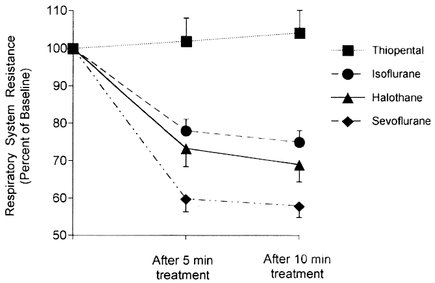
This study indicates that desflurane lacks the ability to cause an early decrease in Rrs after tracheal intubation and, in fact, causes significant increases in Rrs in patients with positive smoking status. Sevoflurane causes significant decreases in Rrs, regardless of smoking status or history, which is not observed with desflurane or sodium thiopental.
Respiratory system resistance (Rrs)
Anesth Analg. 2005 Feb;100(2):348-53.
The effect of volatile anesthetics on respiratory system resistance in patients with chronic obstructive pulmonary disease.
Volta CA1, Alvisi V, Petrini S, Zardi S, Marangoni E, Ragazzi R, Capuzzo M, Alvisi R.
Author information
We examined the effect of isoflurane and sevoflurane on respiratory system resistance (Rmin,rs) in patients with chronic obstructive pulmonary disease (COPD). The diagnosis of COPD rests on the presence of airway obstruction, which is only partially reversible after bronchodilator treatment. Ninety-six consecutive patients undergoing thoracic surgery for peripheral lung cancer were enrolled. They were divided into two groups: preoperative forced expiratory volume in 1 s/forced vital capacity ratio <70% or >70%. Rmin,rs was measured after 5 and 10 min of maintenance anesthesia by using the constant flow/rapid occlusion method. Maintenance of anesthesia was randomized to thiopental 0.30 mg . kg(-1) . min(-1) or 1.1 minimum alveolar anesthetic concentration end-tidal isoflurane or sevoflurane. Eleven patients were excluded: two because anesthesia was erroneously induced with propofol and nine because of an incorrect tube position. Maintenance with thiopental failed to decrease Rmin,rs, whereas both volatile anesthetics were able to decrease Rmin,rs in patients with COPD. The percentage of patients who did not respond to volatile anesthetics was larger in those with COPD as well. In conclusion, we have demonstrated that isoflurane and sevoflurane produce bronchodilation in patients with COPD.
The effect of volatile anesthetics on respiratory system resistance in patients with chronic obstructive pulmonary disease.
Volta CA1, Alvisi V, Petrini S, Zardi S, Marangoni E, Ragazzi R, Capuzzo M, Alvisi R.
Author information
- 1Department of Surgical, Anesthesiological and Radiological Science, Section of Anesthesia and Intensive Care, S. Anna Hospital, University of Ferrara, Corso Giovecca 203, 44100 Ferrara, Italy. [email protected]
We examined the effect of isoflurane and sevoflurane on respiratory system resistance (Rmin,rs) in patients with chronic obstructive pulmonary disease (COPD). The diagnosis of COPD rests on the presence of airway obstruction, which is only partially reversible after bronchodilator treatment. Ninety-six consecutive patients undergoing thoracic surgery for peripheral lung cancer were enrolled. They were divided into two groups: preoperative forced expiratory volume in 1 s/forced vital capacity ratio <70% or >70%. Rmin,rs was measured after 5 and 10 min of maintenance anesthesia by using the constant flow/rapid occlusion method. Maintenance of anesthesia was randomized to thiopental 0.30 mg . kg(-1) . min(-1) or 1.1 minimum alveolar anesthetic concentration end-tidal isoflurane or sevoflurane. Eleven patients were excluded: two because anesthesia was erroneously induced with propofol and nine because of an incorrect tube position. Maintenance with thiopental failed to decrease Rmin,rs, whereas both volatile anesthetics were able to decrease Rmin,rs in patients with COPD. The percentage of patients who did not respond to volatile anesthetics was larger in those with COPD as well. In conclusion, we have demonstrated that isoflurane and sevoflurane produce bronchodilation in patients with COPD.

Last edited:
Advertisement - Members don't see this ad
In healthy adults, neither sevoflurane nor isoflurane produced bronchodilation at 1 and 1.5 MAC. Desflurane did not affect respiratory resistance at 1 MAC, but at 1.5 MAC caused significant increase in both total and airway resistance with return to near baseline values after discontinuation of the agent
http://bja.oxfordjournals.org/content/107/3/454.full.pdf
http://bja.oxfordjournals.org/content/107/3/454.full.pdf

Desflurane is a terrible agent, it's an irritant and causes bronchospasm.

Which one would you use for a pt. with COPD?
Hands down, desflurane for me, with the caveat that I add ketamine with narcotic appropriate to the case. Very clean anesthetic with a very crisply awake patient afterwards.
Desflurane sucks for COPD and smokers. But I still use it anyways.
The biggest negative is the increased number of PACU calls for smoker/COPD patients on Des compared to Sevo.
The investigators should see how the des v sevo effect contributes to prolonged PACU stay, Duoneb usage, oxygen requirements.
The biggest negative is the increased number of PACU calls for smoker/COPD patients on Des compared to Sevo.
The investigators should see how the des v sevo effect contributes to prolonged PACU stay, Duoneb usage, oxygen requirements.

I don't see the benefit of Des for someone with Pulm issues.
Sevo was my preference in general. I used iso for long cases due to cost.
Sevo was my preference in general. I used iso for long cases due to cost.

As a side, does anyone here use desflurane for LMA cases? I don't as I'm concerned about desflurane irritating the airway, but I do know some that use it. Just seeing what are others thoughts.
Sent from my iPhone using SDN mobile app
Sent from my iPhone using SDN mobile app
As a side, does anyone here use desflurane for LMA cases? I don't as I'm concerned about desflurane irritating the airway, but I do know some that use it. Just seeing what are others thoughts.
Sent from my iPhone using SDN mobile app
Yes, it is irritating as F***, more likely to bronchospasm, and unlikely to reverse the bronchospasm with just more des, but fast wakeups are worth it imo.
Don't matter
The correct answer.
D
deleted162650
As a side, does anyone here use desflurane for LMA cases? I don't as I'm concerned about desflurane irritating the airway, but I do know some that use it. Just seeing what are others thoughts.
Sent from my iPhone using SDN mobile app
I've started to recently as my new shop has it at the ASC. I have yet to have an irritable airway issue using Des via LMA.

Mask induction=sevo.
Postop intubation=iso.
Everything else including LMAs= low flow des.
Postop intubation=iso.
Everything else including LMAs= low flow des.

You have them somewhat paralyzed on pressure support?My preference is low-flow desflurane for everyone. I get it off early, supplement with IV adjuncts as needed, breathing on pressure support, maintain some level of neuromuscular blockade, reverse right before drapes come down.
I like my patients fully paralyzed on pressure support. I don't like to half-ass things.
D
deleted162650
I like my patients fully paralyzed on pressure support. I don't like to half-ass things.
Twitches are for Bitches 😎
I use des almost exclusively. Don't believe all the hype about airway irritability. If you use it correctly it won't irritate the airway. I use it on COPD'ers, Asthmatics, kids, and with LMA's.
One thing to note however, you can't drive it into the system like Sevo. You need to go just a bit slower.
I have a formula I saw first here on SDN many years ago.
Once the pt is induced and the LMA or ETT placed you want to keep the sum of (Des conc X fresh gas flow < 24).
For example:
I crank the Des to 12 and turn the O2 to 1L and Air to 0.8L.
12x1.8= 21.6. (Less than 24).
Don't ask me how come this works, it just does.
One thing to note however, you can't drive it into the system like Sevo. You need to go just a bit slower.
I have a formula I saw first here on SDN many years ago.
Once the pt is induced and the LMA or ETT placed you want to keep the sum of (Des conc X fresh gas flow < 24).
For example:
I crank the Des to 12 and turn the O2 to 1L and Air to 0.8L.
12x1.8= 21.6. (Less than 24).
Don't ask me how come this works, it just does.
Advertisement - Members don't see this ad
Why not???You have them somewhat paralyzed on pressure support?
Just asking.Why not???
I do it as well but I don't make a effort to keep them paralyzed any if the surgery doesn't call for it.
The way it was stated made me think that the poster was doing it this way.
D
deleted162650
I have a formula I saw first here on SDN many years ago.
Cue Blade with the abstract in 5, 4, 3, 2. . .
I like that. What I do: turn des to 12 and FGF to 1L/min. Once ETdes is where I want it, I leave the gas at 12 and turn FGF to 0.4 oxygen and 0.1 air. Once the ET des stays around a MAC on this half liter/min, I turn down the dial to around 7-8.I use des almost exclusively. Don't believe all the hype about airway irritability. If you use it correctly it won't irritate the airway. I use it on COPD'ers, Asthmatics, kids, and with LMA's.
One thing to note however, you can't drive it into the system like Sevo. You need to go just a bit slower.
I have a formula I saw first here on SDN many years ago.
Once the pt is induced and the LMA or ETT placed you want to keep the sum of (Des conc X fresh gas flow < 24).
For example:
I crank the Des to 12 and turn the O2 to 1L and Air to 0.8L.
12x1.8= 21.6. (Less than 24).
Don't ask me how come this works, it just does.
Pacu recoveries with des are simply superior to anything else.
D
deleted162650
I like that. What I do: turn des to 12 and FGF to 1L/min. Once ETdes is where I want it, I leave the gas at 12 and turn FGF to 0.4 oxygen and 0.1 air. Once the ET des stays around a MAC on this half liter/min, I turn down the dial to around 7-8.
Pacu recoveries with des are simply superior to anything else.
That's pretty close to what I've been doing lately. Hasn't been any rougher than Sevo.
Sevo is da bomb...!
Wait.... are we talking about inhaled agents?
Wait.... are we talking about inhaled agents?
I think we've brushed on this topic before...
as much as it pains me to say it... 🙂
http://forums.studentdoctor.net/threads/fresh-gas-flow.1077389/#post-15326389
as much as it pains me to say it... 🙂
http://forums.studentdoctor.net/threads/fresh-gas-flow.1077389/#post-15326389

I think we've brushed on this topic before...
as much as it pains me to say it... 🙂
http://forums.studentdoctor.net/threads/fresh-gas-flow.1077389/#post-15326389
The link Hawaiian Bruin posts in that thread to the etherweb PDF about low flow desflurane should be required reading for every CA-1.
Exactly!!!!I like that. What I do: turn des to 12 and FGF to 1L/min. Once ETdes is where I want it, I leave the gas at 12 and turn FGF to 0.4 oxygen and 0.1 air. Once the ET des stays around a MAC on this half liter/min, I turn down the dial to around 7-8.
Pacu recoveries with des are simply superior to anything else.
So where did you learn this technique?
You do hearts all day.Sevo is da bomb...!
Wait.... are we talking about inhaled agents?
It doesn't matter if your pts wake up POD #0 or #1.
I learned it from that etherweb link I posted in the other thread that pgg mentioned.Exactly!!!!
So where did you learn this technique?
Strongly disagree. You can do it with propofol, sure. But you can do it with des just fine.you really want to be smooth with bad COPD? Run TIVA with propofol. Then you don't rely on their crap lungs to get rid of your anesthetic agent and you get a cleaner wake up.
Nearly every thoracic case I did as a resident I did with des. Think 95%+ of them had copd.
TIVA is overrated.you really want to be smooth with bad COPD? Run TIVA with propofol. Then you don't rely on their crap lungs to get rid of your anesthetic agent and you get a cleaner wake up.
Sevo is overrated.Sevo is da bomb...!
Wait.... are we talking about inhaled agents?
Advertisement - Members don't see this ad
Yes, just enough so they don't move while the agent is coming off and the surgeon is closing. It's rarely a problem. Some even pull adequate tidal volumes on spontaneous. I really only use the volatile for amnesia...seldom have more than 0.5-0.7 MAC. That's why I often have to rely a little on muscle relaxant. Never had any problems with awareness.You have them somewhat paralyzed on pressure support?
TIVA is overrated.
overrated for what? I rarely do them, but it is fantastic for preventing PONV and if you have terrible COPD it gives you a more reliable wake up then inhaled agents needing to diffuse out through their alveoli.
Desflurane is not only overrated... it is real garbage!
With Des I find that I can get away with little to no muscle relaxant when compared to Sevo.Yes, just enough so they don't move while the agent is coming off and the surgeon is closing. It's rarely a problem. Some even pull adequate tidal volumes on spontaneous. I really only use the volatile for amnesia...seldom have more than 0.5-0.7 MAC. That's why I often have to rely a little on muscle relaxant. Never had any problems with awareness.
The next time you are doing knee scopes or something with an LMA pay attention to the frequency with which the pts move a little bit at the moment the incision is made. It isn't much movement but it's there. With Des it nearly never occurs but with Sevo it does. I also get away with much less narcotics when using Des. All of this matters and makes a difference in recovery. It's just style but my style is with lots of DES use.
It was sort of tongue in cheek.overrated for what? I rarely do them, but it is fantastic for preventing PONV and if you have terrible COPD it gives you a more reliable wake up then inhaled agents needing to diffuse out through their alveoli.
I use a modified TIVA anesthetic almost every case.


