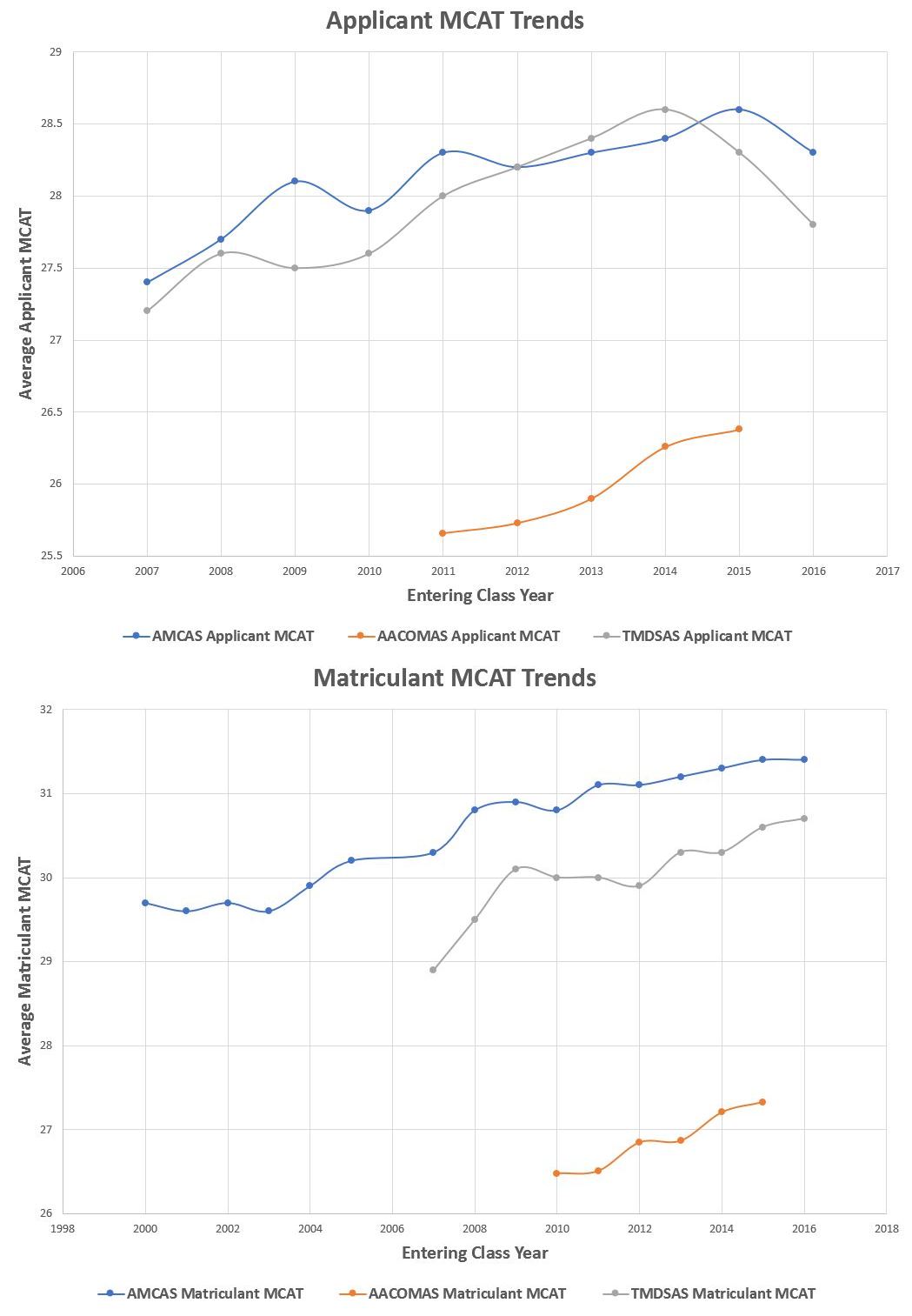
Trends in LizzyM Scores Over Time

Started by Lawpy
This forum made possible through the generous support of SDN members, donors, and sponsors. Thank you.
Get help with your application

Use all the free resources available to you from SDN: articles, guides, expert advising, forums discussions, and school research.

" 4.0 from MIT, 525 MCAT and three papers, should I just apply DO or try my luck with my state MD too? "

-our children on SDN, probably

FI5UZnB.jpg


not really a surprise honestly

Alright I think I found a way to non-arbitrarily combine all the data to measure changes in competitiveness. The bottom line here is that average matriculant data doesn't do us much good, because you don't need to be at that average LizzyM score to get into med school, you only need to be above the acceptance-rejection threshold (i.e. you need to get to a LizzyM where you're at the percentile of all applicants that is just above the percent of applicants who are rejected). Without having to arbitrarily divide LizzyM by Matric% or anything like that, we can just find the LizzyM score at that "threshold" percentile, since both the percentile and corresponding LizzyM score will change dynamically and non-arbitrarily every year.

Let me know what you think of this @efle @Lawper @Lucca

I'm in a bit of a rush so I've only calculated all of this for the past four years.

Acceptance rates:
View attachment 215515

100-Acceptance rates = threshold percentile of applicant pool that applicants must reach
View attachment 215516

Based on changes in GPA averages over the years, these are the GPA's necessary to reach the changing thresholds of the overall applicant pool based on changing acceptance rates (and based on a GPA SD of .34 which was accurate for 2016, but not necessarily accurate for the other years, though it should be close enough)
View attachment 215517

Same process for the MCAT
View attachment 215518

Combining those dynamic GPA percentiles, MCAT percentiles, and applicant pool thresholds based on acceptance rate changes, here's a plot of LizzyM scores needed to reach the relevant acceptance thresholds. I believe these LizzyM scores can pretty reasonably be considered "competitiveness" scores for the overall applicant pools.
View attachment 215520

nice work with this, although i'm a bit unsure with the GPA and MCAT percentiles you used in the calculations.

i think a major inherent problem regardless is limited data.
 
Haha love it. The only criticism I have is that there is no way the GPA distribution is anything approaching normal, because you cannot even get to median+1SD (4.06), while you will have an extremely long left tail with people beyond -1SD still having some luck.

The MCAT one I'd also be wary of with the new test having rolled out making things weird.

Overall though, the fact that the change has been extremely minor on the small time scale (less than a percent climbed in a few years) sounds about right.
Good point, I'd love to find some solid data of the GPA distribution of the overall applicant pool.
 
Advertisement - Members don't see this ad
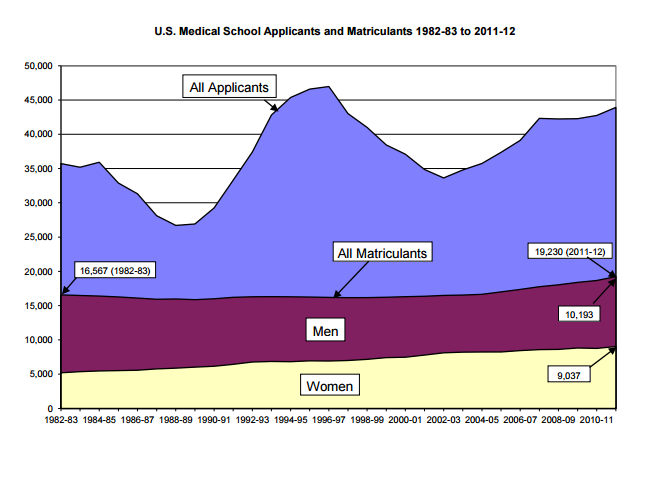
This is somewhat relevant to the thread, much longer term info for percent admitted:

nZM5iDZ.png

In the very long term view, looks like people right now have it rough, mid 1990s had it even worse, and late 1980s/early 2000s were very lucky!
 
I fully recognize that not everyone can or even aims to score a 520+ while balancing a competitive yet personally rejuvenating set of EC's. That's not what I'm saying. I'm providing one counter example to @LizzyM's assertion, of which there are many, many more--just look at the "top 20" schools MCAT range. Do they accept lower than average scores? Of course they do, but in general they don't.

Do you think those students are robots? The students that score in the 90th+ percentiles, and matriculate into these "top" schools, do you think they're any less committed, or passionate, than someone who scores a 500-510? I'd wager that they're not. The MCAT predicts success in medical school, among other, tangential things. That's why it's held to such a high regard.

Sent from my SAMSUNG-SM-G920A using SDN mobile
I work at a "top" academic medical center and I see some medical students that look like complete weirdos, but in my head I figure they scored 525s.

Then again I've gone on interviews at mid tiers and seen weird applicants there as well.

But generally speaking the most intelligent people who score 525+ lose an edge when it comes to being personable. Obviously there are exceptions
 
nice work with this, although i'm a bit unsure with the GPA and MCAT percentiles you used in the calculations.

i think a major inherent problem regardless is limited data.
Yeah there's not much data about SDs for GPAs and MCATs over the years, so it's definitely possible that some of the values I used aren't quite right. Would be fun to do these "competitiveness" calculations with a lot more data and over a much longer time period, but it's probably not in the cards 🙁
 
I work at a "top" academic medical center and I see some medical students that look like complete weirdos, but in my head I figure they scored 525s.

Then again I've gone on interviews at mid tiers and seen weird applicants there as well.

But generally speaking the most intelligent people who score 525+ lose an edge when it comes to being personable. Obviously there are exceptions
In my interview experience throughout this cycle, the smartest people I've met at interviews (or at least the interviewees at the "top-tier" med schools) have also been the most personable by far, N = ~50 interviewees
 
I actually need all this data driven brain power to focus on more pertinent questions now. Usmle scores, what the cv's of matriculants at top residency programs look like and what I have to do to perform well enough to land those residencies. So if I could have all the data folks on here help out with that , that would be great.
 
Last edited:
This is somewhat relevant to the thread, much longer term info for percent admitted:

nZM5iDZ.png

In the very long term view, looks like people right now have it rough, mid 1990s had it even worse, and late 1980s/early 2000s were very lucky!


That rate of increase between 90' and 97 is wild, even by today's measure. Almost 3,000 apps per year! Since 2012, we've only increased ~1,000 apps/year.

Forgive me for not knowing too much about healthcare of the early 90's - but I read a post here, which I can't recall, that mentioned that the profession around that time wasn't highly revered. I wonder what influenced that big of a spike in apps?
 
That rate of increase between 90' and 97 is wild, even by today's measure. Almost 3,000 apps per year! Since 2012, we've only increased ~1,000 apps/year.

Forgive me for not knowing too much about healthcare of the early 90's - but I read a post here, which I can't recall, that mentioned that the profession around that time wasn't highly revered. I wonder what influenced that big of a spike in apps?
I think the steep slope is mostly 1990-1995, and I think that period was a recession in the US. I'm too young to be quoted on that though!
 
The competition to get into a school is the arms race that applicants are engaged in.
The competition to get the best candidates to choose us is the arms race that the schools are engaged in.
I'm sorry to say this but you aren't getting the best candidates. You reward people who get high numbers by taking the easiest path through undergraduate school and then BS their way through an invalid and unreliable interview process. Your "joie de vivre" nonsense in another post sums it up perfectly. This whole process is a happy hunting ground for sociopaths.

Why don't you look for people who are hard workers who are willing to take on tough challenges? Why don't you give priority to people who major in the physical sciences or engineering at colleges with tough admission standards? You just might end up with medical school classes that aren't chock full of whiners.
 
Advertisement - Members don't see this ad
I'm sorry to say this but you aren't getting the best candidates. You reward people who get high numbers by taking the easiest path through undergraduate school and then BS their way through an invalid and unreliable interview process. Your "joie de vivre" nonsense in another post sums it up perfectly. This whole process is a happy hunting ground for sociopaths.

Why don't you look for people who are hard workers who are willing to take on tough challenges? Why don't you give priority to people who major in the physical sciences or engineering at colleges with tough admission standards? You just might end up with medical school classes that aren't chock full of whiners.

I can sympathize with this sentiment, but I wouldn't go around telling adcoms who it is they are actually selecting for. Boring gunner sociopaths with LowestPathOfResistance transcripts might *exist* but they are just not going to be a large part of the pool.

Not caring about what you study is one of the best parts about medical school admissions imo. It would be a nightmare if premeds all had to do only a handful of majors, especially something like engineering.

I think the emphasis on stats is regrettable. In fact, I've said many times on this forum that it would be better for schools to use hard cut off screening and then wipe numbers from an app. That would be *actual* holistic review. The truth, however, is that getting into medical school is fairly formulaic and such a change would highlight how arbitrary most admissions decisions are.
 
I think the emphasis on stats is regrettable. In fact, I've said many times on this forum that it would be better for schools to use hard cut off screening and then wipe numbers from an app. That would be *actual* holistic review.
Not sure that would help lower stat people. I'll echo what was mentioned previously: the brightest people I've met these past 6 months were all sociable and very well accomplished people, albeit with varying degrees in sense of humour.

A person's qualities aren't zero sum. That is, someone with a 100th percentile MCAT didn't need to sacrifice personal or empathetic fluency to achieve that. T10 schools are packed with really bright, personable people. They aren't that rare.
 
long-term trends
Would it be possible to add standard error bars to each year on the first graph (MCAT and GPA vs Year), and see if we have any overlap? I'm curious to see if we're "within error," or if there is a slow creep.

Also, the "connect the dots" thing is sort of suggesting a correlation that may not exist, but I think that's just me being pedantic--there probably is a correlation anyway.
 
Last edited: