Equivalent structures?

This forum made possible through the generous support of SDN members, donors, and sponsors. Thank you.

Teleologist

Full Member
10+ Year Member
Advertisement - Members don't see this ad
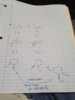
Are these equivalent structures? Copied from my book.

ederepeg.jpg
 
They are equivalent structures. Both (trans)1-chloro-2-methylcyclohexane, right?

Try drawing them as flat structures. You'll see they're the same. The Cl can be seen as "up" or "down" depending on your point of view.... but it's always opposite the CH3. Can be either Axial or Equatorial (will be both as it is constantly chair flipping). This is true for both substituents.

EDIT: Incorrect, see below.
 
Last edited:
Advertisement - Members don't see this ad
I stand corrected.
Pen and paper helps one see
Hi, it is not like I am being an a**h*** to the original poster. R/S is the very basic of organic chemistry. The reason i gave a hint instead of going over the R/S system is that the original poster really needs to work on the R/S system himself. I intentionally pointed out where he did not understand, so he could go over the topic himself. It is for his own benefit. When I was taking the orgo class and had something I did not understand, my professor always gave me some sort of hints instead of giving out the answers directly. This really helped me open up my mind when it came to attack orgo questions. Another thing is that these very basics of organic chem are the essentials one must have a solid understanding before going on to the later materials. Otherwise, it would be just a simple nightmare. One last thing, since you have mentioned, how do i post drawings and pics?
 

Similar threads

D
  • Question Question
Replies
1
Views
1K
6
Replies
21
Views
6K
Replies
1
Views
648
7
Replies
5
Views
3K
752779
7