

You are using an out of date browser. It may not display this or other websites correctly.
You should upgrade or use an alternative browser.
You should upgrade or use an alternative browser.
RO-APM Podcast Episode (from The Accelerators)
Started by elementaryschooleconomics

Get help with your application
Use all the free resources available to you from SDN: articles, guides, expert advising, forums discussions, and school research.
me. though the last two weeks haven't been as bad.I saw 12 consults last week. Idk who these people are that are bored!
Advertisement - Members don't see this ad
My personal numbers are a little different than that... would be happy to share in the private forum.This is very true too. I was talking to a young rad onc recently saying that he sees at least 300 new patients a year. There was a time that this could get you well into the 12000+ RVU range. Now it only gets you close to 9000 evidently. This revelation actually kind of worried me a little. And this young rad onc, by seeing 300 new patients a year, is definitely upper 25%ile busy.

Its crazy that some are seeing 3 or less. I have not slowed down. Just this week i have 8 consults. More knocking down door spilling into next week. Very busy folks!
Comparing what the SDN population admits regarding workload to what I've seen in my day-to-day life, I'm going to go out on a limb and assume people posting here aren't necessarily a representative population.I saw 12 consults last week. Idk who these people are that are bored!
I do know folks seeing 3 consults a week...or fewer. They are not the type of people to spend free time talking about Radiation Oncology on anonymous message boards. They're off publishing evergreen Tweets with all the vogue hashtags, filling their schedule with corporate buzzword meetings ("Synergizing Q3 Service Line Deliverables"), or don't know how to change the brush size in Eclipse (or whatever software their residents use).
Acr metric for consults pts per doc is about 210 on average. 10 years ago it was about 250. This stuff is easy to look up. Small centers with 10 pts on beam probably don’t get accreditation.Comparing what the SDN population admits regarding workload to what I've seen in my day-to-day life, I'm going to go out on a limb and assume people posting here aren't necessarily a representative population.
I do know folks seeing 3 consults a week...or fewer. They are not the type of people to spend free time talking about Radiation Oncology on anonymous message boards. They're off publishing evergreen Tweets with all the vogue hashtags, filling their schedule with corporate buzzword meetings ("Synergizing Q3 Service Line Deliverables"), or don't know how to change the brush size in Eclipse (or whatever software their residents use).

Personnel: Radiation Oncology (Revised 7-22-2026)
Revision History Role Personnel Requirements/Recommendations Medical Director Each program must have a medical director who is a radiation oncologist as described below. He/she is responsible for oversight of the department, includi...
 accreditationsupport.acr.org
Last edited:

Comparing what the SDN population admits regarding workload to what I've seen in my day-to-day life, I'm going to go out on a limb and assume people posting here aren't necessarily a representative population.
I do know folks seeing 3 consults a week...or fewer. They are not the type of people to spend free time talking about Radiation Oncology on anonymous message boards. They're off publishing evergreen Tweets with all the vogue hashtags, filling their schedule with corporate buzzword meetings ("Synergizing Q3 Service Line Deliverables"), or don't know how to change the brush size in Eclipse (or whatever software their residents use).
Okay yeah we all did residency, but chairs, other senior leadership, and physician scientists aren’t most people either.
Be real
Oh sorry I missed the part of my post where I wrote that.Okay yeah we all did residency, but chairs, other senior leadership, and physician scientists aren’t most people either.
Be real
Oh sorry I missed the part of my post where I wrote that.
Okay - even if every single academic faculty at your program was seeing 3 consults or less a week, that would not be most people.
Make sense.
Oh sorry I missed the part of my post where I said only at my residency institution.Okay - even if every single academic faculty at your program was seeing 3 consults or less a week, that would not be most people.
Make sense.
Oh sorry I missed the part of my post where I said only at my residency institution.
Hope you got some Bitcoin
Bitcoin
Dude I don’t know what your issue is. Are you mad because I’m saying your story about some people in academics routinely seeing 3 consults a week or less is not the norm, just as you said that some of us working in busy community PP and seeing 8-12 consults a week isn’t the norm?
Are you suggesting that 0-3 consults a week is common amongst you and most of your rad onc colleagues around the country?
What is your point, exactly
math doesn’t lie. On average most radonc see somewhere between 3 and 4 new pts per week and should be closer to 3 in a few years.Dude I don’t know what your issue is. Are you mad because I’m saying your story about some people in academics routinely seeing 3 consults a week or less is not the norm, just as you said that some of us working in busy community PP and seeing 8-12 consults a week isn’t the norm?
Are you suggesting that 0-3 consults a week is common amongst you and most of your rad onc colleagues around the country?
What is your point, exactly
The future is definitely mega centres with protons and carbon ions seeing 12+ consults per rad onc in 5 fx. These people will do well. The rest will be unemployed. We all need to have a plan when time comes!
Advertisement - Members don't see this ad
Ah, to alleviate your confusion - none of the above. I do think you and @thecarbonionangle really are seeing 8-12 consults a week. My perception, at least, is that the majority of people who post here regularly are early-to-mid career and in jobs/environments which are busier than average.Dude I don’t know what your issue is. Are you mad because I’m saying your story about some people in academics routinely seeing 3 consults a week or less is not the norm, just as you said that some of us working in busy community PP and seeing 8-12 consults a week isn’t the norm?
Are you suggesting that 0-3 consults a week is common amongst you and most of your rad onc colleagues around the country?
What is your point, exactly
Just like the pre-med forums, the people who are apt to not only frequent SDN but also post here are not a representative sample. The historical joke being that going by the "SDN averages", the only people who get into medical school have a 4.0 GPA and a 99th percentile MCAT with 4,000 hours of shadowing.
To help build your understanding, my post also did not comment on 3 consults a week being "routine" or "common". Instead, I stated:
I do know folks seeing 3 consults a week...or fewer.
Your inferences here are your own.
Are you mad
I'm not mad, just disappointed.

Exceedingly common. In the first graph, it's a histogram (y-axis is number of ROs and x-axis is dollars; each bin is $100K) of per rad onc CMS reimbursement; 40-50% (about 2500) of ROs get <$150K per year from Medicare. In the second graph, 58% of rad onc *centers* are seeing less than 2 new breast cancer patients (pink dots) per week. And as you can see, breast is by far the most common RT indication in the U.S. This would suggest, since it's per center, that the majority of U.S. rad oncs (again, as this is *per center data*) are seeing <150 new patients per year.Are you suggesting that 0-3 consults a week is common amongst you and most of your rad onc colleagues around the country?
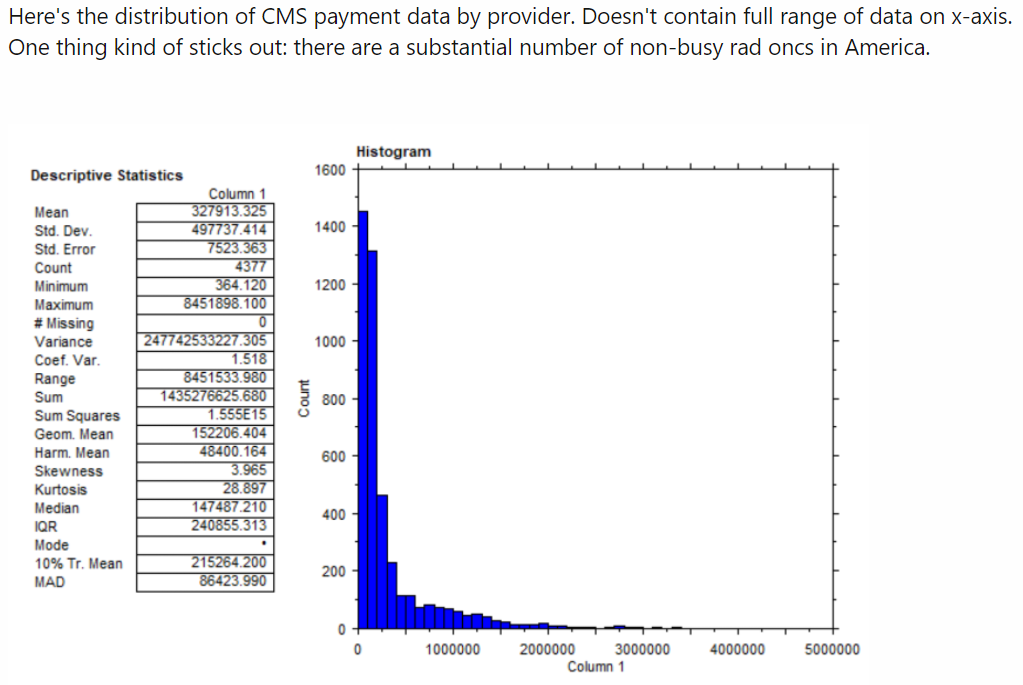
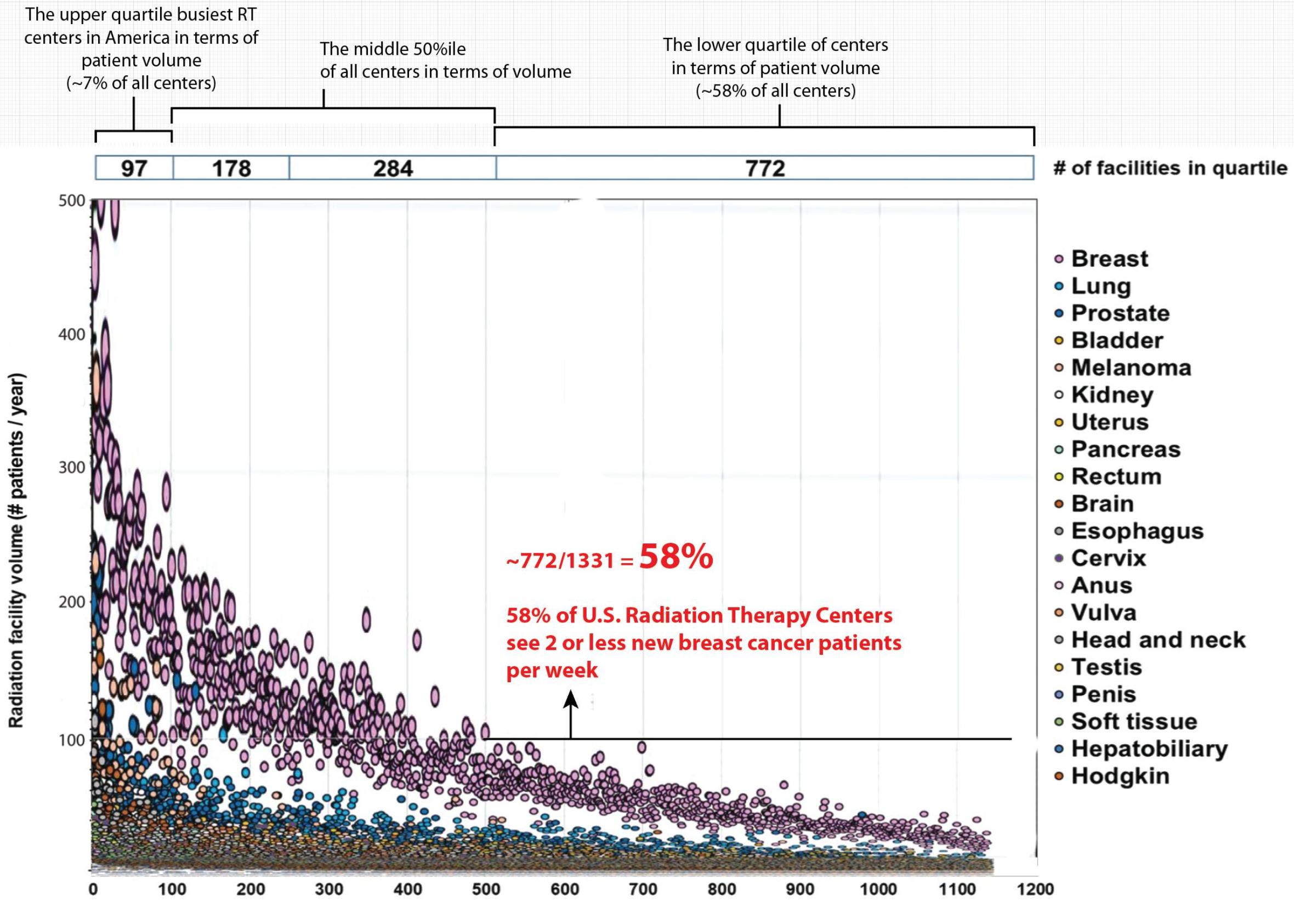
Well there are no assumptions per se. Just the data as published. Re: "working clinical rad oncs," from the viewpoint of the maw of radiation oncologist production (aka the number of new grads per year) it doesn't matter.So many assumptions.
I wish someone would publish this real data, for working clinical rad oncs. Lot of dirt in that data, though I know you’re trying to make the best of the flawed data
The acr publishes on average 200 new pts per academic doc per year- that’s slightly less than 4 per week. It also means that a significant portion of academics see ess than average. No assumptions.Are they common in academics? In my experience they are not.
Of course we all know or know of rad oncs with 0-3. I guess I don’t see the importance of that fact.
I do think business is booming for many I know these days, many who have no clue what SDN is.
And keep in mind that "average" is very misleading in rad onc because, as the data above show, we are very Pareto in rad onc... in money, salary, and work.The acr publishes on average 200 new pts per academic doc per year- that’s slightly less than 4 per week.
Based on the data, one can reasonably guess that if the ACR says the average is 200, the median is 100-150. (I would pick 125.) That is to say, 50% of *all* rad oncs seeing less than ~125 per year.
Personnel: Radiation Oncology (Revised 7-22-2026)
Revision History Role Personnel Requirements/Recommendations Medical Director Each program must have a medical director who is a radiation oncologist as described below. He/she is responsible for oversight of the department, includi...
accreditationsupport.acr.org
Acr metric for consults pts per doc is about 210 on average. 10 years ago it was about 250. This stuff is easy to look up. Small centers with 10 pts on beam probably don’t get accreditation.
Personnel: Radiation Oncology (Revised 7-22-2026)
Revision History Role Personnel Requirements/Recommendations Medical Director Each program must have a medical director who is a radiation oncologist as described below. He/she is responsible for oversight of the department, includi...
I wish someone would publish this real data,
The acr publishes on average 200 new pts per academic doc per year- that’s slightly less than 4 per week. It also means that a significant portion of academics see ess than average. No assumptions.
Using the ACR link from RickyScott, if you look there is a table (in the first column for "600 or more patients" that's facility workload stratum and "275" is number of new patients per rad onc per year on average in that facility), and we can use the Zaorsky data to infer:
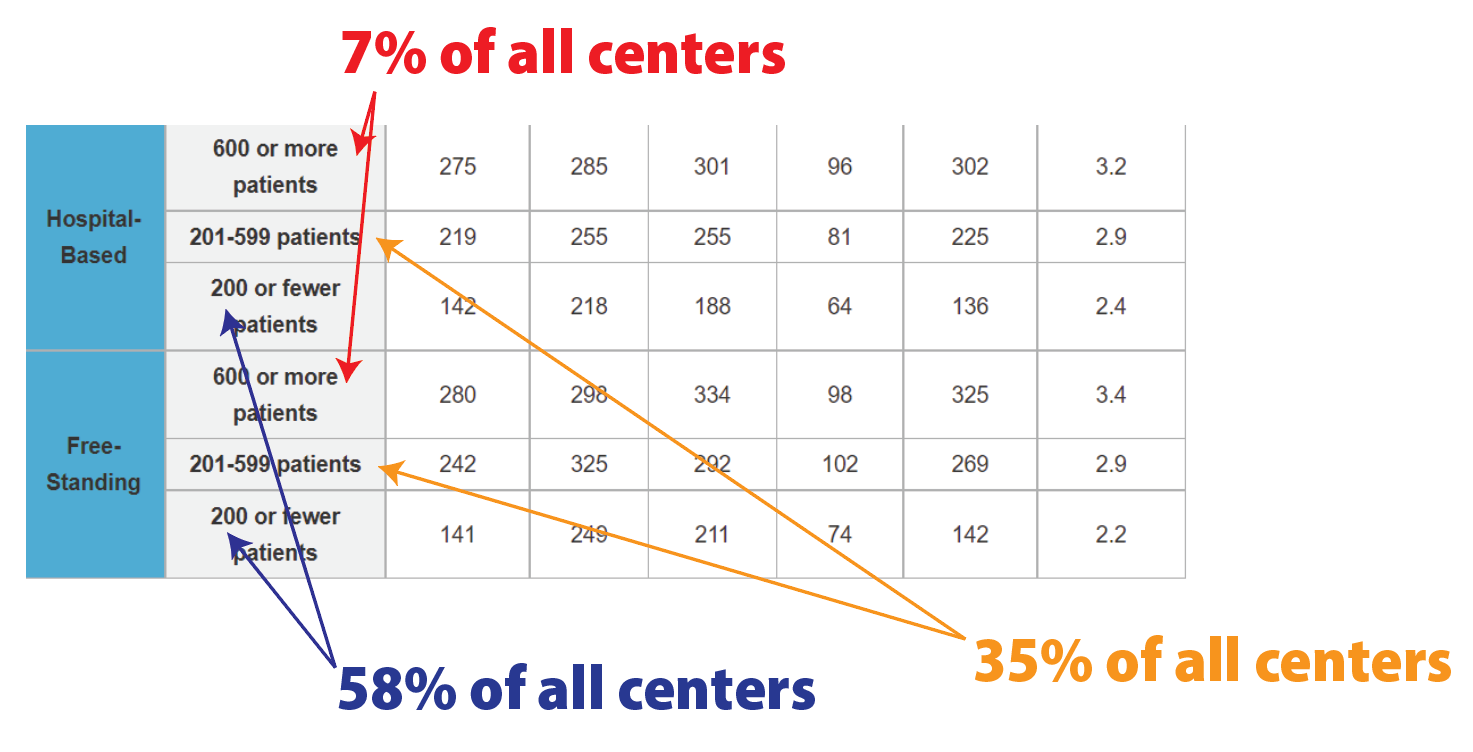
@jondunn this data is published...
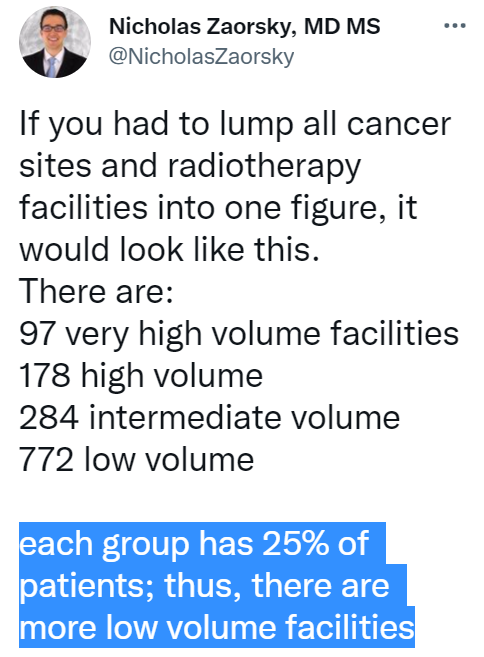
Last edited:
D
deleted1111261
This is an extremely challenging question and I still don’t know how to answer it.
“How many new patients should a busy RO see in a week / month / year?”
The way we decide that tends to be based on RVU targets (last few places I worked). They pick a number, and when everyone is above a certain number, they tend to hire, or they project out and over - hire. But, RVUs are based on consults and fractions. Modern ROs treat with fewer fractions and thus fewer RVUs. So, if they see the 200-230 new patients number that is floating around, they may not even get close to the target. So, they end up seeing more to get closer and find themselves exhausted, when the c-suite is like - “they only got 10k RVUs”.
It’s a funny game to play. To get more RVUs, you can slow down, give 44 fx to prostates (which is fine 🐊, I’m not getting into that) and 10 fx for all bone Mets and just manufacture enough RVUs to get a new hire … all while seeing LESS patients. The whole thing is so confusing to me, especially now when I’m supposed to try to figure out our needs.
In my head, I think a generalist should be able to see 6-8 consults a week of a good mix of patients - breast, prostate, lung, mets and the occasional tougher stuff. With modern fractionation, is that going to get you to your target? I don’t know, depends on a lot.
What a field - we decided to pay ourselves in a way that punishes us if we see more patients, have the same outcomes and do it more efficiently. Bizarre to say the least.
“How many new patients should a busy RO see in a week / month / year?”
The way we decide that tends to be based on RVU targets (last few places I worked). They pick a number, and when everyone is above a certain number, they tend to hire, or they project out and over - hire. But, RVUs are based on consults and fractions. Modern ROs treat with fewer fractions and thus fewer RVUs. So, if they see the 200-230 new patients number that is floating around, they may not even get close to the target. So, they end up seeing more to get closer and find themselves exhausted, when the c-suite is like - “they only got 10k RVUs”.
It’s a funny game to play. To get more RVUs, you can slow down, give 44 fx to prostates (which is fine 🐊, I’m not getting into that) and 10 fx for all bone Mets and just manufacture enough RVUs to get a new hire … all while seeing LESS patients. The whole thing is so confusing to me, especially now when I’m supposed to try to figure out our needs.
In my head, I think a generalist should be able to see 6-8 consults a week of a good mix of patients - breast, prostate, lung, mets and the occasional tougher stuff. With modern fractionation, is that going to get you to your target? I don’t know, depends on a lot.
What a field - we decided to pay ourselves in a way that punishes us if we see more patients, have the same outcomes and do it more efficiently. Bizarre to say the least.
6-8 pts on average is a good number, 300-400 pts per year, but very few radoncs are so fortunate.This is an extremely challenging question and I still don’t know how to answer it.
“How many new patients should a busy RO see in a week / month / year?”
The way we decide that tends to be based on RVU targets (last few places I worked). They pick a number, and when everyone is above a certain number, they tend to hire, or they project out and over - hire. But, RVUs are based on consults and fractions. Modern ROs treat with fewer fractions and thus fewer RVUs. So, if they see the 200-230 new patients number that is floating around, they may not even get close to the target. So, they end up seeing more to get closer and find themselves exhausted, when the c-suite is like - “they only got 10k RVUs”.
It’s a funny game to play. To get more RVUs, you can slow down, give 44 fx to prostates (which is fine 🐊, I’m not getting into that) and 10 fx for all bone Mets and just manufacture enough RVUs to get a new hire … all while seeing LESS patients. The whole thing is so confusing to me, especially now when I’m supposed to try to figure out our needs.
In my head, I think a generalist should be able to see 6-8 consults a week of a good mix of patients - breast, prostate, lung, mets and the occasional tougher stuff. With modern fractionation, is that going to get you to your target? I don’t know, depends on a lot.
What a field - we decided to pay ourselves in a way that punishes us if we see more patients, have the same outcomes and do it more efficiently. Bizarre to say the least.
In the Graypeace article there was data to show that ~20 years ago the *average* RO was seeing 350 new pts a year (so the median was probably ~250-275). In the meantime the average and median have dropped to ~200/150 or less. So the argument is "Well patients are more complex nowadays" so we are seeing less patients.“How many new patients should a busy RO see in a week / month / year?” ... In my head, I think a generalist should be able to see 6-8 consults a week of a good mix of patients - breast, prostate, lung, mets and the occasional tougher stuff. With modern fractionation, is that going to get you to your target? I don’t know, depends on a lot.
For the generalist the patients are not really more complex.
The generalist is mostly a breast doc. By mostly I mean that's going to be the most common patient. That and prostate and some lung. The breasts should all be 5-15 fractions mostly and have less side effects than breast patients 20 years ago. Prostates? Easier to treat, less fx's and less side effects than 20 years ago. Lung? Less side effects for sure and if you factor in SABRs way less fractions too. So yeah treatments, technologically speaking, are more complex. "Computering" is more complex. But the clinic? That's easier (for a generalist).
To repeat... So the argument is "Well patients are more complex nowadays so we are seeing less patients." This is just an RO over-supply excuse when people say this.
I am amazed how some just can’t acknowledge that increasing the number of radoncs means less pts per doc.In the Graypeace article there was data to show that ~20 years ago the *average* RO was seeing 350 new pts a year (so the median was probably ~250-275). In the meantime the average and median have dropped to ~200/150 or less. So the argument is "Well patients are more complex nowadays" so we are seeing less patients.
For the generalist the patients are not really more complex.
The generalist is mostly a breast doc. By mostly I mean that's going to be the most common patient. That and prostate and some lung. The breasts should all be 5-15 fractions mostly and have less side effects than breast patients 20 years ago. Prostates? Easier to treat, less fx's and less side effects than 20 years ago. Lung? Less side effects for sure and if you factor in SABRs way less fractions too. So yeah treatments, technologically speaking, are more complex. "Computering" is more complex. But the clinic? That's easier (for a generalist).
To repeat... So the argument is "Well patients are more complex nowadays so we are seeing less patients." This is just an RO over-supply excuse when people say this.
Some of them can't fathom how hypofractionation means less time seeing patients under treatment and therefore means you have more time to see more patients to stay busyI am amazed how some just can’t acknowledge that increasing the number of radoncs means less pts per doc.
Are they common in academics? In my experience they are not.
Of course we all know or know of rad oncs with 0-3. I guess I don’t see the importance of that fact.
I do think business is booming for many I know these days, many who have no clue what SDN is.
So the data which @TheWallnerus and @RickyScott linked, and the Zaorsky published data from that Tweet are "assumptions"?So many assumptions.
I wish someone would publish this real data, for working clinical rad oncs. Lot of dirt in that data, though I know you’re trying to make the best of the flawed data
Yet you - someone who has stated they're in private practice - are referencing your "experience" regarding academic workflow and the "booming business" of "people you know" as a reason you're skeptical?
What data would you consider "real"?
Advertisement - Members don't see this ad

I think that the extrapolation from breast cases is a stretch. At my center, we treat some breast, but its a minority of our patients on treatment. We have more prostate and lung than breast probably. Practice patterns are different wherever you go.
Bingo. One of my clinics skews lungs and h&n/skin. Lots of smoking sun worshippersI think that the extrapolation from breast cases is a stretch. At my center, we treat some breast, but its a minority of our patients on treatment. We have more prostate and lung than breast probably. Practice patterns are different wherever you go.
I think that the extrapolation from breast cases is a stretch. At my center, we treat some breast, but its a minority of our patients on treatment. We have more prostate and lung than breast probably. Practice patterns are different wherever you go.
yes.
So the data which @TheWallnerus and @RickyScott linked, and the Zaorsky published data from that Tweet are "assumptions"?
Yet you - someone who has stated they're in private practice - are referencing your "experience" regarding academic workflow and the "booming business" of "people you know" as a reason you're skeptical?
What data would you consider "real"?
to be clear - I am not calling anything fake. I have no disagreement that rad oncs are both less busy than in the past, nor that many have capacity for more. many people are in low volume facilities that somehow makes it work for everyone involved. some rad oncs self select for sleepy clinics or sleepy satellites, for example. perfect jobs for parents who want to prioritize their family.
the zarosky data is better. but still, one can dream of published per doc data. maybe a survey. facility volume still has lots of confounders and external factors that affect this. even published per doc would be confusing depending on who replied. where i trained there were 21 attendings. all saw well over 3 consults a week except for 4. the chair and three physician scientists, who probably saw 2 or 3 many weeks. so technically the percent seeing less than 3 consults a week was roughly 20%, though I never would have considered them as part of the equation during residency, they are, tehcnically.
Data has been published ad nauseum, in reality. Google anything to do with RT utilization e.g., lots of it from Bates and Royce. Consistently they show that there are ~550-600K de novo new RT patients per year in America. Divide that by your best guess number of working clinical rad oncs. Is that number 4000? That's the lowest that's reasonable. That's 550K/4000=138 de novo new RT patients per year per RO. Or you can assume close to 600K per year, the highest ever published. But if there are 5000 working rad oncs, and ASTRO says there is, that's 120 (de novo, ignoring re-tx, ignoring later RT farther along diagnosis course) new RT patients per year per RO.So many assumptions.
I wish someone would publish this real data, for working clinical rad oncs. Lot of dirt in that data, though I know you’re trying to make the best of the flawed data
Time after time, the data shows that breast is the most common RT indication in the US. It is the most common malignancy and has very high RT utilization vs other malignancies. So it is a bellwether for RT "busy-ness," and as the Zaorsky data shows, it's the most common patient in >99% of clinics (again, see the "pink dots"). Visually you can see that they're usually 2:1 all other patients.I think that the extrapolation from breast cases is a stretch.
Here is published per doc data. Your name is in here... it includes every RO that billed Medicare for RO in a year.the zarosky data is better. but still, one can dream of published per doc data.
Centers for Medicare & Medicaid Services Data
 data.cms.gov
I won't walk you through all the math, but you can plow through it and determine that the average number of Medicare patients per RO (per year) is:
58 Medicare patients per year per RO (average)
50 Medicare patients per year per RO (median)
There were 318,483 CMS patients who received a weekly tx management or 1-2 tx management EBRT code, or SBRT or SRS, in 2019. As a comparison, derms likely see 10-20x this number of CMS patients per year even though there are only about 3x as many derms as ROs.
Those who are producing ROs for America are being very poor stewards.
Last edited:
Data has been published ad nauseum, in reality. Google anything to do with RT utilization e.g., lots of it from Bates and Royce. Consistently they show that there are ~550-600K de novo new RT patients per year in America. Divide that by your best guess number of working clinical rad oncs. Is that number 4000? That's the lowest that's reasonable. That's 550K/4000=138 de novo new RT patients per year per RO. Or you can assume close to 600K per year, the highest ever published. But if there are 5000 working rad oncs, and ASTRO says there is, that's 120 new RT patients per year per RO.
Time after time, the data shows that breast is the most common RT indication in the US. So it is a bellwether for RT "busy-ness," and as the Zaorsky data shows, it's the most common patient in >99% of clinics (again, see the "pink dots"). Visually you can see that they're usually 2:1 all other patients.
Here is published per doc data. Your name is in here... it includes every RO that billed Medicare for RO in a year.
Centers for Medicare & Medicaid Services Data
I won't walk you through all the math, but you can plow through it and determine that the average number of Medicare patients per RO (per year) is 58 and the median is 50. There were 318,483 CMS patients who received a weekly tx management or 1-2 tx management EBRT code, or SBRT or SRS, in 2019. As a comparison, derms likely see 10-20x this number of CMS patients per year even though there are only about 3x as many derms as ROs.
Those who are producing ROs for America are being very poor stewards.
You will get zero argument from me regarding oversupply
I do stand by my question above about people here and their consult/week numbers. It is true that perhaps SDN may have a non-representative population, but just curious
Last edited:
Even the people that "believe" in over-supply struggle with believing the above numbers and per-RO work.You will get zero argument from me regarding oversupply
I do stand by my question above about people here and their consult/week numbers. It is true that perhaps SDN may have a non-representative population, but just curious
Imagine how those who don't believe in over-supply struggle.
Well it’s clear that things like hospital based reimbursement and stuff like SBRT/SRS which muddy the waters for ‘number of patients’ keep the salaries looking okay. But it’s a house of cards
Also another confounder - Our practice has 6 sites. We are not at 2 of the sites every day, and the volume is low at each site. However because of the deal we have, it’s financially viable to keep those two places as offices facilities we have open.
Also another confounder - Our practice has 6 sites. We are not at 2 of the sites every day, and the volume is low at each site. However because of the deal we have, it’s financially viable to keep those two places as offices facilities we have open.
I am amazed how some just can’t acknowledge that increasing the number of radoncs means less pts per doc.
I guess I'm one of those.
Just because a new radonc is minted doesn't mean that radonc will be joining the workforce and diluting patients. Our practice isn't going to hire anyone unless we have the demand, and radonc is one of of those truly "impossible to hang a shingle" specialties. Also, especially now with hospital- and academic-based salaries where they are, it's not as if the radonc's salary is the one thing preventing a cancer center from being built.
Just because a new radonc is minted doesn't mean that radonc will be joining the workforce and diluting patients.
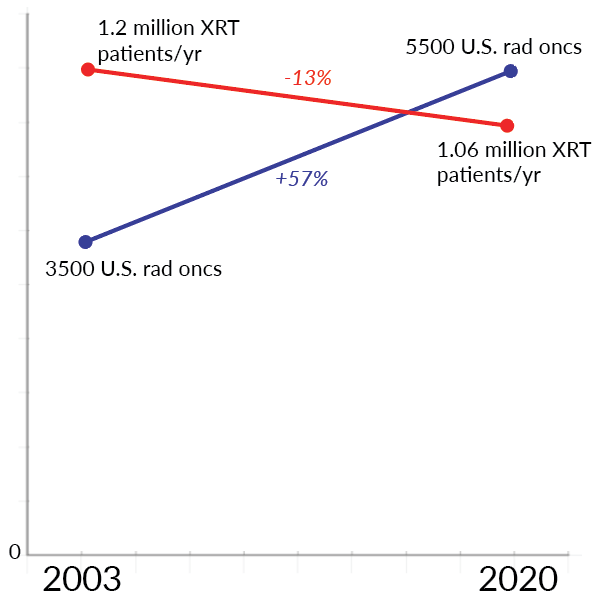
on macroscopic level, if they are minted and not joining the workforce, they are treating 0 patients and bringing down the average.I guess I'm one of those.
Just because a new radonc is minted doesn't mean that radonc will be joining the workforce and diluting patients. Our practice isn't going to hire anyone unless we have the demand, and radonc is one of of those truly "impossible to hang a shingle" specialties. Also, especially now with hospital- and academic-based salaries where they are, it's not as if the radonc's salary is the one thing preventing a cancer center from being built.
D
deleted1111261
Tis trueon macroscopic level, if they are minted and not joining the workforce, they are treating 0 patients and bringing down the average.
on macroscopic level, if they are minted and not joining the workforce, they are treating 0 patients and bringing down the average.
That's a good point. Are we talking about the average among all radoncs who graduated from a training program, or radoncs who are actually working? If we're talking about the former, then I certainly stand corrected.
If we're talking about the latter, then I still think I'm correct, as we can't assume that just because someone graduated from residency they will be employed. Isn't that what breadlines were all about?
thats why pareto distribution. Locums etc will count against the average. nevertheless, the acr averages are falling over time (which dont take it into account locums, unemployed etc, or likely small centers). Am surprised that nobody is writing this upThat's a good point. Are we talking about the average among all radoncs who graduated from a training program, or radoncs who are actually working? If we're talking about the former, then I certainly stand corrected.
If we're talking about the latter, then I still think I'm correct, as we can't assume that just because someone graduated from residency they will be employed. Isn't that what breadlines were all about?
Advertisement - Members don't see this ad
Because it's on par with us all being in the Freon manufacturing business. And discovering via various lines of evidence that chlorofluorocarbons were slowly destroying the ozone layer. And then having someone in our industry write that up.Am surprised that nobody is writing this up
Per ARRO's data clinical, taking-care-of-people unemployment after graduation is for all intents and purposes <5%, so it seems to be a reasonable assumption at least just for the sake of making some workforce guesstimates.as we can't assume that just because someone graduated from residency they will be employed.

Don't cross the streams!
Regarding the ARRO survey: Several of the MSKCC graduating residents entered fellowship as did several from Stanford. So these 2 programs represent the majority of the 7 fellowships?Because it's on par with us all being in the Freon manufacturing business. And discovering via various lines of evidence that chlorofluorocarbons were slowly destroying the ozone layer. And then having someone in our industry write that up.
Per ARRO's data clinical, taking-care-of-people unemployment after graduation is for all intents and purposes <5%, so it seems to be a reasonable assumption at least just for the sake of making some workforce guesstimates.
The ARRO fellowship data are as inscrutable as Enron's accounting methods.Regarding the ARRO survey: Several of the MSKCC graduating residents entered fellowship as did several from Stanford. So these 2 programs represent the majority of the 7 fellowships?
Last edited:
Regarding the ARRO survey: Several of the MSKCC graduating residents entered fellowship as did several from Stanford. So these 2 programs represent the majority of the 7 fellowships?
the MSKCC people (at least a few of them) I know for a fact sought out research fellowships on purpose.
there are some people that actually want to do this stuff!
Similar threads


- Replies
- 78
- Views
- 5K
