D

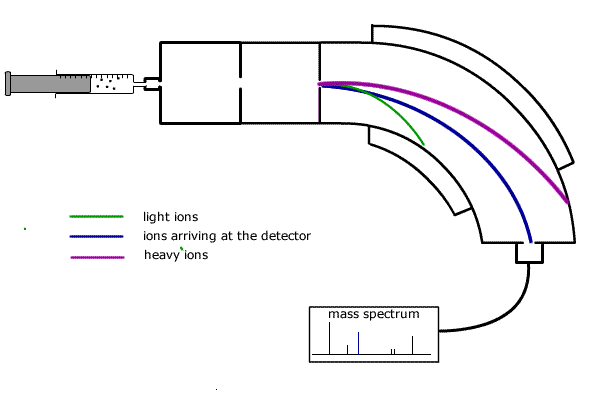
The radius of curvature is the radius of the (circular) path the object will take. Since the heavier object resists the centripetal force pulling it into a circular path given its larger mass ("deflects less") it will travel in a large circular path, as opposed to a tighter circle. Therefore, the radius of curvature will be relatively large.
Think about it this way. You release two particles at the same time and they fly in a straight line. A is bigger than B. Then, you apply an equal force on each of the the particles, trying to deflect it so that it curves. Since you're applying equal force and F = m*a, which particle will experience the largest acceleration. The particle that experiences the largest acceleration will curve more and thus hit the side first. The particle that experiences the smallest acceleration will curve the least with application of force and will thus hit the side last.
Was curious about this because I always see 2 reasons for the decreased deflection, and I'm just curious if my logic is off. The first is exactly like yours - equal force means lower acceleration for the more massive object. For the second, I came across a practice problem that discussed particles being accelerated from rest across a potential difference V. In this case, the PE=qV is converted to KE=1/2mv^2, so the more massive object should have a lower velocity upon entering the mass spec. By that logic, lower velocity should correspond to lower force applied by the magnetic field (F=qvB), so less force means less deflection. Is this also true, or am I making an error in my logic somewhere?
Makes total sense. Thanks so much!Good question. Look up velocity selector.
I'm sorry but this still doesn't make sense to me. I attached a sketch of how I see the deflection with A having a larger mass than B so A is deflecting less and in my figure I see that the radius for A (heavier) is smaller than B.
Thanks again!View attachment 214119
Was curious about this because I always see 2 reasons for the decreased deflection, and I'm just curious if my logic is off. The first is exactly like yours - equal force means lower acceleration for the more massive object. For the second, I came across a practice problem that discussed particles being accelerated from rest across a potential difference V. In this case, the PE=qV is converted to KE=1/2mv^2, so the more massive object should have a lower velocity upon entering the mass spec. By that logic, lower velocity should correspond to lower force applied by the magnetic field (F=qvB), so less force means less deflection. Is this also true, or am I making an error in my logic somewhere?
You have it backwards. Deflection = deviation from the normal path. Less deflection = less deviation = less "curviness" = larger circles.
![]()
These ions are initially traveling in a straight line. Due to the magnetic field, an equal force acts on each ion. The heavier ions (purple) are accelerated less due to their higher mass. Therefore, they are deflected less, and follow a trajectory with a larger radius (imagine if these trajectories formed a circle: the purple circle will be larger (larger radius r) and the green circle will be smaller (smaller radius r).
Yes, the logic for the second explanation makes sense as well.